Staff shortages are predicted to continue well beyond 2022 according to predictions from recruitment agencies following a KPMG survey.
The report found that recruitment consultancies across the UK have seen higher pay for starting salaries and a rise in recruitment during December.
The report by KPMG and REC, UK Report on Jobs also said permanent staff appointments and temp billings continued to rise at what is described as ‘historically sharp rates’.
It found candidates were also more likely to be available in December than in the previous eight months, which seemed positive.

However, the report – which had measured recruitment at 400 agencies – found that competition for scarce workers pushed up rates of starting pay for both permanent and temporary staff, with the respective rates of inflation among the quickest on record.
Neil Carberry, Chief Executive of the REC, said he expected staff shortages to continue for a while: “This survey shows again how tight the labour market was at the end of last year. Demand for staff is growing across every sector and region of the UK, and candidate availability is still falling. These trends have been slowing for the past few months, but that is not surprising considering the record pace of change earlier in the autumn of 2021.
Permanent Placements / Temporary Billings
50.0 = no-change
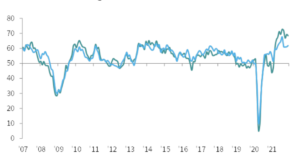
Sources: KPMG, REC, IHS Markit
Claire Warnes, Head of Education, Skills and Productivity at KPMG UK, said: “Employers in all sectors haven’t lost their appetite to hire, but many will be frustrated by the pressure these inflationary and competitive conditions, which are likely to continue for some time, are putting on their operating costs and ability to expand.
“The availability of workers is testing the resolve of employers across the economy and will likely cause distortion in recruitment patterns as businesses shift focus from long-term growth to short-term cover. However, we shouldn’t underestimate the business community’s ability to adapt to these new conditions and look to training and technology solutions to find a way forward.”
Least severe drop in candidate numbers since April
The supply of overall candidates continued to fall sharply during December, according to the report, but the rate of deterioration eased for the fourth month running.
Notably, the report found that the latest drop in candidate supply was the least severe since April. However, recruiters blamed uncertainty around the pandemic, a generally low unemployment rate and fewer foreign workers on lower candidate numbers.
Regional and Sector Variations
The North of England saw the fastest upturn of permanent staff appointments in England in December.
However, regional data showed that the upturn in temp billings was broad-based across all four monitored English regions. The quickest expansion was seen in London, while the softest was in the Midlands.
Vacancies continued to increase at a stronger pace in the private sector than in the public sector in December. The fastest growth rate was signalled for private sector permanent roles, while the softest rise was indicated for public sector temporary jobs.
IT & Computing was the most in-demand category for permanent staff during December, as was the case in the previous month. Nonetheless, steep increases in vacancies were also seen across the other nine monitored sectors.
Nursing/Medical/Care was at the top of the rankings for temporary staff vacancies at the end of the year. The softest increase in demand was meanwhile for short-term retail workers.
Mr Carberry said: “Businesses need to make sure they are reacting to the long-term challenges of this market, thinking harder about their offer to staff and how to shape their future workforce. Recruiters are ideally positioned to help employers with this, and support governments across the UK on the skills, immigration and tax reforms that are needed to keep us competitive.”

Feyaza Khan has been a journalist for more than 20 years in print and broadcast. Her special interests include neurodiversity in the workplace, tech, diversity, trauma and wellbeing.
- Feyaza Khan

- Feyaza Khan
- Feyaza Khan
- Feyaza Khan