

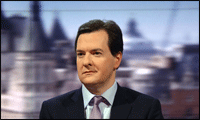
 George Osborne has prepared the ground for a damaging admission in Wednesday’s autumn statement that lower than expected growth means he will breach the second of his fiscal targets, on reducing debt as a proportion of national income by the end of the parliament.
The chancellor has already admitted he has had to extend the time it will take to eradicate the structural deficit from five years to seven, and he may have to extend that timetable by another year to 2018.
Treasury sources believe the markets have already absorbed the likelihood that he will miss his debt/GDP target, and as a result there will be no negative reaction from the markets or credit rating agencies.
However, it is deeply humiliating that the chancellor is to see both of his targets smashed less than two and a half years after setting them amid much fanfare.

Osborne told the BBC’s Andrew Marr programme: “It’s clearly taking longer to deal with Britain’s debts. It’s clearly taking longer to recover from the financial crisis than anyone would have hoped. But we’ve made real progress – the deficit is down by a quarter, there are a million more jobs in the private sector – and to turn back now, to go back to the borrowing and the debt and the spending, would be a complete disaster for our country.”
The Office for Budget Responsibility is also expected to forecast growth of around 1.2% for 2013 after near-zero growth this year. The chancellor said: “In the last two years we’ve had the eurozone crisis, we’ve had an oil price shock, we’ve got problems in some of the emerging markets. You know we don’t operate in a vacuum.”
He is expected to announce an increase in capital infrastructure spending, including roads and housing, as well as a package of help for further education.
Former Labour chancellor Alistair Darling accused Osborne of a “bankruptcy of ideas” over how to generate growth. He told Sky News the chancellor was “wildly off all his targets” for cutting the record budget deficit.
Osborne also signalled his determination to raise extra cash not just by slicing back welfare but through a further squeeze on the rich, saying: “Its got to be done fairly. That means, yes, the richest have to bear their fair share – and they will – and that does mean more than they’re paying at the moment.” Charities and campaigners have urged the chancellor to not reduce benefits to the poorest in a bid to cut the deficit as this would be a “tragedy for millions and a travesty for the economy”.
More than 50 charities, unions and academics warned in a letter to the Independent that with food and utility prices rising it is not a good time to penalise the poorest.
“It would be a tragedy for millions, and a travesty for the economy, to push the poorest into deeper poverty by this week failing to uprate benefits in line with inflation, or by making other cuts to social security for families and disabled people,” they state.
Among those who signed the letter were Fiona Weir, the chief executive of single parents charity Gingerbread, Alison Garnham, chief executive of Child Poverty Action Group (CPAG), and Anne Marie Carrie, the chief executive of Barnardo’s.
Osborne is expected to announce a further raid on pension tax relief for the wealthy by reducing by up to a third the tax-exempt amount people can pay into their pension pots. This would raise nearly £2 billion and infuriate the pensions industry.
The government is understood to be examining proposals to reduce the amount from £50,000 to either £40,000 or £30,000. He has already cut the annual allowance on pension tax relief from £255,000 to £50,000.
Another option is to cut the level of pension tax relief that high earners can claim, which stands at 50% for those earning more than £150,000 a year.
He is also expected to squeeze, rather than freeze, working age benefits, allowing them to rise below inflation from next April, although a two-year freeze had been suggested.
The chancellor is likely to say his plans to withdraw housing benefit from the under-25s have been shelved and will appear in the Tory manifesto, in the face of Liberal Democrat hostility. Making joint decisions on welfare cuts that go into the next parliament is sensitive territory for the Liberal Democrats because they are determined to fight the election as an independent party.
The Social Liberal Forum, a leftwing group inside the Liberal Democrats, is due to issue a statement on Monday warning it would not support “a government that takes regressive spending decisions, on the welfare budget in particular, that will go beyond the term of this parliament There is no basis for taking such decisions in the policy of the Liberal Democrats, nor in the coalition agreement.
“Senior Liberal Democrats have always clearly stated that addressing a widening deficit through further spending cuts, not least those that harm the spending power of the poorest, would lead to an unacceptable downward spiral of low growth and higher deficits. If the state of the economy leaves the coalition with a choice between investing in future growth by easing the deficit reduction programme and cutting support to the most vulnerable people in society, it can only choose the former.”
The justice secretary, Chris Grayling speaking on Pienaar’s Politics on BBC Radio Five Live refused to give the Liberal Democrats any credit for squeezing the rich, saying: “If we had a majority Conservative government we would be taking decisions where everyone had to share the load, and that’s the position we’re in: we’ve got some difficult times as a nation. I don’t buy the argument that any one part of the coalition is the conscience of the coalition.”





