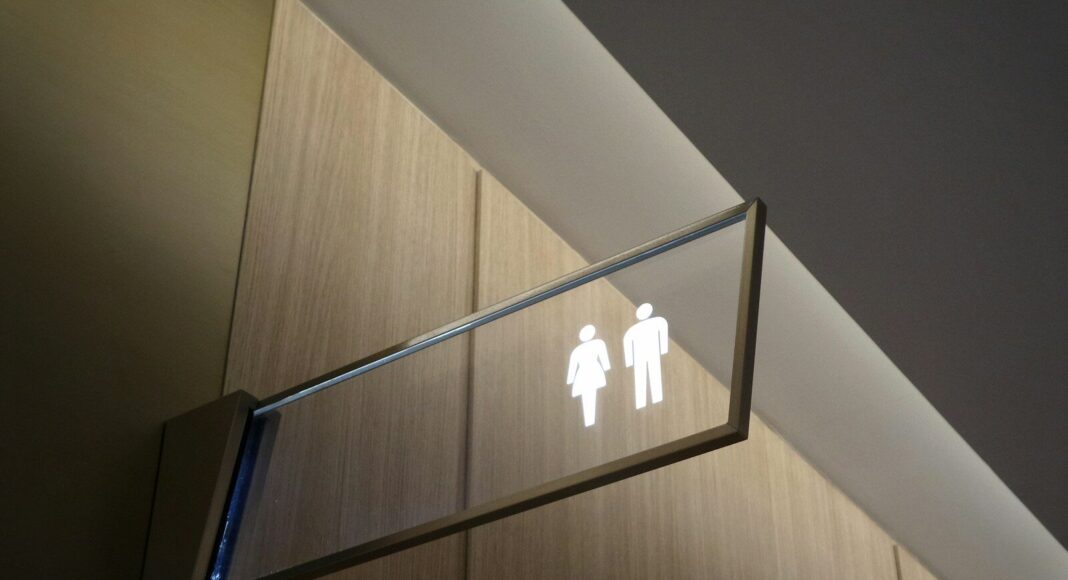
Transgender people must be excluded from single-sex toilets and changing rooms that correspond with their lived gender under updated equality guidance issued by Britain’s equalities watchdog, prompting renewed controversy over workplace inclusion and access to public spaces.
The Equality and Human Rights Commission (EHRC) published the revised draft code of practice on Thursday after last year’s Supreme Court ruling that “sex” under the Equality Act refers to biological sex. The guidance applies across England, Wales and Scotland and will affect employers, service providers, associations and public bodies.
Under the draft code, businesses allowing a trans person to use facilities matching their gender identity would risk those facilities no longer being legally regarded as single-sex spaces.
The guidance immediately reignited divisions over transgender rights, women’s spaces and how employers are expected to manage competing legal protections in practice.

Employers face pressure over workplace facilities
The EHRC said organisations should consider providing gender-neutral or lockable self-contained facilities where possible, particularly for people who do not wish to use facilities linked to their biological sex.
The updated draft code was laid before Parliament on Thursday by Women and Equalities Minister Bridget Phillipson and will be subject to a 40-day consideration period before potentially becoming law.
“The Equality Act enshrines our rights in law so that people can live free from discrimination and harassment,” Phillipson said.
“Our focus has always been making sure organisations have clear, accessible guidance on how to implement the law.
“I thank the EHRC for their work updating the draft Code of Practice, and look forward to continuing to work with them to ensure people’s rights are upheld across our country.”
The EHRC chair, Dr Mary-Ann Stephenson, said the Supreme Court had been “very clear” that separate male and female toilets had to operate “on the basis of biological sex”.
She also called for broader discussions around toilet access and practical solutions, arguing the debate had become overly focused on trans women specifically.
“We know there are strongly held views throughout our society about how the law should balance the rights of different people,” she said. “It’s our job to issue guidance which clarifies how duty-bearers can meet their obligations under the Equality Act while respecting everyone’s rights.
“The updated code was informed by two public consultations, extensive legal analysis and comments from the UK government, to help us ensure that it provides legally accurate, practical guidance that is useful to duty-bearers.”
The draft guidance contains examples suggesting shopping centres and other venues could install individual lockable toilets open to all users. But businesses would bear the cost of any redesigns or refurbishments themselves.
That is likely to create practical and legal concerns for employers, particularly those operating in older buildings with limited space or shared facilities.
Inclusion concerns grow after Supreme Court ruling
Trans advocacy groups warned the guidance could deepen exclusion and deter transgender people from accessing workplaces and public spaces.
Alexandra Parmar-Yee, director of campaign group Trans+ Solidarity Alliance, said the measures risked further excluding trans people from society.
“The law here is a mess, and clearly many businesses will just go gender neutral to avoid the headache, but the government risks pushing trans people yet further out of public life,” she was quoted in the Guardian as saying.
But gender-critical campaign group For Women Scotland, which brought the original Supreme Court case, welcomed the updated guidance and said organisations no longer had grounds to delay implementing the ruling.
The government’s own equality impact assessment reportedly acknowledged the guidance would likely have a “negative” impact on transgender people, while arguing that alternative facilities could help reduce some of those effects.
The code also addresses healthcare settings, stating that trans patients should generally be accommodated according to their biological sex where only single-sex wards exist. However, it says excluding a trans man from obstetrics and gynaecology outpatient services would not be proportionate.
HR leaders may face difficult balancing act
The changes are expected to create significant challenges for employers attempting to balance legal compliance, staff wellbeing and inclusion policies.
Many organisations have spent years developing gender identity policies allowing employees to use facilities matching their lived gender. Some employers may now face pressure to revise those approaches, particularly in sectors with customer-facing environments or shared changing facilities.
Employment lawyers said the updated code would now force organisations to urgently reassess workplace policies and staff guidance. Alasdair Hobbs, an employment partner with national law firm Excello Law, told HRreview that the guidance brought long-awaited clarity after months of uncertainty following the Supreme Court ruling.
“Since the Supreme Court’s landmark ruling in April 2025, which confirmed that ‘woman’ and ‘sex’ in the Equality Act 2010 refer to biological sex, organisations have been left to navigate a period of genuine legal uncertainty. This code begins to resolve that.
“Equalities Minister Bridget Phillipson is right to make clear that biological sex protections and trans protections are not in competition with one another. Trans people retain clear protection under the Equality Act through the characteristic of gender reassignment, and that matters.
“At the same time, single-sex spaces in specific contexts — refuges for survivors of domestic abuse, competitive sport, intimate care and medical settings — exist for legitimate and important reasons that the law is right to uphold. A well-implemented code should make both of those things achievable, and that has to be the right outcome.”
Hobbs said employers should use the parliamentary review period to examine policies and seek specialist legal advice.
“The 40-day parliamentary scrutiny period before the code comes into force is a genuine window of opportunity to review existing policies, identify gaps and take specialist employment law advice before making any changes. Organisations that act now will be far better placed than those who wait.”
Employment lawyers are also warning that confusion remains over implementation, especially where businesses attempt to reconcile obligations under sex discrimination and gender reassignment protections simultaneously.
The draft code stresses that transgender people remain protected under the Equality Act through the characteristic of gender reassignment. But critics argue the practical effect of the guidance could still lead to exclusion in workplaces and public settings.
The updated code also includes new sections on menopause discrimination, breastfeeding harassment and legal developments linked to same-sex marriage.

William Furney is a Managing Editor at Black and White Trading Ltd based in Kingston upon Hull, UK. He is a prolific author and contributor at Workplace Wellbeing Professional, with over 127 published posts covering HR, employee engagement, and workplace wellbeing topics. His writing focuses on contemporary employment issues including pension schemes, employee health, financial struggles affecting workers, and broader workplace trends.
- William Furney

- William Furney
- William Furney
- William Furney