


The debate about AI coaching usually asks whether software can replace a manager. That’s the wrong question. The more revealing question is what happens when support becomes cheap and constant, because it exposes how little coaching many managers were actually providing. I saw this firsthand.
I lead AI Labs at Degreed, where we build and test learning and coaching tools, so I ran one on my own team. For a month, everyone used an AI coach that checked in against goals we had set in person, and (with permission) I compared the themes from those sessions with the transcripts of our in-person meetings and check-ins. This was not a controlled study, just a practical experiment on my own team.
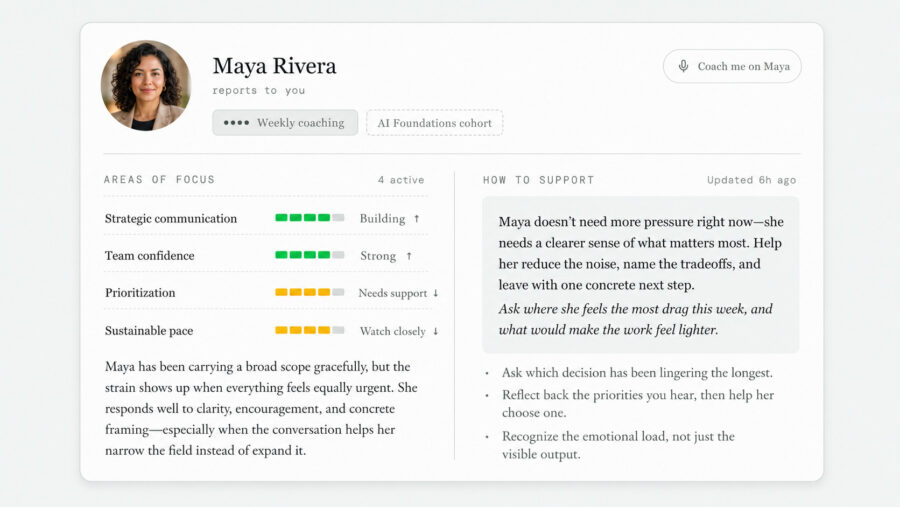
The in-person meetings were almost entirely project work: updates, blockers, collaboration. The coaching tool was where more explicit reflection and development started to happen. It surfaced how people measured their own progress, what they wanted to protect rather than hand off, where burnout and isolation were starting to show, and what each of them needed from me as a manager. More developmental reflection was happening there than in our normal manager check-ins.
Sometimes these gaps were showing up even within the same day. I’d have a routine project meeting with a team member. An hour later they’d have a coaching session and discuss real challenges I hadn’t uncovered. Fortunately the coaching wasn’t just for the employee; in return, I got coaching on how to better show up for my team.

The wrong comparison
We default to comparing AI against the idealised view of manager coaching. Yes, there are many great manager coaches. But plenty of employees get something less substantial, like the cancelled one-to-one or the career conversation that never happens. The real comparison is not with the best manager you ever had but with what most employees get in a typical week, which is often very little.
This gap is structural, not personal. Companies say managers should coach, then build the job around delivery and escalation, leaving coaching for whenever time is left over. I think of that as coaching debt: the distance between the development that organisations promise and what employees actually get.
Managers aren’t lazy. Gallup’s 2026 State of the Global Workplace report found manager engagement falling from 31% in 2022 to 22% in 2025. Gallup’s 2026 span-of-control research also found managers carrying larger teams and more player-coach work: average direct reports rose from 10.9 to 12.1 in a year, and 97% of managers had individual contributor responsibilities (Gallup’s 2026 span-of-control research). That matters, because Gallup also finds that weekly meaningful feedback nearly triples engagement, yet only 16% of employees said their last manager conversation was extremely meaningful.
AI coaching doesn’t need to be perfect
AI doesn’t have to be as good as a great human coach, only available and specific where employees currently get little support. A 2026 preregistered, randomised trial found that an AI career coach improved short-term goal progress versus a no-support control, though it did not outperform structured written reflection (Schimpf et al., 2026). It matters because most employees are not comparing AI coaching to an exceptional manager. They’re comparing it to getting very little coaching at all.
A lot of what gets called coaching is not really coaching. It is advice, correction, and reassurance, which AI will make cheap and abundant. For managers who genuinely coach, it changes little.
The pressure falls on managers whose contribution was mostly generic advice delivered inconsistently. “Try communicating more proactively” is generic advice. Helping someone navigate a politically sensitive, cross-functional conflict is coaching grounded in trust and judgment. Managers are uniquely equipped with the ability to apply context, sponsorship and care for their team.
Employees don’t reach for an AI coach out of a preference for machines. A manager assigns their work, rates them and shapes their reputation, which makes some conversations risky to have honestly. A machine can feel like a safer place to think first.
That safety is conditional. When coaching feels like surveillance or a box-ticking exercise, people disengage quickly. AI coaching needs clear privacy boundaries: what is private, what is aggregated, what a manager can see and what is excluded from performance decisions.
What this means for HR
The worst response would be to use AI coaching to let managers off the hook. It should be a diagnostic and a prompt for better human conversations, not a cheap substitute for developing managers. A few things would help.
- Keep coaching data separate from performance data, and tell people what’s private and what a manager can see.
- Use AI coaching as a starting point for better manager conversations, not a replacement for them. AI suggestions still need real context and judgement.
- Hold managers accountable for development, not only delivery. If coaching is real work, it belongs in how managers are selected, trained, and reviewed.
Used well, AI coaching helps an organisation see the quality of its management more clearly. It should not be a way to avoid the responsibility of improving it.
None of this makes managers obsolete. But the shift means coaching debt stops being invisible, and as I found out from my own team, that can be uncomfortable and also useful. It exposed the ways I needed to step up as a manager. As support becomes cheap and constant, weak coaching becomes much easier to see, and much harder to excuse.

Taylor Blake
Taylor Blake is senior vice president of new initiatives at learning and skills development platform Degreed. He leads Degreed Experiments, exploring how AI is shaping workplace learning. He previously co-founded workplace upskilling platform Learn In and served as chief product officer before its acquisition by Degreed. A member of Degreed’s founding team, he helped develop tools to identify and close skills gaps. Earlier in his career, he worked at HR consultancy The RBL Group.





