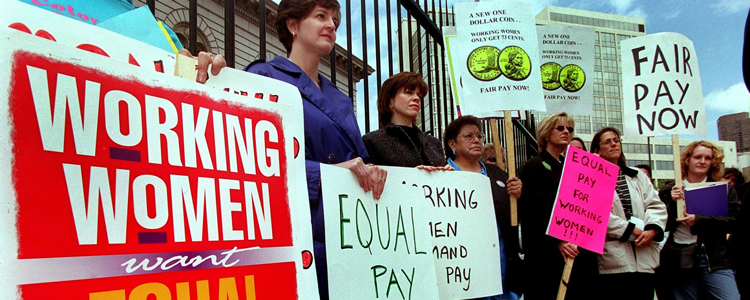
Women may be shouting louder than ever for equal treatment and pay, but a new report indicates it will take centuries to achieve gender parity in workplaces around the globe.
The World Economic Forum (WEF) report said there had been some improvements in wage equality this year compared to 2017, when the global gender gap widened for the first time in a decade. But it warned that these were offset by declining representation of women in politics, coupled with greater inequality in their access to health and education.
At current rates, the global gender gap across a range of areas will not close for another 108 years, while it is expected to take 202 years to close the workplace gap, WEF found. The Geneva-based organisation’s annual report tracked disparities between the sexes in 149 countries across four areas: education, health, economic opportunity and political empowerment.

After years of advances in education, health and political representation, women registered setbacks in all three areas this year, WEF said. Only in the area of economic opportunity did the gender gap narrow somewhat, although there is not much to celebrate, with the global wage gap narrowing to nearly 51 percent. And the number of women in leadership roles has risen to 34 percent globally, WEF said.
But at the same time, the report showed that there are now proportionately fewer women than men participating in the workforce, suggesting that automation is having a disproportionate impact on jobs traditionally performed by women. And women are significantly under-represented in growing areas of employment that require science, technology, engineering and mathematics skills, WEF said.
It decried the particularly low participation of women within the artificial intelligence field, where they make up just 22 percent of the workforce.
But there are big regional differences. The WEF statement said that this gap is three times larger than in other industry talent pools. It said that in addition to being outnumbered three to one, women in AI are less likely to be positioned in senior roles. The WEF stressed the clear need for proactive measures to prevent a deepening of the gender gap in other industries where AI skills are in increasing demand.
The situation varies greatly in different countries and regions. For instance, while Western European countries could close their gender gaps within 61 years, countries in the Middle East and North Africa will take 153 years, the report estimated.
Overall, the Nordic countries once again dominated the top of the table: men and women were most equal in Iceland, followed by Norway, Sweden and Finland.
Syria, Iraq, Pakistan and finally Yemen showed the biggest overall gender gaps of the countries surveyed.
Among the world’s 20 leading economies, France fared the best, taking 12th place overall, followed by Germany in 14th place, Britain in 15th, Canada in 16th and South Africa in 19th.
Sarah Kaiser, Employee Experience, Diversity & Inclusion Lead at Fujitsu EMEIA comments on what businesses can actively do to improve diversity and inclusion,
The World Economic Forum’s latest report indicates that we are still a long way off from closing the gender pay gap, with only a mere 0.1 per cent improvement from last year. As such, one thing remains clear: whilst great strides have been made, there’s still an ocean of gender inequality left for us to conquer. Amid the #MeToo and #TimesUp campaigns, mandatory gender pay reporting and a push for more women in senior positions, this is especially apparent in the 2018 workplace.
There are many efforts that businesses can make to facilitate a diverse and inclusive work environment. One major factor preventing gender equality is the pipeline problem. If organisations are to address the low number of women in more senior-level positions the first step is to increase the pipeline of talent by driving recruitment of women at a graduate and apprentice level.
But it doesn’t stop there. It’s easy enough to put in place initiatives where half of a company’s graduates employed are women, but this shouldn’t be seen as a box-ticking exercise. Women need to be properly retained and included with an organisation, and the introduction of women’s networks, for instance, can be vital in ensuring women receive the proper support and advice they need. But it should be the responsibility of the senior team to encourage senior women to act as mentors and role models and lead by example in supporting women within their organisation.
The future does look bright for women in the UK, but transparency is vital if we are to close the gender pay gap once and for all.
Interested in diversity? Join our Diversity & Inclusion for HR Professionals training course

Aphrodite is a creative writer and editor specialising in publishing and communications. She is passionate about undertaking projects in diverse sectors. She has written and edited copy for media as varied as social enterprise, art, fashion and education. She is at her most happy owning a project from its very conception, focusing on the client and project research in the first instance, and working closely with CEOs and Directors throughout the consultation process. Much of her work has focused on rebranding; messaging and tone of voice is one of her expertise, as is a distinctively unique writing style in my most of her creative projects. Her work is always driven by the versatility of language to galvanise image and to change perception, as it is by inspiring and being inspired by the wondrous diversity of people with whom paths she crosses cross!
Aphrodite has had a variety of high profile industry clients as a freelancer, and previously worked for a number of years as an Editor and Journalist for Prospects.ac.uk.
Aphrodite is also a professional painter.
- Aphrodite Papadatou

- Aphrodite Papadatou
- Aphrodite Papadatou
- Aphrodite Papadatou