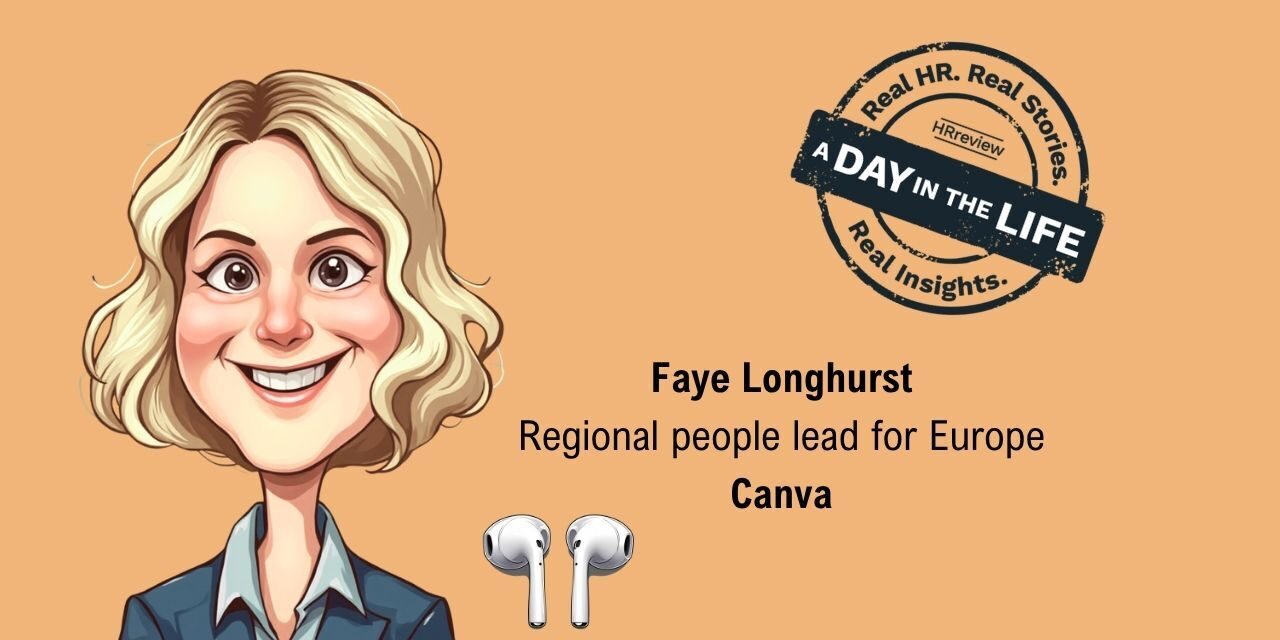
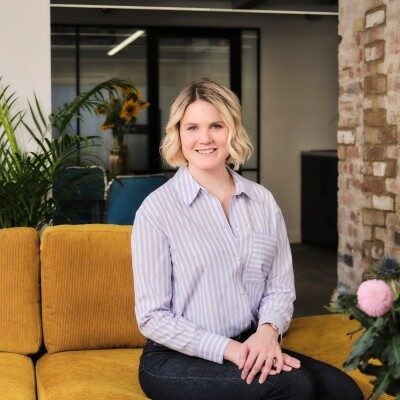
After nearly a decade refining employee experiences across continents, Canva’s regional people lead for Europe, Faye Longhurst, now navigates her busy London mornings with meticulous calm and deliberate focus.
Since returning to the UK from Australia in 2022, Faye, 37, has been at the heart of European expansion at popular graphic design platform Canva, from opening the vibrant new London office to steering major projects like Canva Create. A morning enthusiast, she leverages the early hours to connect with global colleagues, recharge through podcasts and keep her ambitious reading goals on track, all while ensuring there’s space for exercise and a carefully brewed coffee.
In this latest edition of A Day in the Life of an HR Professional, Faye shares insights on the power of skills-based hiring, the underestimated art of data storytelling and why even the most social HR leaders need their quiet moments to thrive.
I’m an early riser, naturally waking up around 6 to 6:30am, although in summer it moves to more like 5:30am due to the daylight. After checking to see if anything needs my immediate attention that came in overnight, since I work with an international team and my crossover time with our teammates in Australia is my morning, I then have tech-free time while I get up and either go straight to the gym for a workout or get ready at a more leisurely pace and make a coffee.

I love listening to music as I get ready for whatever the day has for me — a way to free my mind and be mentally away from work while I get ready. I see getting ready time as an extension of that pre-work period: a mini break at the beginning of the day so you can enter the work day with freshness.
I commute to work via bus and tube; including walking, it takes me about an hour. I use the time as valuable me time for my wellbeing, either listening to podcasts — my current favourite is Elizabeth Day’s How to Fail — or a book. I’ve set myself a challenge of 50 books this year. I’m currently listening to Stephen King’s The Outsider; the one before was The Nightingale by Kristin Hannah; and before that, Conversations on Love by Natasha Lunn. I prefer to listen on my commute, rather than read, to give my eyes a break and I can continue to listen when I’m walking.
The first thing I do when I start work is check through my Slack messages and emails, to triage anything important that needs my attention first. I also take a look at my calendar to make sure I’m prepared for any meetings coming up that day.
At the beginning of each week I’ll look across my whole week to identify the — up to — three things I’d like to achieve that week or help my team to achieve in order to have real impact and move the needle forward. I check back on this at the end of the week, to reflect on how the week went, where I had impact and where I may need to re-focus for the following week.
I ask my team to do the same, so I can understand how they may need me to progress what they’re working on and looking to achieve in the week. This also helps us all see where there’s overlap and identify opportunities to collaborate.
I always make a point to take a lunch break. I find that stepping away for a bit helps me refocus and boosts my productivity for the rest of the day. The break gives my mind a chance to process the morning, and I often come back with fresh ideas or solutions in the afternoon. Depending on the day, my lunch break can be anywhere from 30 minutes to an hour.
When I’m working from home, I’ll usually make a sandwich or a salad, and if the weather’s nice, I like to go for a walk to get some fresh air and stretch my legs. If I’m in the office, I enjoy one of the amazing meals prepared by our in-house chef. Taking that time away from my desk really makes a difference for me, and I’m grateful that across the company, in all locations, an hour is carved out of our day to sit with colleagues and enjoy lunch – something that’s been instilled in our culture since the beginning of Canva.
I believe we haven’t even scraped the surface of AI’s potential impact in the HR industry. But outside of AI, I think the next game-changing shift in HR will be the rise of skills-based hiring and talent management models.
We’re already seeing forward-thinking companies move past legacy recruitment methods and focus instead on what really matters: critical skills like creative thinking, digital know-how and intuition. In fact, our 2025 New Year New Job survey found that 91% of UK hiring managers think a candidate’s digital brand, including the style, design and language of their application, makes a massive impact, and 61% say they first look for that professional polish in a CV.
On top of that, I’m excited about how data storytelling is taking off in HR. At our Canva Create summit last month, we launched new features like Canva Sheets and Magic Charts that make it easy to transform complex data into digestible, interactive and engaging stories. It’s a huge boost for productivity and helps everyone stay on the same page, while also sparking a bit of creativity in the way we crunch numbers and keep on track with our objective timelines.
I think these kinds of changes are going to make HR even more dynamic, creative and employee-centric in the years ahead.
I think the next game-changing shift in HR will be the rise of skills-based hiring and talent management models.
For those looking to advance their career in HR, I say to always look out for opportunities and apply for them or do something with them. These experiences will really help you understand what resonates with you most — and least — and help take you in directions you perhaps hadn’t even considered at the outset.
For example, they can be small acts, such as opportunities like improving a process, system or policy that you’ve noticed could be done better or needs an update. Do what you need to do get approval to work on it and proactively take charge in making the changes needed and collaborating with the related teams this touches and impacts. You gain so much experience by taking advantage of these small moments of learning and stepping outside of your box.
Then there are bigger opportunities such as projects coming up or new roles. Be the person who volunteers to get involved in the small and big things consistently. This helps you to start building your brand and network, as well as your experience, so when the truly amazing things come around you’re high on the list of potential people they may reach out to. I am only here because I did just that. It also helped me to figure out what I most enjoy in what I do.
Afternoons are the time I reserve for meetings that are for folks in my timezone plus focus time to work on projects. Meetings, as I’ve mentioned before, are incredibly important for connection — our team are across Europe and these meetings help us to stay connected, collaborate and catch up.
I stay productive by taking breaks, whether that be a longer break — walk or lunch — or a small break like simply getting up and away from my screen to make a cup of tea. These breaks really help me to come back with a fresh perspective to whatever item I’m working on and come with new solutions or ideas to share.
Also by having a to-do list of items to focus on. I love lists and this helps me stay mentally tidy and focused on what’s important. That said, it’s important to be flexible with your list as priorities shift. It’s also entirely OK to write every small thing on your list just so you can tick it off. I occasionally do this and find it can be a great motivator.
And by carving out focus time during my week for key project work and messages that need to be sent to ensure work continues to progress; this time is so crucial to give yourself the space to think.
I really enjoy working in HR. [There’s a] common perception that HR can be quite one-dimensional, [but] in reality, HR is incredibly broad: it straddles business strategy, wellbeing, rewards and recognition, talent acquisition, talent management, operations, learning and development, business partnering and more. It’s such a varied and exciting role and has strategic significance that I think can be overlooked.
Even though I love working with people and building a culture where everyone feels like they belong and can thrive, I’m actually quite introverted. I get a real buzz from connecting with colleagues and helping teams grow. Spending time with others really lifts my spirits and energises me.
I never check my work messages once I’ve finished work — something I’m strict with to ensure I have time to wind down and move my mind to non-work things. Once I’ve done my prep for the next day and closed the laptop, work is done.
My evenings can look a bit different depending on the day, but I look to cook. My Thermomix makes it really easy to be adventurous for what I cook without spending hours in the kitchen. I often cook in a quiet kitchen, without any music or TV on, since my days are filled with so much talking. I find the quiet time very restorative and helps my mind wander where it needs to.
[There’s a] common perception that HR can be quite one-dimensional, [but] in reality, HR is incredibly broad.
I also love watching movies or shows during the evening, or spending time with friends, often trying somewhere new to eat. An Italian restaurant will always be a go-to if we’re stuck thinking on where to go.
I’m also in a local choir that meets weekly. Even when I’m tired, I find it really helps me to lift my spirits and boost my energy by prioritising it.
The gym is usually a morning thing for me, but every now and then I’ll squeeze in an evening session if I can. Overall, I try to balance quiet time and social activities to help me switch off from work and recharge for the next day.
As I’m an early riser, I love an early night. I prepare for sleep in two ways. First, mental prep: I have a relatively short skincare regime and starting with that helps me to prepare my mind for bed and get to sleep quickly. Second, body prep: I have a shower before getting into bed, which is a signal to my body that it’s close to bed time and to prepare for sleep. Preparing the body and mind for rest is crucial to me to have a good night’s sleep.
Most of the time I fall asleep pretty easily. I often wind down by watching YouTube or reading to try to switch my brain off from thinking. If I have something on my mind that might keep me up, I’ll just write it down so I can revisit it in the morning. That way, I can relax and get a good night’s sleep.

William Furney is a Managing Editor at Black and White Trading Ltd based in Kingston upon Hull, UK. He is a prolific author and contributor at Workplace Wellbeing Professional, with over 127 published posts covering HR, employee engagement, and workplace wellbeing topics. His writing focuses on contemporary employment issues including pension schemes, employee health, financial struggles affecting workers, and broader workplace trends.
- William Furney

- William Furney
- William Furney
- William Furney