The news from Paris this weekend, for once, was nothing but good. The vast majority of governments in the world reached a deal to work together to slow down climate change. The Paris pact aims to curb global warning to less than 2C (3.6F) by the end of the current century. President Obama labeled the deal as ‘the best chance we have to save the one planet we have,’ and labeled the deal, which was also signed by some of the world’s biggest polluters such as India and China, as a ‘turning point’ towards a low-carbon future.
In light of the seismic events detailed in the above paragraph, what follows could, perhaps, be portrayed as small beer, but nonetheless, I do feel that it is worth a mention. As the negotiations in Paris reached there frenetic peak on Saturday, the Secretary General of the United Nations Ban Ki-moon posted a photograph on the UN’s Instagram feed of himself huddled with his advisers reading the final draft of the agreement. This was the photograph:

It is, of course, just a photograph, a snapshot in time and, no doubt, not an accurate reflection of the true nature of the Secretary General’s staff. But, it would seem that at a very key moment in his secretary generalship he was principally being advised by middle aged white men. There is just one woman in the photograph. As business battles to make boardrooms more diverse and balanced, it would seem that not enough focus is being put on government and the role of women in the corridors of power. Are an equal number of men and women advising our political leaders?

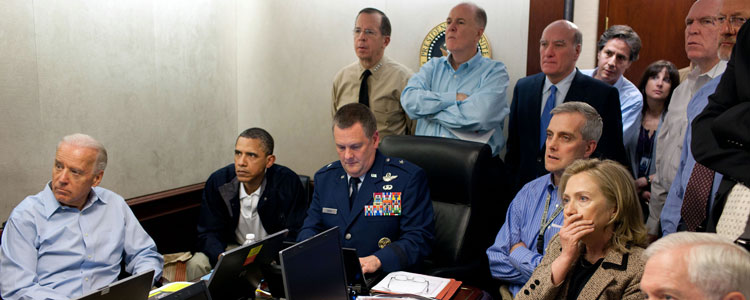
Another photograph that raised the same questions was the famous picture of President Obama sat with his national security team as they awaited news of the raid that ultimately killed Osama bin Laden. Sat in the White House situation room, the scene captured is an essentially white male one, with the notable exception of then Secretary of State Hillary Clinton, Audrey Tomason, the Director of Counterterrorism for the National Security Council and of course, the President himself, who is the only African American represented.
In the week that Time Magazine named Angela Merkel, the chancellor of Germany, as its Person of the Year, labeling her as ‘Chancellor of the Free World’ and the ‘de facto leader of the European continent’, it can hardly be said that women are not represented at the very top tables of world diplomacy (although Merkel is only the 4th woman since Time’s yearly accolade was founded in 1927 to win, after Wallis Simpson, Queen Elizabeth II and Corazon Aquino, former president of the Philippines).
However, when taking into account these photographs, one does have to wonder if the ranks of people offering advise to our leaders is diverse enough. For example, the Civil Service, which advises the government in the UK, is predominately female (53 percent), however only 38 percent of those women hold senior positions and it is often senior civil servants who advise ministers.
Two photographs do not tell a full story, but they are telling. In a world apparently becoming more diverse and equal, at two critical moments in recent world history, women and ethic minorities appear to have been left underrepresented.

Robert joined the HRreview editorial team in October 2015. After graduating from the University of Salford in 2009 with a BA in Politics, Robert has spent several years working in print and online journalism in Manchester and London. In the past he has been part of editorial teams at Flux Magazine, Mondo*Arc Magazine and The Marine Professional.
- Robert Leeming

- Robert Leeming
- Robert Leeming
- Robert Leeming