

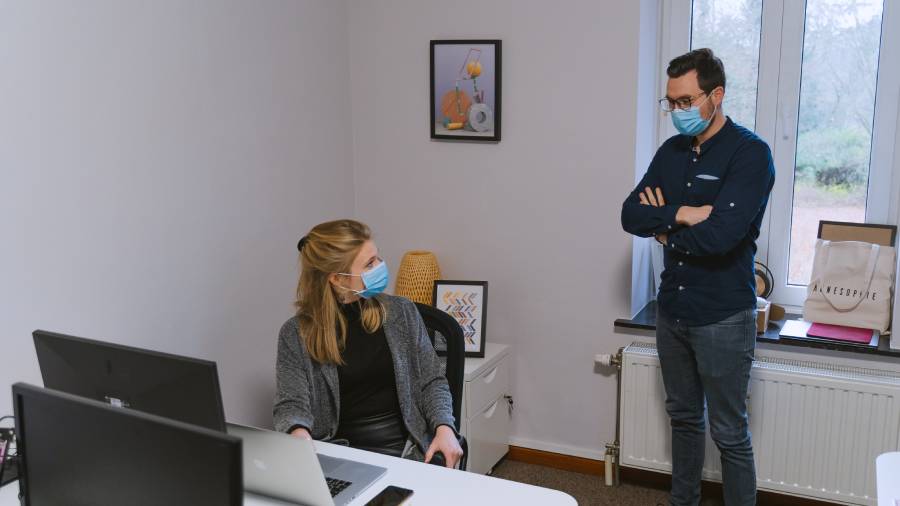
A growing number of employers are being hit with COVID-related employment tribunal claims, a law firm warns.
Employers have been advised to carry out appropriate risk assessments as employment tribunal claims linked to COVID-19 continue to grow.
According to Shah Qureshi, the London Head of Employment & Professional Discipline at law firm Irwin Mitchell, COVID-related claims have risen by a fifth (20 per cent) over recent months.
Additionally, he predicts this to rise further by the turn of the year as employers and employees alike fall foul of new workplace rules.

Mr. Qureshi warned of the difficult ‘Catch-22’ situations that employers may be increasingly faced with:
On the one hand, we all want to get back to ‘business as usual’ but on the other hand, employers have to duty to ensure that employees are returning to a safe workplace.
This will inevitably mean companies will adopt policies that some employees will see as draconian such as the mandatory wearing of masks, social distancing and requiring staff to be vaccinated.
Describing this difficult balance, Mr. Qureshi continued to explain employers should think twice about disciplining staff for minor transgressions while also conducting risk assessments to ensure staff return to a safe place of work.
Uncertainty is a significant problem for many businesses currently as many have begun a phased return to offices since the start of September.
However, recent advice by SAGE suggested that the UK could return back to homeworking if hospital admissions rise substantially over the coming months.
In addition, around three-fifths of workers (60 per cent) expect some form of restrictions to be back in place this year, be that regional lockdowns or a national return to some restrictions on work and behaviour.
Therefore, lawyers have stated that whilst the outlook currently remains uncertain, having clear policies in place and involving staff is vital to avoid what can be unnecessary disputes or the risk of well-intentioned policy changes being misused for unintended purposes, such as disciplinary procedures.
Mr. Qureshi went on to further explain the need for clear company policies around health and safety in the workplace:
Businesses need well thought out policies in place, so they are ready for likely eventualities, such as staff meeting clients who may take a more relaxed approach, for example.
Making up company policy on the fly is never a good idea and if ill-conceived COVID policies are taken out of context and used to censure or dismiss a staff member, an employer has already formed a negative opinion about, they could cause more problems than they solve.
Employers also need to make adjustments for workers who may be particularly vulnerable to COVID such as pregnant women or those with particular disabilities to ensure their health and safety is protected and they do not suffer discrimination.
Depending on how policies are drafted, someone could find themselves disciplined for a minor breach of rules, like forgetting to wear a mask. Working out rules all can accept in this new world is going to help everyone.
With employers needing to balance the health and wellbeing of staff and the business, getting it right reduces the risk to health time and temper and should keep post-lockdown dilemma to a minimum.

Monica Sharma is an English Literature graduate from the University of Warwick. As Editor for HRreview, her particular interests in HR include issues concerning diversity, employment law and wellbeing in the workplace. Alongside this, she has written for student publications in both England and Canada. Monica has also presented her academic work concerning the relationship between legal systems, sexual harassment and racism at a university conference at the University of Western Ontario, Canada.
- Monica Sharma

- Monica Sharma
- Monica Sharma
- Monica Sharma









