

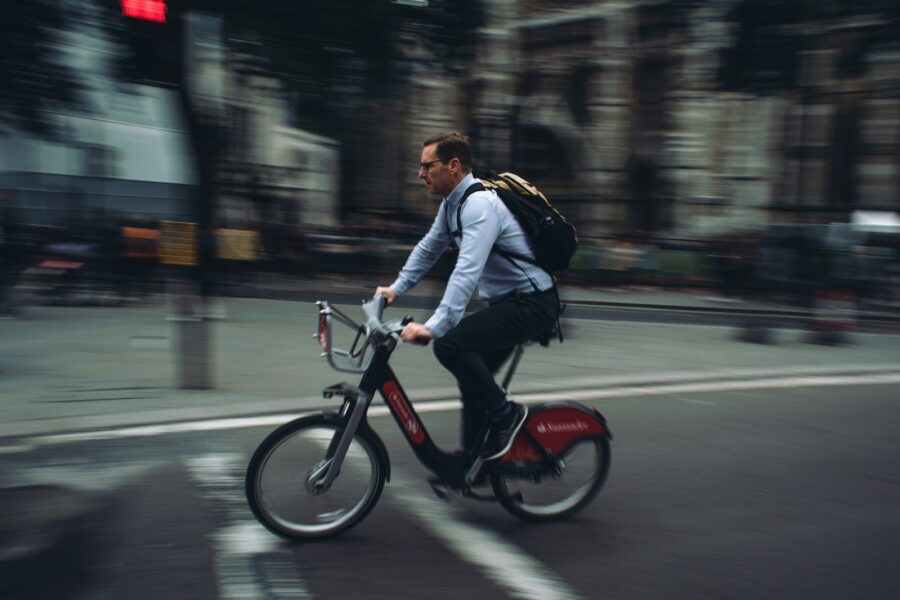
The shift to hybrid working has led to a rise in active commuting – where employees incorporate physical exercise, such as walking or cycling, into their commute – with remarkable benefits for employee wellness, productivity, and job satisfaction.
These are the findings of new research from International Workplace Group (IWG). The study shows that with more employees using local workspaces, nearly two-thirds (62%) of commutes are now mostly or entirely active, a 38 percent increase compared to commutes to city-centre offices.
Those who engage in active commutes face lower risks of mental and physical health issues, reducing the likelihood of hospital admission by 10-11 percent. IWG’s research, surveying over 1,000 hybrid workers, found that walking (88%), cycling (34%), and running (28%) are the most common forms of active commuting. The study also highlighted less traditional active commute options, such as commuting via scooters (7%), skateboards (6%), and rollerblades (4%).
‘Silver Strollers’ Lead Active Commuting Increase
Older workers have particularly embraced active commuting, with those aged 55 to 64 reporting a 109 percent increase in physical activity during their commutes when travelling to local rather than central workspaces. Walking is the most popular option for this demographic, who collectively cover an additional 259 km per year on foot.
 |
Get our essential weekday HR news and updates.
|
Among this group, 67 percent stated they are more inclined to integrate physical activity into their commute when heading to a nearby workspace. Over three-quarters (79%) reported improved physical health as a direct result.
Mental Health and Productivity Gains
Active commuting not only provides physical health benefits but has also improved mental wellbeing, productivity, and work-life balance. More than four in five (82%) hybrid workers who actively commute report enhanced mental health, while three in five (60%) attribute higher productivity levels to incorporating exercise into their journey. Further research from IWG shows that three-quarters (75%) of hybrid workers experienced a marked reduction in burnout symptoms since transitioning to hybrid work models.
Hybrid work’s positive impact on job satisfaction is also evident, with 85 percent of hybrid workers expressing increased job satisfaction, and 75 percent noting higher motivation levels.
Demand for Local Workspaces
The increased emphasis on active commuting has led to heightened demand for workspaces closer to home, with nearly three in five (59 percent) employees expressing a preference for local workspaces that enable more exercise. Three-quarters (75 percent) of hybrid employees report they are more likely to incorporate physical activity into their commute when they have access to a nearby workspace.
The survey suggests that leaders are receptive to these employee needs, with three-quarters (75 percent) of UK CEOs indicating that a strict five-day office return is no longer a business priority. Additionally, 65 percent of CEOs noted that enforcing daily central office attendance could lead to talent loss.
Mark Dixon, International Workplace Group CEO, said, “The growing use of workspaces closer to where employees live, allowing them to reduce long daily commutes, is contributing to major improvements in worker’s physical and mental wellbeing. This research demonstrates that hybrid working is a win/win for everyone. Business leaders are seeing substantial productivity and financial gains, while employees enjoy a better work/life balance and higher job satisfaction.
“Companies are increasingly appreciating that they will not only will they have a happier, healthier workforce when they allow people to work flexibly, but people actually feel more productive and motivated.”

Alessandra Pacelli is a journalist and author contributing to HRreview, where she covers topics including labour market trends, employment costs, and workplace issues.
- Alessandra Pacelli
 Friday, August 1, 2025
 - Alessandra PacelliFriday, August 1, 2025
- Alessandra PacelliThursday, July 31, 2025








