

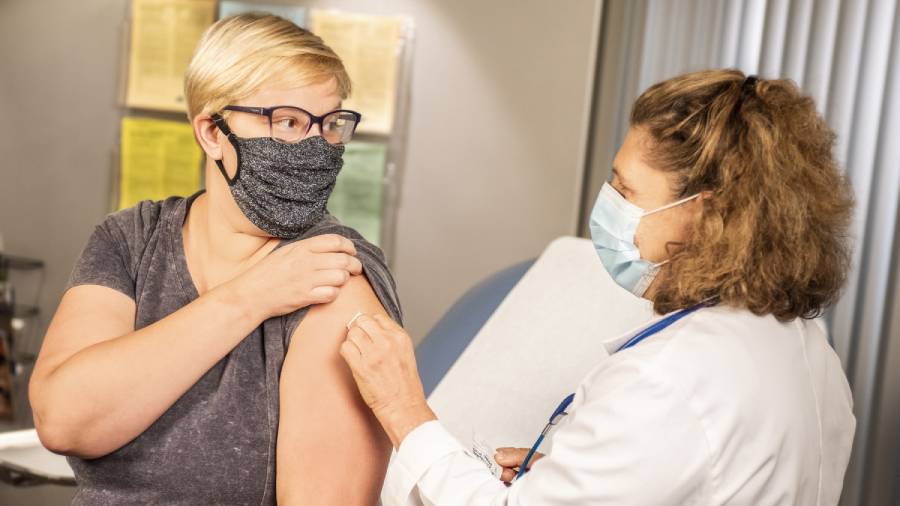
The vast majority of UK workers have stated they would not feel safe returning to work unless colleagues had been vaccinated, showing health and safety has become a growing priority for staff during the pandemic.
New research by Randstad, which surveyed 27,000 workers worldwide, highlights the belief of workers that being inoculated against COVID-19 is important for a safe workplace.
Three-quarters of employees in the UK (72 per cent) confessed that they would not feel safe in the office unless others around them had been vaccinated.
The number of UK workers feeling this way was almost a fifth higher (19 per cent) than results worldwide, showing this is a particularly important condition for the workforce to return back to offices.

As such, just under two-thirds (63 per cent) stated that they would prefer to work at home until the vaccine is widely distributed, giving greater protection to the whole workforce.
At present, over 32 million people in the UK have received their first dose of the vaccine. Employers have been encouraged to provide impartial information to employees, allowing them to make their own decision about whether to get vaccinated.
Adopting this voluntary approach, lawyers have said, will protect employers from discrimination and unfair dismissal claims.
It is evident that vaccinations have also been looked upon favourably by UK workers to retain or improve their career. The majority of employees (87 per cent) stated that they would be willing to get vaccinated if it was required for their job. Furthermore, two-thirds (67 per cent) believe they will have better job opportunities once vaccinated.
Looking to the future of work, the research found that a sizeable amount of staff (52 per cent) miss in-person interactions with colleagues. Almost four in five (78 per cent) did want to return back to the workplace in some capacity.
However, outside of safety concerns linked to COVID, another prominent issue for workers has been struggling with the balance between work and life. Due to this, over a quarter of workers (27 per cent) wanted to see HR implement policies regarding work hours, allowing them to cultivate a good balance between their work and personal life.
Marc-Etienne Julien, CEO, Randstad Canada & Managing Director, Global Talent:
To help employers instill greater confidence around wellness and safety, C-suite and human capital leaders need to map what a post-pandemic work environment looks like — whether that means hybrid schedules to maintain distancing in the office, incentive programs to encourage widespread vaccination or more employee assistance programs offering a variety of support mechanisms.
Even when most of the global workforce is inoculated, it will take time for the workforce to acclimate to so much change ahead.
*Randstad surveyed 27,000 workers in 34 countries to obtain these results, which can be found here.

Monica Sharma is an English Literature graduate from the University of Warwick. As Editor for HRreview, her particular interests in HR include issues concerning diversity, employment law and wellbeing in the workplace. Alongside this, she has written for student publications in both England and Canada. Monica has also presented her academic work concerning the relationship between legal systems, sexual harassment and racism at a university conference at the University of Western Ontario, Canada.
- Monica Sharma

- Monica Sharma

- Monica Sharma

- Monica Sharma





