


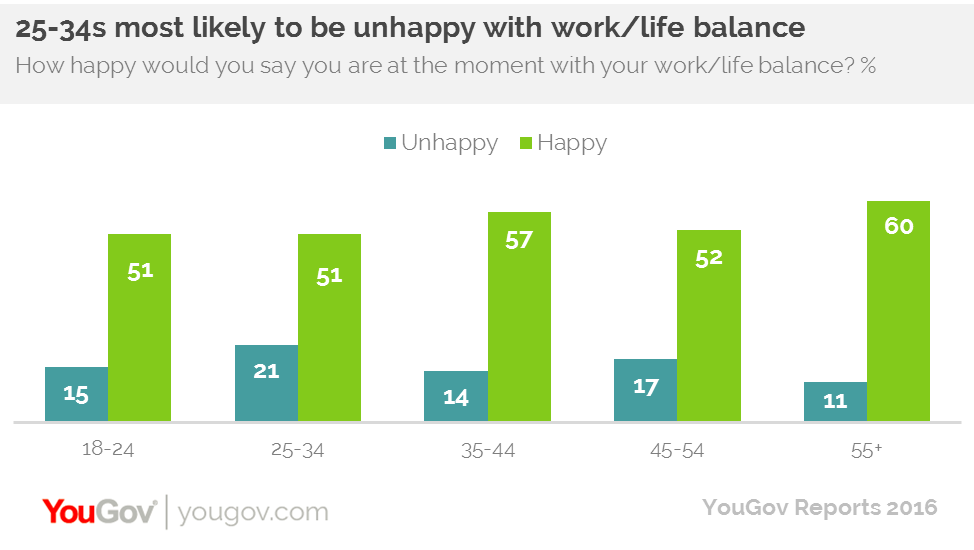
People in their late twenties and early thirties (25-34) are more unhappy about their work-life balance than any other age group, according to a YouGov poll.
The report shows that one in five 25-34 year-olds are unhappy with their work-life balance, compared to around one in six 18-24 year-olds. Just 14 per cent of 35-44 year-olds and 17 per cent of 45-54 year-olds say that they feel unhappy with the balance between their professional and private lives.
The survey, based on responses from 1,995 employed adults in the UK, found that responding to communications out of hours, for example e-mails, is one of the major pressures employees feel.

41 per cent of 25-34 year-olds believe there is sometimes an expectation from their boss or employer to work outside their normal hours. What’s more, a quarter say that there is pressure to work outside their regular work day.
Responding to communications is one of the major pressures employees feel. The report reveals over four in 10 read or send work-related emails outside of office hours, while for some even holidays aren’t an escape – with approaching two in five (38 per cent) either making or receiving work phones calls while on holiday.
YouGov’s study finds that poor work-life balance can have a notable impact on employees. They tend to be more disengaged with life in general than the average person, envying their friends’ lifestyles (34 per cent) and feeling alienated by modern life (46 per cent).
The issue of maintaining a healthy work life balance is key to both employees and organisations. However, with many young people finding it tricky to find employment, the pressure to go above and beyond what should be normally expected is very real. Our data indicates that those in the 25-34 age group are people that HR professionals need to focus on and regular contact is needed in order to placate their worries and frustrations.
Stephen Harmston, head of YouGov Reports says:
“The issue of maintaining a healthy work life balance is key to both employees and organisations. However, with many young people finding it tricky to find employment, the pressure to go above and beyond what should be normally expected is very real,”
He said that human resource departments should particularly focus on those aged 25-34.
“Regular contact is needed in order to placate their worries and frustrations,” he said.

Rebecca joined the HRreview editorial team in January 2016. After graduating from the University of Sheffield Hallam in 2013 with a BA in English Literature, Rebecca has spent five years working in print and online journalism in Manchester and London. In the past she has been part of the editorial teams at Sleeper and Dezeen and has founded her own arts collective.
- Rebecca Clarke

- Rebecca Clarke
- Rebecca Clarke

- Rebecca Clarke







