<

!Google ads have two elements of code. This is the 'header' code. There will be another short tag of code that is placed whereever you want the ads to appear. These tags are generated in the Google DFP ad manager. Go to Ad Units = Tags. If you update the code, you need to replace both elements.> <! Prime Home Page Banner (usually shows to right of logo) It's managed in the Extra Theme Options section*> <! 728x90_1_home_hrreview - This can be turned off if needed - it shows at the top of the content, but under the header menu. It's managed in the Extra Theme Options section * > <! 728x90_2_home_hrreview - shows in the main homepage content section. Might be 1st or 2nd ad depending if the one above is turned off. Managed from the home page layout* > <! 728x90_3_home_hrreview - shows in the main homepage content section. Might be 2nd or 3rd ad depending if the one above is turned off. Managed from the home page layout* > <! Footer - 970x250_large_footerboard_hrreview. It's managed in the Extra Theme Options section* > <! MPU1 - It's managed in the Widgets-sidebar section* > <! MPU2 - It's managed in the Widgets-sidebar section* > <! MPU - It's managed in the Widgets-sidebar section3* > <! MPU4 - It's managed in the Widgets-sidebar section* > <! Sidebar_large_1 - It's managed in the Widgets-sidebar section* > <! Sidebar_large_2 - It's managed in the Widgets-sidebar section* > <! Sidebar_large_3 - It's managed in the Widgets-sidebar section* > <! Sidebar_large_4 - It's managed in the Widgets-sidebar section* > <! Sidebar_large_5 are not currently being used - It's managed in the Widgets-sidebar section* > <! Bombora simple version of script - not inlcuding Google Analytics code* >

Employees aged 25-34 most unhappy with work-life balance

-

People in their late twenties and early thirties  (25-34) are more unhappy about their work-life balance than any other age group, according to a YouGov poll.

The report  shows that one in five 25-34 year-olds are unhappy with their work-life balance, compared to around one in six 18-24 year-olds. Just 14 per cent of 35-44 year-olds and 17 per cent of 45-54 year-olds say that they feel unhappy with the balance between their professional and private lives.

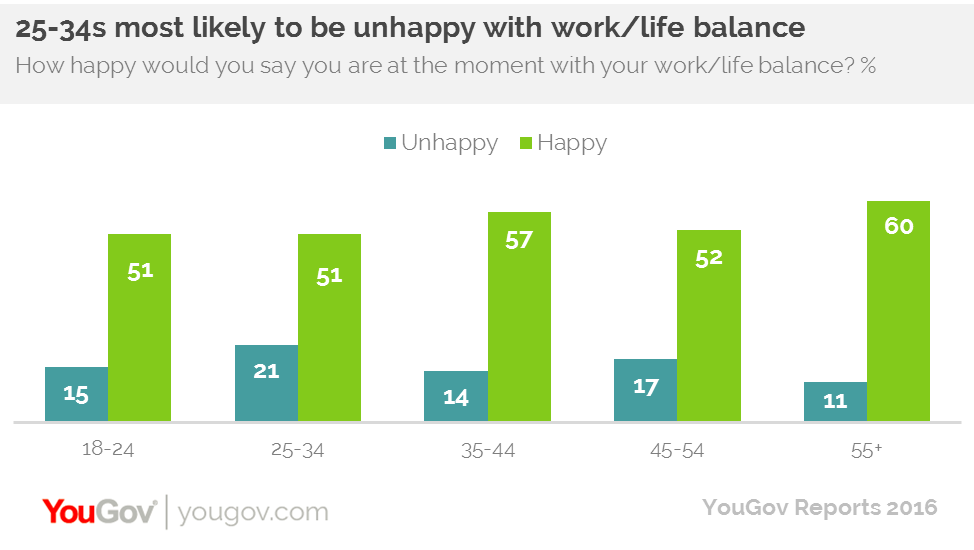
 

Image courtesy of YouGov

The survey, based on responses from 1,995 employed adults in the UK, found that responding to communications out of hours, for example e-mails, is one of the major pressures employees feel.

41 per cent of 25-34 year-olds believe there is sometimes an expectation from their boss or employer to work outside their normal hours. What’s more, a quarter say that there is pressure to work outside their regular work day.

Responding to communications is one of the major pressures employees feel. The report reveals over four in 10 read or send work-related emails outside of office hours, while for some even holidays aren’t an escape – with approaching two in five (38 per cent) either making or receiving work phones calls while on holiday.

YouGov’s study finds that poor work-life balance can have a notable impact on employees. They tend to be more disengaged with life in general than the average person, envying their friends’ lifestyles (34 per cent) and feeling alienated by modern life (46 per cent).

The issue of maintaining a healthy work life balance is key to both employees and organisations. However, with many young people finding it tricky to find employment, the pressure to go above and beyond what should be normally expected is very real. Our data indicates that those in the 25-34 age group are people that HR professionals need to focus on and regular contact is needed in order to placate their worries and frustrations.

Stephen Harmston, head of YouGov Reports says:

“The issue of maintaining a healthy work life balance is key to both employees and organisations. However, with many young people finding it tricky to find employment, the pressure to go above and beyond what should be normally expected is very real,”

He said that human resource departments should particularly focus on those aged 25-34.

“Regular contact is needed in order to placate their worries and frustrations,” he said.


Rebecca joined the HRreview editorial team in January 2016. After graduating from the University of Sheffield Hallam in 2013 with a BA in English Literature, Rebecca has spent five years working in print and online journalism in Manchester and London. In the past she has been part of the editorial teams at Sleeper and Dezeen and has founded her own arts collective.

Latest news

Turning Workforce Data into Real Insight: A practical session for HR leaders

HR teams are being asked to deliver greater impact with fewer resources. This practical session is designed to help you move beyond instinct and start using workforce data to make faster, smarter decisions that drive real business results.

Bethany Cann of Specsavers

A working day balancing early talent strategy, university partnerships and family life at the international opticians retailer.

Workplace silence leaving staff afraid to raise mistakes

Almost half of UK workers feel unable to raise concerns or mistakes at work, with new research warning that workplace silence is damaging productivity.

Managers’ biggest fears? ‘Confrontation and redundancies’

Survey of UK managers reveals fear of confrontation and redundancies, with many lacking training to handle difficult workplace situations.
- Advertisement -

Mike Bond: Redefining talent – and prioritising the creative mindset

Not too long ago, the most prized CVs boasted MBAs, consulting pedigrees and an impressive record of traditional experience. Now, things are different.

UK loses ground in global remote work rankings

Connectivity gaps across the UK risk weakening the country’s appeal to remote workers and internationally mobile talent.

Must read

Three reasons why HR should worry when engaging contractors overseas

HR departments engaging contractors overseas should have tax compliance at the top of their agenda if they want to mitigate the very real risks of prosecution, according to 6CATS.

Nii Cleland: Workplace racial equity: what’s changed since May 2020?

Nii Cleland explores why there has been such slow progress improving racial equity within organisations.
- Advertisement -

You might also likeRELATED
Recommended to you

Exit mobile version


