

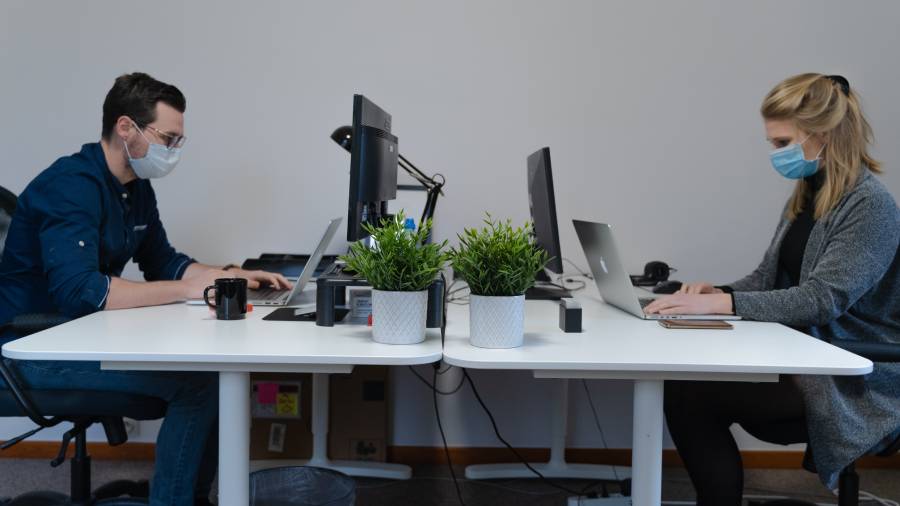
New research highlights workplace safety as a significant concern for workers, with two-fifths expressing fear of catching COVID-19 by being in direct contact with colleagues.
Research by Velocity Smart Technology shows that a key concern, for employees, about returning to the office is the threat of catching COVID-19.
Two-fifths of workers (40 per cent) were worried that this could occur as a direct result of being back in contact with colleagues.
However, in addition to this, over a third (37 per cent) also expressed fear that they would catch the virus through a lack of cleanliness of office equipment. This could occur through contamination of shared office devices and equipment such as keyboards or computers.

In line with Government guidelines, two-thirds of workers (65 per cent) would also advocate for social distancing measures of two metres between desks.
In addition to this, although not compulsory by law if social distancing is occurring, over half (52 per cent) would welcome mandatory mask wearing in office spaces.
The importance of enforcing strict safety measures during the return to offices was also echoed by the TUC. The union body warned that virus cases could spike as a result of a lack of COVID safety protocol in the workplace.
Whilst employees who can do so are still urged to work from home until lockdown restrictions are completely lifted, the TUC also emphasised the need for effective ventilation, social distancing and risk assessments. Employers were also advised to offer employees information about the vaccine, allowing them to create their own informed decision about whether or not to become inocculated.
Frances O’Grady, General Secretary of the TUC, said:
Before reopening, every employer must run a new risk assessment, prioritising good ventilation – and act to make sure their workplace is Covid-Secure. They have to consult their workers and unions on their safety plans. And they have to publish their risk assessment to reassure their workers and customers.
Government guidelines have also stressed that employers should consult with their workers to decide who needs to come into the workplace. In addition, it encourages the frequent cleaning of work areas and equipment, objects and surfaces. It also calls for employees to work within fixed teams and for employers to find ways to remove direct contact between workers.
*The Velocity research was conducted in December 2020 using an online methodology. In total 3,000 interviews were completed (1,000 in the UK and 2,000 in the USA) with people who worked in organisations employing more than 200 people.

Monica Sharma is an English Literature graduate from the University of Warwick. As Editor for HRreview, her particular interests in HR include issues concerning diversity, employment law and wellbeing in the workplace. Alongside this, she has written for student publications in both England and Canada. Monica has also presented her academic work concerning the relationship between legal systems, sexual harassment and racism at a university conference at the University of Western Ontario, Canada.
- Monica Sharma

- Monica Sharma

- Monica Sharma

- Monica Sharma






