

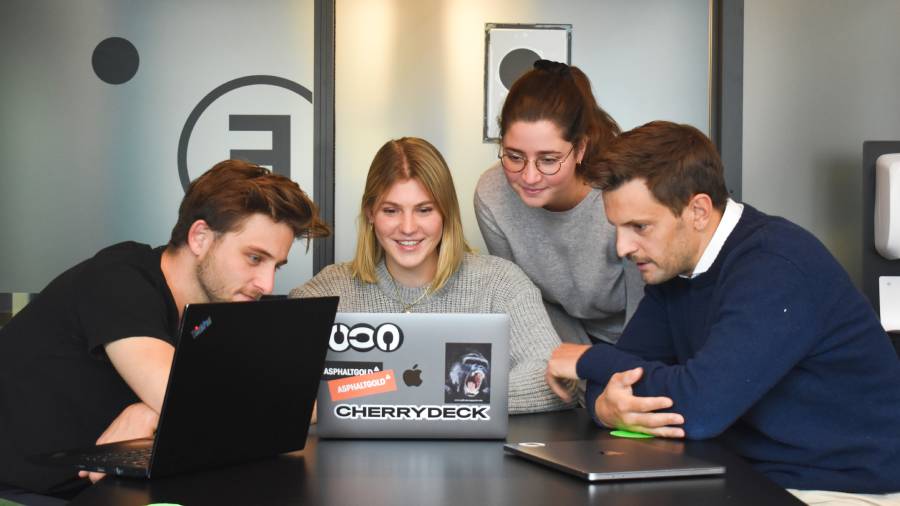
New research highlights the need for employers to formulate efficient wellbeing strategies, looking past simply returning to the office as a way of reconstructing morale.
A new study by Tictrac, an employee wellbeing platform, warns employers that physical proximity may not be enough to foster significant social wellbeing in the workplace.
This comes as data from Aon reveals just under a third of employers (27 per cent) believe that remote working is a barrier which prevents improving social wellbeing.
Beyond remote working, other barriers identified include COVID-19 social distancing (38 per cent) and shift work (21 per cent).

Around a fifth (20 per cent) of employers also flagged a lack of overall employee engagement in organisations as well as cultural barriers (13 per cent) and a lack of team-focussed work (12 per cent).
Despite these prominent barriers, under two-thirds of organisations (65 per cent) incorporate social wellbeing into their strategy, compared to seven in 10 (70 per cent) who incorporate physical wellbeing and two-thirds (67 per cent) who incorporate emotional wellbeing, demonstrating that social wellbeing can be overlooked by firms.
Martin Blinder, CEO and Founder of Tictrac, dubbed social wellbeing a “vital pillar of our overall wellbeing” but stressed it needs daily care. Mr. Blinder continued:
Having people physically back together in the office isn’t enough to unite teams.
Wellbeing isn’t a one-off event. Like happiness, it’s not a permanent state. Some days our wellbeing might be great, but on others it’s not. That’s why we consistently need to look after ourselves. Engagement is the same – it can swing depending on the employee.
As we begin to socialise again, consistent and meaningful interactions will make more of a difference to employees than one big re-uniting. Welcoming employees back with a team-building event might be a great way to kick off re-integrating teams and colleagues old and new, but we’re not the same people we were 18 months ago.
We need time to get to know each other again through consistent interactions, in some ways and more so for some people, learning how to do it again.
Further research from Aon found that close to half of employers (42 per cent) struggled to maintain employee engagement in wellbeing programmes whilst the same number felt that it was a challenge to expand or start wellbeing initiatives whilst also keeping employees engaged.
Furthermore, while over four in five companies (87 per cent) have a wellbeing initiative, only half (55 per cent) have a strategy.
Blinder continued:
We can see from the research that 60 per cent of companies don’t currently offer social or sporting clubs, 59 per cent don’t currently encourage participation in charity walks or runs and 41 per cent don’t currently provide shared collaboration spaces.
Mixing social wellbeing into a wellbeing strategy like this will not only get engagement high, but it will also keep it there. All the while, fostering connection and camaraderie.

Monica Sharma is an English Literature graduate from the University of Warwick. As Editor for HRreview, her particular interests in HR include issues concerning diversity, employment law and wellbeing in the workplace. Alongside this, she has written for student publications in both England and Canada. Monica has also presented her academic work concerning the relationship between legal systems, sexual harassment and racism at a university conference at the University of Western Ontario, Canada.
- Monica Sharma

- Monica Sharma
- Monica Sharma
- Monica Sharma









