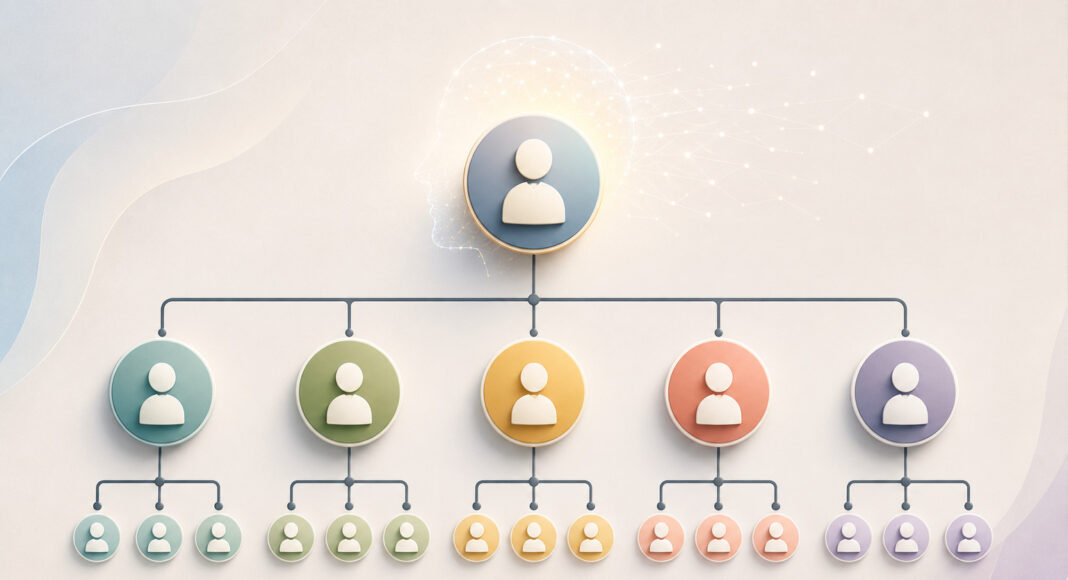
Last year, Block, the payments firm, cut around 40 percent of its workforce. It called the move not a redundancy round but a new way to run a company. That is an argument HR cannot sit out. The org chart is not dying. It is being demoted.
Here is the question worth sitting with. Once a machine can coordinate the work, what is the org chart actually for?
Most writing on AI and structure is confidence dressed as evidence. The discipline that helps is older and duller. Separate what we know from what we believe, and be honest about which is which.
So start with what we know. For more than a century, the org chart has done a job we rarely name: it coordinated work. When information was scarce and slow, the chart moved it. Managers gathered context, passed it up, relayed decisions down and held the line on who could approve what. Reporting lines were never only about power, they were the operating system of the firm.
AI changes the problem the org chart was built to solve. When work leaves a digital trace, a business can hold a live picture of itself: what is being built, what is stuck. Context no longer has to travel through people, layer by layer. AI does not remove structure; it changes where structure lives.

So the chart is not dead. It is being asked to do less. Microsoft now envisions a work chart: teams forming around an outcome, then dissolving when the work is done. Picture two maps of the same company. One shows accountability: who employs whom, who carries the risk, who signs. The other shows coordination: how the work actually gets done, through people, data, agents and decisions. Two maps, not one. It is the thread through everything that follows.
The middle is unbundled, not deleted
This is where the headlines get lazy. Middle management is not one job. It is a bundle. Some of it is administration: collecting status, chasing updates, booking the meeting about the meeting. Some of it is deeply human: judgement, coaching, ethical sense, building trust, growing the next person. AI is good at the first. It is poor at the second.
So the layer does not vanish; it splits. Boston Consulting Group reports that around 45 percent of AI leaders expect fewer layers of middle management. That is not a story about fewer people who matter. It is about removing the routing and keeping the judgement. Deloitte puts it the other way round: cut managers without replacing what they did, and you simply move the confusion somewhere else. The manager as router weakens; the manager as coach and steward matters more. The middle does not disappear. It becomes an intelligence layer.
The part nobody puts on the slide
None of this is automatic, and HR should be the first to say so. Gartner expects more than 40 percent of agentic AI projects will be cancelled by the end of 2027, citing cost, unclear value and weak controls. The direction is real. The maturity is not there yet. Anyone selling you a self-running company is selling you a story.
And here is the harder question the debate keeps skipping: When coordination moves into the system, who is accountable when the system is wrong? An agent can draft the contract, flag the risk, even take the action. It cannot sit before a tribunal, answer a regulator or face a customer who has been let down. Researchers at MIT warn that quietly treating agents as if they were employees blurs that line. It weakens the review that should catch the error.
That is not a technology problem; it is a people and governance problem, which makes it ours. The board question is no longer only who reports to whom. It is who owns the outcome, which agent acted, on what data, under whose authority and who can switch it off. Those questions are where any honest conversation now starts.
The questions we now have to answer
There is the company that cut 40 percent of its staff and called it progress. Blueprint, or warning? There is the cost we are not yet pricing. A leaner firm is an efficiency story, but it is also a human one, and the two rarely agree. There is a quieter problem. If AI does the routine work juniors once learned on, where will tomorrow’s leaders come from? And beneath it all, the question most HR leaders actually want answered: What do I do about this on Monday morning?
I will answer each in the columns ahead. For now, you already have the two maps and the questions above. Start there. Because a system can coordinate the work. It can hold the context, route the decision, speed the handoff. The one thing it can never do is be accountable for the outcome. That has always been a human act. It is the reason the people profession exists, and AI is about to make it the most important seat at the table.

James Nash
James Nash is the founder of inBeta. He has spent fifteen years working with boards and senior leadership teams at global and publicly listed companies on succession, talent, capability and leadership governance. He holds executive education from Saïd Business School, University of Oxford, in Artificial Intelligence (including Audit and Ethics), Executive Leadership, Strategic Innovation and Executive Finance.