

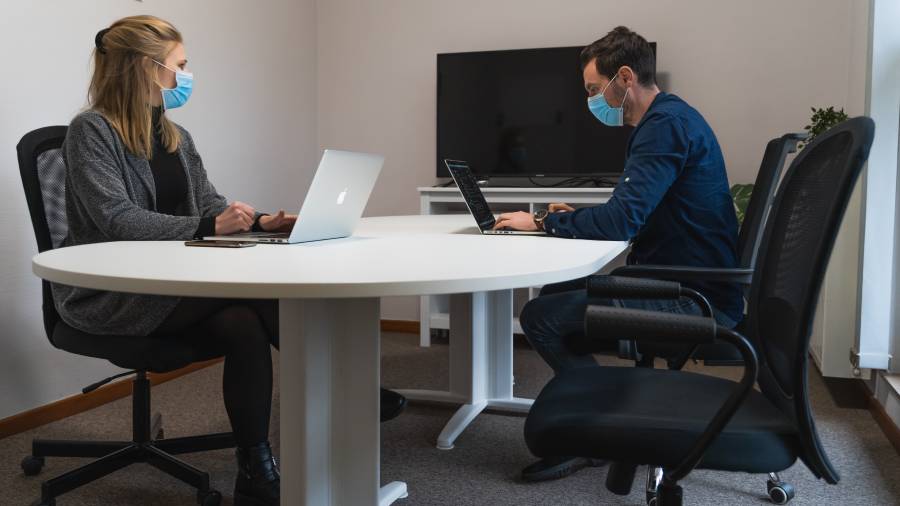
The Home Office have announced that right to work checks will be reverting back to in-person checks from the 17th May 2021.
The Government have stated that right to work checks, made virtual during the pandemic, will be shifting back to an in-person method.
From the 17th May, the temporary adjustments made to right to work checks are ending. This means employers will be expected to conduct this in-person once again or can check the applicant’s right to work online, if they have been given authority to do so.
These measures were put in place to prevent illegal working, with employers having responsibility over ensuring that the individual has the right to work in the UK.

As part of this, employers are expected to obtain original versions of documentations such as a passport, check the document’s validity in front of the employee and make and retain a copy of this.
However, during the pandemic, this method was altered in order to adhere to lockdown restrictions and social distancing rules. Candidates were able to complete these checks over a video call and send through scanned documents.
This shift back to original ways of performing the checks has not been entirely well received, with some citing the flexibility that virtual checks allow.
Tania Bowers, Legal Counsel and Head of Public Policy at The Association of Professional Staffing Companies (APSCo), stated it was “disappointing” to see these checks return to being in-person:
It’s disappointing that the Home Office has decided to return to the position of employers needing to see original documents to undertake verification checks from 17th May rather than retaining the Covid remote video checks that have worked well over the last year for a longer period.
We hoped that the Home Office would prioritise the expansion of digital checks, currently only available for checking EU settlement, a process more suitable for the modern world of flexible work. There has been a huge amount of time and effort that has gone into adapting the Right to Work verification processes in a remote environment and to return to pre-pandemic systems that do not retain the flexibility that is needed in a hybrid working environment will not help organisations during this recovery period.
Ms. Bowers also raised concern about the “short deadline” given to businesses and warned this would “only add further unnecessary burdens on already struggling businesses”.
In addition, the Recruitment and Employment Confederation (REC) wrote a letter to Home Secretary, Priti Patel, urging a rethink on this decision.
REC’s Deputy Chief Executive Kate Shoesmith, wrote:
The digital checks have hugely benefitted us all – ensuring UK business and our workforces can operate as effectively as possible and respond to spikes in demand during the pandemic.
However, removing the ability to perform these checks digitally, whilst the nation remains under some level of lockdown does not make sense and is an avoidable barrier which could stop some of the services we all rely on – in health, care, retail, food and logistics for instance, from being provided. Requiring a physical check to take place whilst there are still restrictions on gatherings seems at odds with the Government’s ongoing advice to work from home where possible.
As such, the REC made the recommendation for these checks to remain digital until lockdown rules are fully lifted on the 21st June. They further asked to keep an open review of right to work checks going forward.

Monica Sharma is an English Literature graduate from the University of Warwick. As Editor for HRreview, her particular interests in HR include issues concerning diversity, employment law and wellbeing in the workplace. Alongside this, she has written for student publications in both England and Canada. Monica has also presented her academic work concerning the relationship between legal systems, sexual harassment and racism at a university conference at the University of Western Ontario, Canada.
- Monica Sharma

- Monica Sharma

- Monica Sharma

- Monica Sharma






