Defined benefit pensions in the public sector are worth more as a share of the total remuneration package than they are in the private sector.
Research by Professor Richard Disney, Carl Emmerson and Gemma Tetlow, published in the latest Economic Journal, reveals the key drivers of this public sector pension advantage: longer job tenures; the option of claiming pensions earlier; and lifetime earnings profiles that peak in workers’ late 50s rather than their late 40s.
The team of researchers from the Institute for Fiscal Studies (IFS) address the question ‘what is a public sector pension worth?’ Public sector jobs, they note, are much more likely to be covered by occupational pensions than jobs in the private sector. Public sector occupational pensions are also more likely to be ‘defined benefit’ plans, offering pensions calculated by years of service and a measure of final salary (See Figure 1).
Defined benefit pension plans typically also contain provisions for early retirement on a variety of grounds (most notably ill-health) and are, in some cases, only partially funded by employee and employer contributions, particularly in the public sector.

As such, they are a highly attractive addition to a worker’s total remuneration package. But the rising budgetary cost of the unfunded liabilities of public sector pension plans continues to cause concern.
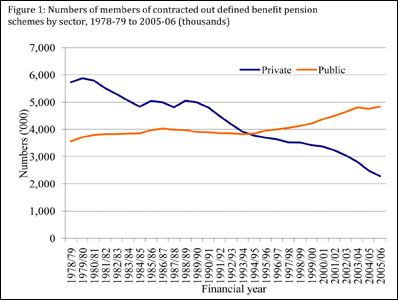
The IFS study examines not just trends in coverage by defined benefit plans in the public and private sector, but also what those pension plans are worth as part of the total remuneration package to employees in the public and private sectors.
These pension values differ between sectors for several reasons:
- First, most public sector workers are able to claim their pensions at an earlier date than workers in the private sector, which means that the accrual of extra pension rights is worth more to public sector workers.
- Second, public and private sector workers have different earnings profiles over the lifetime. Public sector male graduates, for example, typically have peak real earnings in their late 50s whereas private sector graduates’ earnings peak ten years earlier.
- Third, job tenures in the public sector are longer than in the private sector, and pension entitlements are typically easier to transfer between employers in the public sector than in the private sector.
What do these facts imply about the ‘worth’ of defined benefit pension plans to workers in the public sector relative to the private sector? The authors calculate the value of the additional future stream of pension benefits, relative to salary, for each additional year’s work (see Table 1).
ÂÂ

Not surprisingly, given the factors described above, these values are on average higher for workers in the public sector than in the private sector. So it is not just true that defined benefit pension coverage is higher in the public sector than the private sector, but those pensions are also worth more as a share of the total remuneration package.
These results add further information to the debate on levels of pensions in the public and private sector. But the authors also show that it is not just different degrees of ‘generosity’ in pensions that drive these differences in pension rights between sectors (such as in the age at which pensions can first be received).
Other differences are also important. For example, if public sector workers had shorter job tenures or the lifetime earnings profiles of private sector workers (for whom earnings peak earlier), final salary defined benefit plans would be far less attractive to public sector workers.
The authors conclude: ‘In comparing remuneration across sectors, we have to look at the whole remuneration package and at typical employment patterns, and not just focus on one component in isolation.’
ÂÂ


Paul Gray is an entrepreneur and digital publisher who creates online publications focused on solving problems, delivering news, and providing platforms for informed comment and debate. He is associated with HRZone and has built businesses in the HR and professional publishing sector. His work emphasizes creating industry-specific content platforms.
- Paul Gray

- Paul Gray
- Paul Gray
- Paul Gray