



There has been a lot of talking recently about Employee Experience. But what does it actually mean? How can you make sure that you are providing the right Employee Experience? With countless possible initiatives and opportunities to invest in, here is a methodical approach to ensure you deliver on what matters most.
Spoiler: It’s probably not a few more drinks at the Christmas party.
Not all employee experiences are created equal

Some things you do for your team have far greater and more durable impact than others. I believe that those experiences you give to employees when they’re under pressure (professional or personal), and how you treat them during times of stress are far more impactful than classic perks and company parties.
For example, individuals’ stress levels are very volatile during their first weeks at work. The support you provide in that time is very impactful to them.
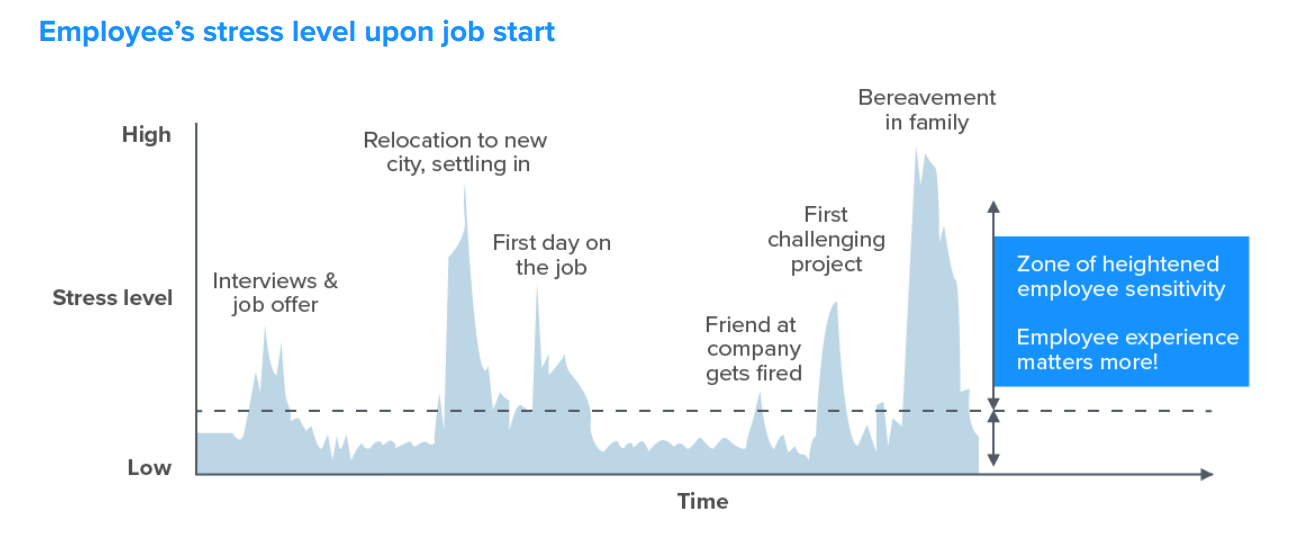
Of course, this does not only apply to new starters. Even long-tenured colleagues can have a setback at work (miss a promotion or lose a client), or, on the other side of the challenge spectrum, get promoted into a big new role. In all those cases, your support matters more than when they are at relative ease.
But not only professional challenges are opportunities to support your employees. Besides starting a new job, the other biggest sources of stress, across cultures, are death or serious illness in the family, divorce, moving house, and having a baby. Support and understanding from the employer can be a considerable factor for finding balance and being a valuable team member despite these challenges.
And it’s not just individual times of stress that are worth looking into. When the company goes through a rough patch (redundancies, revenue decline) or the country is in a pickle (Brexit, anyone?), people experience stress and uncertainty.
My advice is to identify those triggers of collective and individual stress and optimise your response towards them.
But how will you know which initiative is the most impactful?
I suggest a simple but effective way of measuring the effect of Employee Experiences.
Measure your Employee Experience with eNPS
(A detailed breakdown and explanation of this method can be found in our White Paper How to Measure Employee Experience).
The Employee Net Promoter Score (eNPS) is a metric that asks “How likely is it that you would recommend your employer to a friend as a company to work for?”
The respondent gives a score from 0 (very unlikely) to 10 (very likely). That’s it, 15-20 seconds spent and they’re done.
If you make it a habit of asking this question on a regular basis, you will be able to assess the impact of different initiatives you run. You can ask both collectively, or individually, after someone has had a stressful experience and you helped.
After measuring, you can compare which initiative has a bigger impact. You can be very specific and tweak the question based on the initiative you ran (“based on the recent Christmas party, how likely is it that you would recommend us to a friend as a company to work for?”)
Asking the question: “If we hadn’t done the Christmas party, what would have been your response to the question how likely you are to recommend us to a friend as a company to work for?” – that will help you establish a control group to compare against. You can supplement this by asking the eNPS question generically to other employees who did not attend the party or participate in the initiative.
And finally, yet another option is to simply ask your employees to rank the initiatives by their impact: “Over the last six months, we did A, B, C. Tell us which of these is the most likely to have you recommend us as an employer to your friends?”
One example of delivering outsized returns on Employee Experience
We at Benivo have researched the impact of a Welcome experience. Starting a new job is one of the most stressful events in someone’s career, and a small investment to make employees feel welcome can bring outsized returns.
We found that companies who put an effort into giving their new joiners a great Company Welcome end up with a 60% rise in their eNPS, which easily translates into an increase in Employer Brand appreciation.
Simply by asking the eNPS question after the fact, we found that the Company Welcome was a major point of leverage that companies can use to make their employees love them. The impact on retention, engagement, and productivity is significant.
Learn more about our research, and how you can implement it with your company in our Employee Experience White Papers Part 1, 2 and 3
The one thing you should do right this Christmas
It’s sometimes easier (and more fun) to spend more money on the Christmas party. But what impact will it make? Will the employees remember it? Will they feel more engaged with and more committed towards the company?
The answer is clear – measure it and find out how to optimize your budget, and get the best employee experience you can afford.
It turns out that, when the team feels well taken care of, one or two rounds of cheap mulled wine in the office is more than enough to awaken the festive cheer.

Nitzan Yudan, moved house 7 times, started a new job 10 times.
He is the CEO of Benivo, a company helping employers of choice make every relocating employee welcome, without breaking the budget. Clients include Google, Microsoft, Bloomberg, Vodafone, and Hertz.




