


Shanil Kaderali
Global Talent Acquisition, Strategy Leader at PierPoint Global
I’ve been agnostic over most of my career within corporate TA (Talent Acquisition) as to which is better (in-house TA teams vs. RPO hiring models) and would always respond: “Well, It depends.” I’d cite complexity of positions, volume, readiness for change, cost, etc. In most cases also, that’s the right answer. Now, I’m working in RPO, I still answer the same way.
The final decision on engaging a RPO model should be based on a well-articulated business case that outlines the business impact, costs, risks, challenges and expected outcomes which will give a TA/HR Leader the guidance for the best decision.
Let’s define Recruitment Process Outsourcing (RPO): the operational responsibility for one or more recruiting functions, from the client to a services provider where the provider essentially takes on the entire or part of role of the clients recruiting department. Pricing is based on the process, usually at volume rates that could be per hire or a monthly retainer.

Originally RPO was viewed as staffing and research but now it has evolved to the full cycle including everything from sourcing to onboarding supported by data management, applicant tracking systems and integrations to social media, mobile and for some, big data.
The RPO landscape:
It is estimated to be currently a £3.2B industry globally and growing. It is the fastest growing area of all HR outsourcing practices.
The big US players include: Right Thing (Acquired by ADP); Kenexa (Acquired by IBM); Pinstripe (Pure Play RPO only) as well as legacy staffing firms such as Adecco, Allegis, Futurestep and others. Some of the big UK players include Alexander Mann Solutions (AMS), Ochre House, Hays and others.
The RPO market is very dynamic and changing.
How do you decide to go RPO?
1) Define the business problems you are trying to solve
2) Compare your current model versus a RPO for your specific needs
3) Develop a cost-focused business case and then compare the baseline (current approach) to RPO models
Define your business problem:
Are you trying to solve for short-term turnover? Improve time-to-fill? Agency costs are too high?
There are examples of RPOs helping to solve the above problems. Hays saved £2m by reducing reliance on temp workers for a major investment bank. Right Thing (ADP), through a rigorous standardised hiring process reduced >90 day turnover for Wal-Mart from 54% to 30% in various regions.
After you define your problems, you should calculate the total cost of the problem as well. I’ve always included cost-of-turnover in my analysis. At a private US education firm, there was 48% turnover for teachers resulting in hiring 12,000 teachers at a cost at approx. £658 per teacher. It was also determined that 3% of parents didn’t renew due to the primary reason of teacher turnover which additionally resulted in over £3.2M in sales not renewed. This is a compelling problem. I encourage all TA/HR (talent acquisition and HR) leaders to work with their internal teams like finance to determine the cost of the problem.
Compare the models: When to use RPO? There are no absolutes here but we do see trends
Some of the key drivers to look at RPO include:
- Cost management
- Scalable solutions (especially with global growth)
- Demand for quality talent
There are generalities about the pros and cons. RPOs are generally known for being scalable, cost-effective, and for process standardisation with high volume replicable positions with end result being better hires. They represent the company as well but are not employees of the company and have multiple clients.
Examples include Retail, Finance, Call Centers and Health Care. Aberdeen Group research shows that 43% of Healthcare organisations worldwide are investing in RPO as a way to improve efficiencies, and stay compliant. Pinstripe hired over 4000 nurses in 2012.
There are exceptions – Starbucks and Chipotle are great examples of large volume retail hiring that have made investments in their in-house capabilities, yielding positive results. HSBC (Bank) lowered their agency costs by 60% a few years ago with an internal sourcing team.
With the need to globalise quickly, RPOs are good options. Some firms have strategic partnerships as observed by Pinstripe & Ochre House. Allegis with their global relationships/investments in Hayes & Talent 2 is another example.
When to not use RPO?
Again, no absolutes but having been a TA (Talent Acquisition) Leader, there are situations I have not entertained RPO:
• Complex, niche based positions (ex, Statisticians at senior levels)
• VPs and above (building an internal Exec Recruiting function – Apple & WellPoint are good examples)
• When the RPO provider has large clients in the same industry (how to determine loyalty?)
• When the RPO is not willing to put fees at risk if they don’t achieve Critical Service Level Agreement Metrics (SLAs)
Industries with strong internal employment brands and a strong established culture such as high tech in Silicon Valley tend to be hostile to RPO. Examples include Google, Facebook, Cisco, Disney, Bain Consulting – The culture just doesn’t align to RPO, or at least not yet.
Finally, the business case:
This provides a common point of measurement to compare service provider pricing to internal cost of providing the in-scope activities and should be an “apples-to-apples” comparison between service providers (generally with a moderate amount of “normalisation”). To clarify, I recommend the business case to be contrasted with multiple service providers, but the template should stay same.
Here is an example:
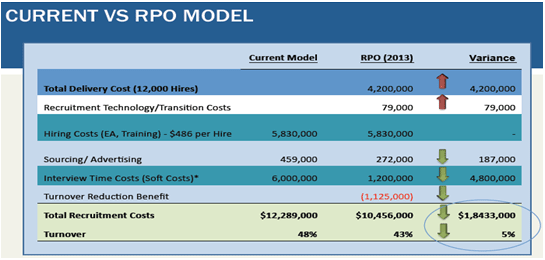
Figure 1
The example above (figure 1) is based on hiring 12,000 employees of the same role (replicable positions). Cost is quoted at £230 per hire and involves some transition expenses with technology. Hiring Costs (training, EA is administration – These are expenses you’ll incur with or without a RPO). There is an assumption that the firm is covering some level of sourcing which needs to be factored (lowering costs of job boards). In this case, it was estimated to reduce posting costs by 40%. Here, we factor in interview time for hiring managers as a soft cost. The RPO should reduce HM (Hiring Manager) time (in this case, HMs were doing the heavy lifting for screening).
Any RPO deal should have fees at risk negotiated. In this case, the goal was to reduce >90 turnover by 5% (the business problem to solve). If the RPO delivers on that promise, then that is 600 less hires with the turnover cost saved and should be factored. We call this a normalisation and here, a turnover reduction benefit.
Partner with your internal teams to get the right data. The variances will tell you about the costs. I’d compare over three years to determine if it really is a good idea. In this example, this company would save approx. £1.8M with a standardised process, technology it didn’t have prior and resources to interview candidates usually handled by the hiring manager. A compelling business case.
Also with RPO, if you bundle services into a pricing model, you have leverage. For large companies, while it’s not advisable to put all your eggs in one basket, synergy makes sense. It’s not just cost; it’s efficient to have one partner if the data is all in one place – This could apply in cases where the RPO is offering their applicant tracking system and/or offering Vendor Service Programs (VSP).
As stated, there are no absolutes (death, taxes and need for hiring great talent notwithstanding), a good business case will help guide your decision-making for RPO or not.

Pamela Flores is an events professional with experience at Symposium Events, a UK-based conference and events organization. She has worked in editorial and event coordination roles within the HR and expatriate management sector, contributing to the organization of major conferences including the Expatriate Management and Global Mobility conference. Her background spans online editorial work and events management within the professional conference industry.
- Pamela Flores

- Pamela Flores

- Pamela Flores

- Pamela Flores






