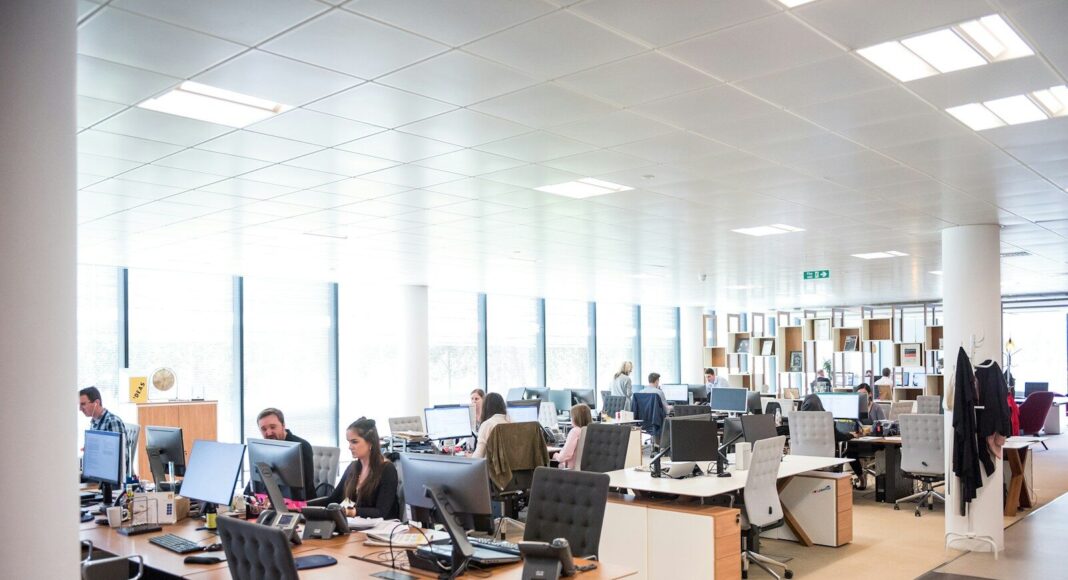
Three in five UK office workers say they work from home specifically to escape workplace noise, according to new research that suggests poor office acoustics are becoming a growing challenge for employers seeking to improve productivity and encourage staff back into the workplace.
A survey of 2,000 UK office workers found that employees lose an average of 26 minutes of productive time each day because of office noise. Nearly half of respondents said they would consider leaving their job as a result.
Younger employees appear to be particularly affected. Two-thirds of workers aged 18 to 24 described their workplace as noisy, compared with 47 percent of those aged over 55.
Office noise emerges as return-to-office challenge
The research, commissioned by acoustic design company Oscar Acoustics and conducted by polling firm Censuswide, found that 66 percent of job seekers consider noise levels and acoustic comfort when evaluating potential employers. It suggests that workplace design could become a more significant factor in recruitment and retention as organisations continue to encourage greater office attendance.

Employees also reported shortcomings in the physical office environment. Nearly a quarter of workplaces have no private or quiet spaces, while fewer than one in 10 employers have installed acoustic treatments during the past two years.
Ben Hancock, managing director of Oscar Acoustics, said younger workers were increasingly unwilling to tolerate distracting workplace environments.
“The data shows a clear generational shift. Younger workers are walking into offices that weren’t built for focused work, and they’re not prepared to put up with it. Employers who treat acoustic comfort as an afterthought will struggle to attract and keep talent.”
He said workplace acoustics should be viewed in the same way as other aspects of the office environment.
“Acoustic environment is as fundamental to a productive workplace as lighting or ventilation. With two-thirds of job seekers now factoring it into their decisions, and a £40 billion annual bill landing on UK businesses, the companies that invest in better acoustics will have a genuine advantage in a competitive graduate market.”
Retention and wellbeing concerns
The study found that 45 percent of workers would consider leaving their job because of workplace noise, suggesting the issue extends beyond productivity and may also affect employee retention.
Researchers estimated that poor acoustic design costs UK businesses more than £40 billion a year through a combination of lost productivity, staff turnover and customer dissatisfaction. The estimate is based on modelling that combines survey findings with external economic and workplace data.
The research also points to potential wellbeing concerns, particularly for employees who are sensitive to noise or require quiet environments to concentrate effectively. This includes many neurodivergent workers as well as those with hearing or visual impairments.
With employers continuing to invest in office refurbishments and workplace experience initiatives, it suggests that acoustics may become a more prominent consideration in efforts to improve attendance, engagement and employee satisfaction.
The survey involved 2,000 UK office workers who work in an office at least some of the time and was conducted in February.

William Furney is a Managing Editor at Black and White Trading Ltd based in Kingston upon Hull, UK. He is a prolific author and contributor at Workplace Wellbeing Professional, with over 127 published posts covering HR, employee engagement, and workplace wellbeing topics. His writing focuses on contemporary employment issues including pension schemes, employee health, financial struggles affecting workers, and broader workplace trends.
- William Furney

- William Furney
- William Furney
- William Furney