

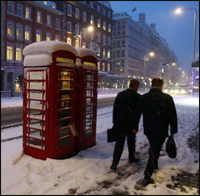
Heavy snow has fallen across most parts of the UK, bringing disruption to millions of people trying to get to work.
The snow and icy cold conditions fell across much of England and Wales overnight, with the band moving to central and southern areas. The snow has eased in Scotland and Northern Ireland, but warnings over icy roads and pavements have been issued.
One in five Scottish employees failed to make it to work after snow blizzards and freezing temperatures closed schools and caused transport chaos – forcing staff to stay at home. That time off would have cost Scottish firms up to £25.8 million, the Forum of Private Business (FPB) said, with a similar story expected today, after forecasters warned the weather was set to get worse.

East Lothian witnessed the highest snowfall, at Nunraw Abbey, near Haddington, where Met Office experts said 43cm (17in) had collected since Friday. Official snowfalls of 9cm, 8cm and 18cm were recorded at Edinburgh, Glasgow and Aberdeen respectively, although reports suggested far more had fallen in parts of the cities.
Hundreds of schools are closed and driving conditions hazardous, as the UK endures the earliest widespread snowfall since 1993.
The Met Office has issued severe weather warnings for almost every part of the UK, bar south-west England, and western and southern parts of Wales.
Up to 5cm (2in) of snow fell in the north of England overnight, with North Yorkshire, Lincolnshire and Merseyside all experiencing heavy and persistent flurries.
Birmingham and parts of Gloucestershire and Sussex also experienced snowfalls as the band of snow headed south.
Temperatures in the Scottish Highlands dropped to -15C (5F) overnight, with forecasters predicting that daytime temperatures would struggle to get above zero due to the bitter wind chill.
The unusual weather is being caused by high pressure over Greenland and low pressure in the Baltic states, forcing cold winds from the north-east across Europe.
‘The very low overnight temperatures we have seen are likely to be repeated through the coming week as the cold and snowy weather continues,’ said the Met Office chief forecaster Steve Willington.
‘As winds increase into next week, it will feel increasingly cold with a significant wind chill to contend with by day and night.’
British airports have also succumbed to the snow as Newcastle, Glasgow and Edinburgh Airport reported disruption.




