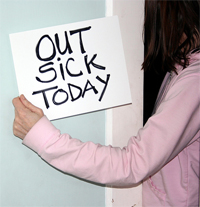
 Sickies’ to become much harder to take thanks to new technologies
With Monday 6th February named as the day that UK employees are most likely to ‘pull a sickie’, new research suggests that it is going to become increasingly difficult to pull the wool over the boss’ eyes and take a false sick day in the future. The study by leading office recruitment agency Office Angels, compiled to mark the company’s 25th anniversary, shows that workers expect technology to put a stop to the practice as bosses will be better able to keep an eye on staff.
More than a third (35%) of those surveyed think that ‘pulling a sickie’ will get more difficult as bosses will be able to make facetime calls with staff. Those in the North are particularly convinced that this is the case – especially in the North East (43%) and N. Ireland (44%) – while those in the East are most likely to think they can get away with skipping work, with just 28% predicting an end to unnecessary days off.
Different industries also have different views on the issue, with almost half of those working in arts and culture (50%), sales and marketing (48%) and in HR (46%) feeling that ‘pulling a sickie’ will get more difficult, while just 13% of those in the legal sector agree. Older people are also most likely to say that it will become more difficult to call in sick without good reason, with 46% of those aged 55+ saying they agree with the statement.

David Clubb, Managing Director of Office Angels, said, “Days off sick cost the economy billions of pounds every year, and when they are taken falsely, it can point to a deeper problem with morale. While technological advances may mean that staff feel less able to ‘pull a sickie’, we don’t expect an Orwellian world where employers can monitor every move. The most effective way for businesses to tackle this problem is to ensure that all their staff feel included in the organisation, understand what it represents, and are passionate about what it’s trying to achieve. At the end of the day, sick days should only be taken when a person is genuinely too ill to work.”

Pamela Flores is an events professional with experience at Symposium Events, a UK-based conference and events organization. She has worked in editorial and event coordination roles within the HR and expatriate management sector, contributing to the organization of major conferences including the Expatriate Management and Global Mobility conference. Her background spans online editorial work and events management within the professional conference industry.
- Pamela Flores

- Pamela Flores
- Pamela Flores
- Pamela Flores