
Gender pay gaps remain entrenched across the UK, with large differences in hourly earnings persisting in many towns and cities despite years of reporting requirements and policy focus.
Women working full time continue to earn less per hour than men on average in most major urban areas, with some locations reporting particularly wide disparities that far exceed the national picture.
These gaps are not confined to specific sectors or regions but are spread across a wide range of local economies, including some of the country’s largest employment hubs.
A new analysis of Office for National Statistics data by Ciphr, an HR and payroll software provider, found that 88 percent of large towns and cities have a gender pay gap, and in more than half of cases the gap is at least 7 percent in favour of men.

Pay disparities vary widely across UK towns
Bracknell in Berkshire recorded the widest gap at 26.5 percent, meaning women earn the equivalent of 73p for every £1 earned by men. The difference translates into around £14,065 a year in median gross earnings. Farnborough followed with a gap of 25.2 percent, while Portsmouth ranked third at 22.1 percent.
Other areas with significant gaps include Stockport at 19.3 percent, Tynemouth at 19.1 percent, and Telford at 19 percent. Crawley and Derby both recorded gaps of 18.9 percent.
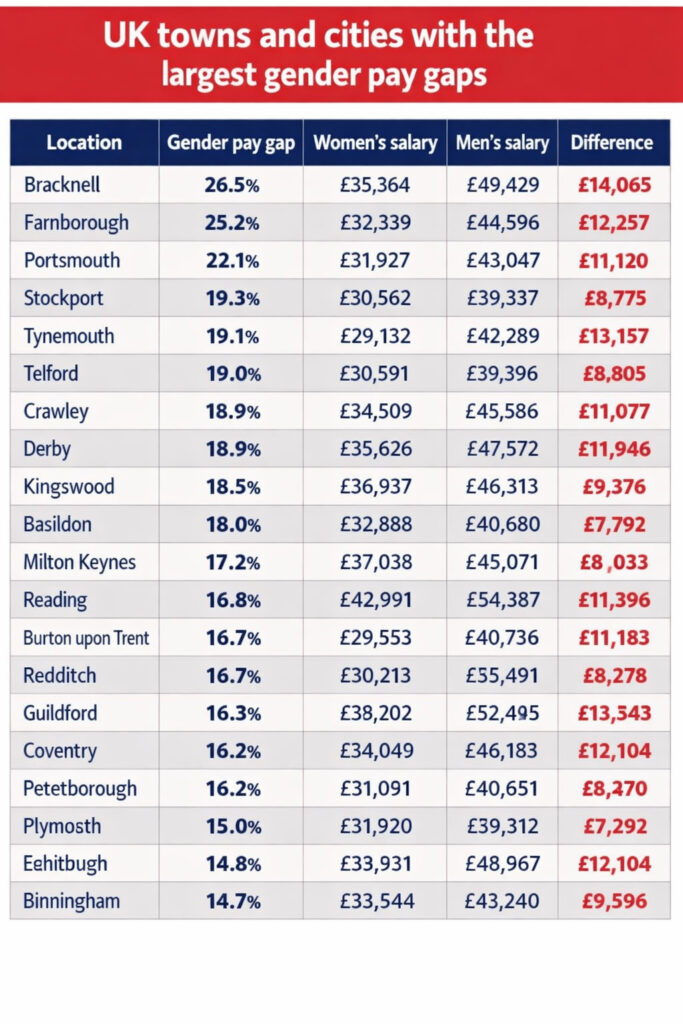
While some towns reported near parity or small gaps favouring women, including Wolverhampton and Newport, these areas often had lower overall salary levels for both men and women, suggesting that smaller gaps do not necessarily reflect stronger pay outcomes.
Higher paying locations were not immune. London, Reading and Cambridge recorded some of the highest salaries for women, yet all still showed gender pay gaps, reflecting broader trends across the labour market where men typically out earn women in most industries.
Local economies and workforce patterns shape pay disparities
Claire Hawes, chief people and operations officer at Ciphr, said the figures showed the issue was deeply rooted in local labour markets and required sustained employer action. “These findings are just another reminder that the gender pay gap isn’t just a national statistic. It’s a very real, local issue affecting women’s livelihoods in communities across the UK.
“That so many industries and job roles have a gender pay gap is incredibly disappointing and is an important flag for employers. It highlights that organisations must continue to critically evaluate their own gender pay gap and focus their efforts on what they can do within their own business to reduce embedded salary discrepancies, and ensure people are fairly rewarded for the value they bring.
“The onus is on all employers to be part of the solution, not part of this problem. Behind every percentage point in these figures is a real woman, taking home significantly less than her male colleague. These aren’t just stats these are real people and real inequalities.”
Industry, childcare and culture drive regional gaps
Ann Allcock, head of diversity at Ciphr, said differences between locations were largely shaped by industry mix and workforce patterns. “A key driver is likely to be the type, size and concentration of the industries present, and the number of workers they employ.”
She said gaps tended to be wider in higher-paying sectors and roles with clear gender imbalances. “Gaps are usually larger among higher-paying businesses, those with clearly delineated gender roles such as more men working in construction and STEM occupations or those with a high proportion of consistently undervalued roles.”
She also pointed to childcare access and social expectations as key factors affecting women’s earnings. “Another important factor influencing pay gaps across towns and cities is the lack of access to affordable childcare, which translates into the ‘Motherhood Penalty’.”
Allcock said cultural expectations and structural barriers continued to limit progression. “Local or regional cultural norms that support traditional gender roles and tend to view women as secondary earners can also drive up pay gaps in favour of men, as these impact women’s career progression and promotion opportunities, and salary levels.”
Steps employers can take to address disparities
Employers are being urged to take a more proactive approach to tackling pay inequality within their organisations. Recommended actions include conducting regular equal pay audits, reviewing starting salaries and bonus structures, and ensuring that promotion pathways are fair and transparent.
Experts say expanding flexible working and parental leave options for all employees, alongside reviewing recruitment practices for bias, may also help to reduce long-standing disparities.
The research compared more than 150 of the UK’s most populated towns and cities using 2025 data from the Office for National Statistics, focusing on median gross annual earnings and average hourly pay differences between men and women.

William Furney is a Managing Editor at Black and White Trading Ltd based in Kingston upon Hull, UK. He is a prolific author and contributor at Workplace Wellbeing Professional, with over 127 published posts covering HR, employee engagement, and workplace wellbeing topics. His writing focuses on contemporary employment issues including pension schemes, employee health, financial struggles affecting workers, and broader workplace trends.
- William Furney

- William Furney
- William Furney
- William Furney