

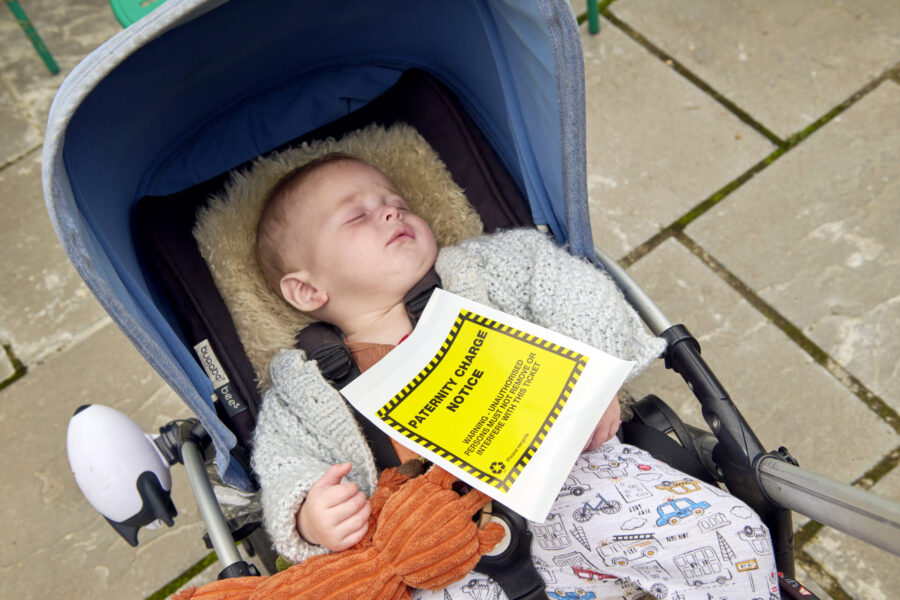
Hundreds of fathers have taken to the streets to protest against what they call the “pittance” of statutory paternity pay, issuing spoof “Paternity Charge Notices” in towns and cities across the UK.
The protest, organised by campaign group The Dad Shift and supported by men’s health charity Movember, saw new fathers place yellow tickets resembling parking fines on prams, nappies and formula tins at more than 50 locations on Tuesday to draw attention to the soaring cost of a child’s first year and the lack of financial support for parents.
Campaigners say the current rate of statutory paternity pay — £374.36 for two weeks — leaves many families struggling to cover basic expenses. The figure equates to less than half the minimum wage and, according to organisers, “not even enough to buy the average pram”.
Financial pressure and family impact
Polling commissioned by The Dad Shift and Movember found that 61% of new fathers said the pressure to provide financially had affected their mental health, while 51% reported an impact on their physical wellbeing.

Almost two-thirds said their families had struggled under the pressure when a new baby arrived, and 57% said financial insecurity had influenced their decision not to have more children.
For some, the effects have been life-changing.
One father, self-employed landscaper Tom Windle from Wiltshire, said he was forced into debt after taking unpaid time off following his wife’s emergency caesarean. The debt took seven years to repay and, at the time, he said the financial stress drove him to a suicide attempt.
Another parent, Dan Whiteway from Newbury, said he had taken two weeks’ statutory leave and then used annual leave to extend his time at home, making finances tight. His partner developed post-traumatic stress disorder after a difficult birth, and he said the short leave period left them both without support.
“As a family, we weren’t ready for me to go back to work, but I couldn’t take any more time off. My partner had a traumatic experience during childbirth and was subsequently diagnosed with PTSD,” he said.
“But in those four weeks it’s just survival mode, isn’t it? So we hadn’t made a start on getting her the support she needed. And I didn’t get the chance to properly come to terms with what I witnessed.”
Calls for urgent reform
Dad Shift co-founder George Gabriel said the campaign was designed to show how disconnected the UK’s policies had become from the real cost of living.
“£374.36 might be enough for a weekend getaway, but to meaningfully help with the costs when a new baby arrives? Ridiculous,” he said. “And that without mentioning the self-employed dads who don’t get a penny.”
He said “[w]orking fathers and non-birthing partners pay their share, yet when a new baby arrives there’s next to nothing left to help with costs that have skyrocketed in recent years.”
And he added that the “responsibility to provide is one we take really seriously as dads. But with zero support, the pressure it comes with is wrecking people’s health just when their families need them. No wonder more than half of dads are put off having more kids by the risk of financial insecurity.”
The group wants statutory paternity leave extended and paternity pay raised to a meaningful level to allow fathers to spend more time supporting partners and bonding with their babies. Currently, self-employed fathers are not entitled to any paternity pay.
Research by The Dad Shift shows that statutory paternity pay has increased by just 23% in five years, while the cost of essentials such as formula milk has risen more than 25% in half that time. Prices of nappies and wipes have increased by between 20% and 37% in just 12 months.
Political and health support
Movember, which has supported the campaign as part of its broader men’s health work, said improving paternity provision should be central to the government’s forthcoming men’s health strategy.
Amy O’Connor, Movember’s director of policy and advocacy, said supporting fathers to bond with their families was vital for both men’s wellbeing and family stability.
“For too many years, policy that supports men’s health has been relegated to the sidelines,” she said. “Supporting fathers to bond with their family is not only beneficial to the health of men but also the wider family too.”
She said Movember was “calling for increased paternity leave as part of this government’s commitment to improving men’s health alongside the upcoming men’s health strategy”.
Labour MP Luke Charters, who represents York Outer, said he understood fathers’ frustration with “the worst paternity leave in Europe”. He said Labour’s expansion of free childcare would ease the burden on working parents, but more reform was needed.
“I’m a dad and I get it,” he said. “Fathers have every right to be frustrated…”
Amanda Martin, Labour MP for Portsmouth North, said she welcomed Labour’s plans to support working families but insisted more reform was needed to fix long-standing failures on paternity leave.
“Labour’s huge expansion of free childcare hours, in addition to free breakfast clubs, is a massive financial boost to working families, but we know we’ve got to go further.
“I’m looking forward to Labour’s review of parental leave, to fix years of Tory failure around this country’s terrible paternity leave offer.
“I have three sons, and I hope that when they become fathers, all dads will have the support of the government to play a much more active role in their children’s early years, and support their partners much better through postpartum.”
A movement gathering momentum
The Dad Shift describes itself as a group of men and parents campaigning for better paternity leave in the UK. Its latest act marks the start of what organisers call a “national reckoning” on how fatherhood is supported.
The group argues that the UK’s limited provision not only undermines family wellbeing but also reinforces gender inequality by placing the entire early childcare burden on mothers.
The campaign’s satirical notices, plastered on park benches, baby shops and buggies, read: “Costs for so many things have soared in the past few years, but the country’s paternity leave system remains stuck in the past.”
The message, organisers say, is about more than money. It is about recognising that fathers and partners play a crucial role in a baby’s first weeks, and that giving them time to do so is an investment in the nation’s mental health, equality and family resilience.
As the yellow “Paternity Charge Notices” continue appearing in towns and cities, campaigners hope the stunt will do more than raise smiles. They want it to raise the political stakes, and finally put fair paternity leave on the government’s agenda.

William Furney is a Managing Editor at Black and White Trading Ltd based in Kingston upon Hull, UK. He is a prolific author and contributor at Workplace Wellbeing Professional, with over 127 published posts covering HR, employee engagement, and workplace wellbeing topics. His writing focuses on contemporary employment issues including pension schemes, employee health, financial struggles affecting workers, and broader workplace trends.
- William Furney

- William Furney

- William Furney

- William Furney






