Recently a new corporate governance code has been published aimed at improving trust in UK businesses, including looking at how companies engage with their staff. The new code will apply from the start of next year, however businesses do have the option to ‘opt out’ if they wish.
In the wake of this, and other news surrounding recent gender pay gap scandals, it is vital that UK businesses address issues surrounding trust in the workplace. Trust plays a pivotal role in employee engagement and the running of a successful business.
A recent survey found that 95 per cent of senior management are confident that they are trusted by their staff, but research of 2,000 UK employees discovered that in fact only 16 per cent of people trust senior management at the companies they work at.
In the research carried out by Virtual College, employees rated their trust in different roles in the following order:

- Co-workers – 57 per cent
- Managers – 45 per cent
- Team members – 42 per cent
- Senior management – 16 per cent
Trust in senior management was found to be considerably lower than trust in other positions such as middle management. The sectors that trusted senior management the least included; utilities (3 per cent), legal (8 per cent) and government services (8.7 per cent).
Building a culture of trust in the workplace
Nearly half (44 per cent) of employees felt that improving workplace trust would help to improve happiness in their roles. It was found that this would particularly boost staff working in the entertainment (55 per cent), healthcare (53 per cent), and social care sectors (52 per cent).
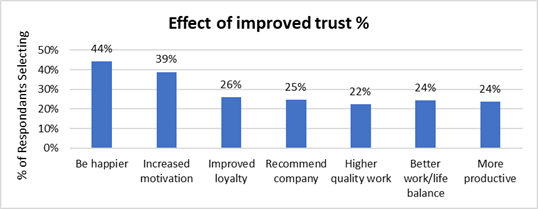
Improvements in communication (52 per cent) and regular catch ups (40 per cent) were considered the best ways by employees for management to improve trust in the workplace. Communication from management was also considered particularly important in the education (57 per cent) and healthcare sectors (59 per cent).
In an increasingly digital world, it comes as no surprise that employees are looking for further communication from senior figures in a business. It is this lack of communication which is likely to have contributed to the results discovered in the research, as employees typically have more regular points of contact with other members of staff and this communication is integral to building trust.
Virtual College commented on the findings of the research, “It can be difficult for businesses to create a culture which is open and trusting. Navigating the different elements of trust in the workplace in a modern environment can be tricky, however the benefits of improving trust can be hugely rewarding to a business. Improving trust can help to boost productivity and employee satisfaction, which both ultimately impact on the performance of a business.
“Our research has also shown that communication is a key factor when looking to improve trust and it is clear that employees are keen to see more interaction with senior management in particular.”

Rebecca joined the HRreview editorial team in January 2016. After graduating from the University of Sheffield Hallam in 2013 with a BA in English Literature, Rebecca has spent five years working in print and online journalism in Manchester and London. In the past she has been part of the editorial teams at Sleeper and Dezeen and has founded her own arts collective.
- Rebecca Clarke

- Rebecca Clarke
- Rebecca Clarke

- Rebecca Clarke