

 There is the perception amongst some that British workers take too much time off work sick, but there is little in the way of hard facts about sick leave in the UK. A new study commissioned by a leading HR software provider seeks to establish the truth about when, why and how often the British public calls in sick to work.
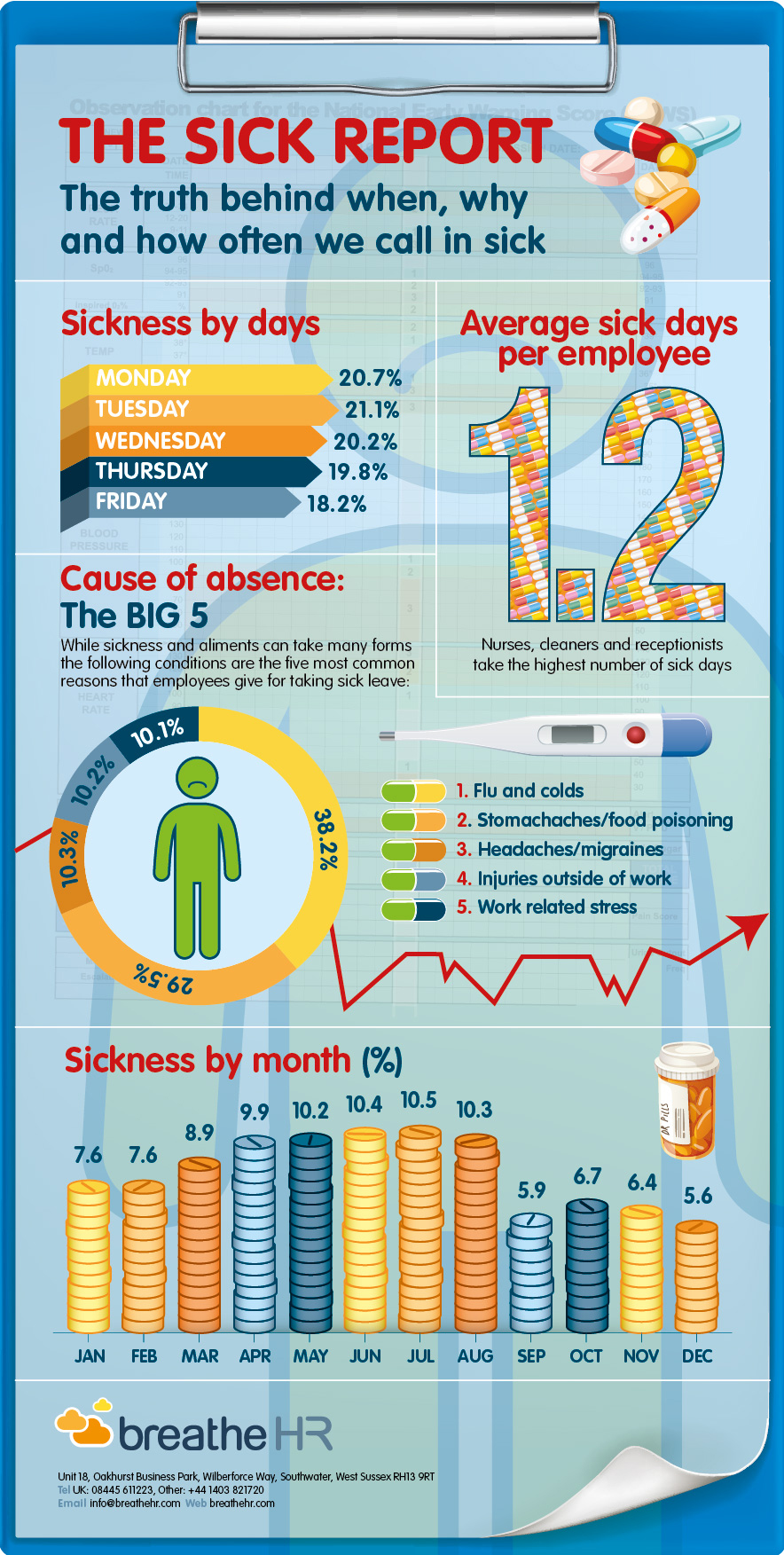
The below infographic, compiled by breatheHR and based on over 15,000 sick days taken by employees at small to medium sized companies across the UK, illustrates that Britons actually only call in sick on average just over once a year. This contrasts starkly with PwC’s assertion that the national average stood at 9 days, perhaps highlighting a worrying trend at larger companies.
Unsurprisingly, those exposed to illness and disease such as nurses take the most number of sick days alongside receptionists and cleaners, themselves working in sometimes unsanitary conditions.
Things get interesting when looking at when employees call in sick. Bosses should brace themselves for quiet workplaces on Tuesday mornings, with 21.1% of all sick days being taken on the second day of the week. Perhaps unsurprisingly, our health gradually improves as the weekend approaches. It is heartening to discover that Mondays see less people calling in sick, pointing to a valid illness rather than the effects of a heavy weekend.

The summer month of July sees 10% of all annual sick leave taking place, suggesting that long evenings in the park or on the beach may take their toll on Britain’s workforce the following day. Vitamin D is reported to have immune-boosting properties so it’s tempting to be sceptical about the summer sickness figures overall, with June and August also registering over 10% of days off sick. Surprisingly, the autumn and winter months see the lowest number of sick days being taken, an average of around 6% in effect between September and February.
When taking into account the how, results are to be expected, with flu and colds being given as the main reason for taking the day off. Stomachaches and food poisoning come a close second. Work related stress alarmingly accounts for around 10% of all sickness. Indeed, a study conducted by HSE found that over 35% of mental illness in the UK is caused by ‘factors intrinsic to the job’.
The statistics from breatheHR’s research are as follows:
- Flu and colds 38.2%
- Stomach aches/food poisoning 29.5%
- Headaches/migraines 10.3%
- Injuries outside of work 10.2%
- Work related stress 10.1%
The figures overall are certainly encouraging for SME bosses and point to a collection of employees that appear to genuinely want to give their all for the companies they work for. Workers within a small team perhaps feel that if they take unnecessary sick days they would be letting the side down, hence the low national average of 1.2 per annum.




