<

!Google ads have two elements of code. This is the 'header' code. There will be another short tag of code that is placed whereever you want the ads to appear. These tags are generated in the Google DFP ad manager. Go to Ad Units = Tags. If you update the code, you need to replace both elements.> <! Prime Home Page Banner (usually shows to right of logo) It's managed in the Extra Theme Options section*> <! 728x90_1_home_hrreview - This can be turned off if needed - it shows at the top of the content, but under the header menu. It's managed in the Extra Theme Options section * > <! 728x90_2_home_hrreview - shows in the main homepage content section. Might be 1st or 2nd ad depending if the one above is turned off. Managed from the home page layout* > <! 728x90_3_home_hrreview - shows in the main homepage content section. Might be 2nd or 3rd ad depending if the one above is turned off. Managed from the home page layout* > <! Footer - 970x250_large_footerboard_hrreview. It's managed in the Extra Theme Options section* > <! MPU1 - It's managed in the Widgets-sidebar section* > <! MPU2 - It's managed in the Widgets-sidebar section* > <! MPU - It's managed in the Widgets-sidebar section3* > <! MPU4 - It's managed in the Widgets-sidebar section* > <! Sidebar_large_1 - It's managed in the Widgets-sidebar section* > <! Sidebar_large_2 - It's managed in the Widgets-sidebar section* > <! Sidebar_large_3 - It's managed in the Widgets-sidebar section* > <! Sidebar_large_4 - It's managed in the Widgets-sidebar section* > <! Sidebar_large_5 are not currently being used - It's managed in the Widgets-sidebar section* > <! Bombora simple version of script - not inlcuding Google Analytics code* >

Study reveals when, why & how often Britons call in sick

-

There is the perception amongst some that British workers take too much time off work sick, but there is little in the way of hard facts about sick leave in the UK. A new study commissioned by a leading HR software provider seeks to establish the truth about when, why and how often the British public calls in sick to work.

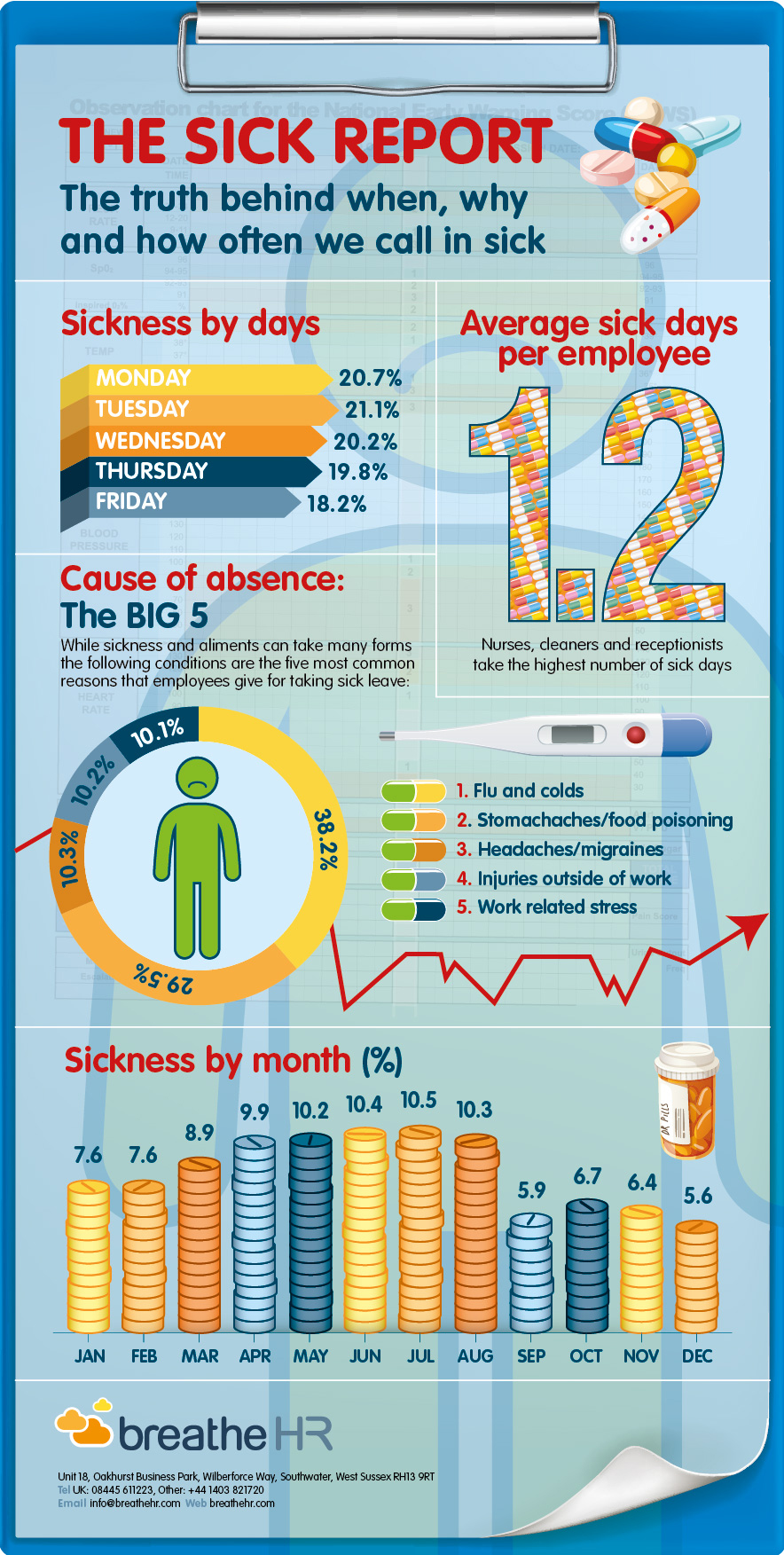
The below infographic, compiled by breatheHR and based on over 15,000 sick days taken by employees at small to medium sized companies across the UK, illustrates that Britons actually only call in sick on average just over once a year. This contrasts starkly with PwC’s assertion that the national average stood at 9 days, perhaps highlighting a worrying trend at larger companies.

Unsurprisingly, those exposed to illness and disease such as nurses take the most number of sick days alongside receptionists and cleaners, themselves working in sometimes unsanitary conditions.

Things get interesting when looking at when employees call in sick. Bosses should brace themselves for quiet workplaces on Tuesday mornings, with 21.1% of all sick days being taken on the second day of the week. Perhaps unsurprisingly, our health gradually improves as the weekend approaches. It is heartening to discover that Mondays see less people calling in sick, pointing to a valid illness rather than the effects of a heavy weekend.

The summer month of July sees 10% of all annual sick leave taking place, suggesting that long evenings in the park or on the beach may take their toll on Britain’s workforce the following day. Vitamin D is reported to have immune-boosting properties so it’s tempting to be sceptical about the summer sickness figures overall, with June and August also registering over 10% of days off sick. Surprisingly, the autumn and winter months see the lowest number of sick days being taken, an average of around 6% in effect between September and February.

When taking into account the how, results are to be expected, with flu and colds being given as the main reason for taking the day off. Stomachaches and food poisoning come a close second. Work related stress alarmingly accounts for around 10% of all sickness. Indeed, a study conducted by HSE found that over 35% of mental illness in the UK is caused by ‘factors intrinsic to the job’.

The statistics from breatheHR’s research are as follows:

  • Flu and colds 38.2%
  • Stomach aches/food poisoning 29.5%
  • Headaches/migraines 10.3%
  • Injuries outside of work 10.2%
  • Work related stress 10.1%

The figures overall are certainly encouraging for SME bosses and point to a collection of employees that appear to genuinely want to give their all for the companies they work for. Workers within a small team perhaps feel that if they take unnecessary sick days they would be letting the side down, hence the low national average of 1.2 per annum.

Latest news

Turning Workforce Data into Real Insight: A practical session for HR leaders

HR teams are being asked to deliver greater impact with fewer resources. This practical session is designed to help you move beyond instinct and start using workforce data to make faster, smarter decisions that drive real business results.

Bethany Cann of Specsavers

A working day balancing early talent strategy, university partnerships and family life at the international opticians retailer.

Workplace silence leaving staff afraid to raise mistakes

Almost half of UK workers feel unable to raise concerns or mistakes at work, with new research warning that workplace silence is damaging productivity.

Managers’ biggest fears? ‘Confrontation and redundancies’

Survey of UK managers reveals fear of confrontation and redundancies, with many lacking training to handle difficult workplace situations.
- Advertisement -

Mike Bond: Redefining talent – and prioritising the creative mindset

Not too long ago, the most prized CVs boasted MBAs, consulting pedigrees and an impressive record of traditional experience. Now, things are different.

UK loses ground in global remote work rankings

Connectivity gaps across the UK risk weakening the country’s appeal to remote workers and internationally mobile talent.

Must read

Introducing right to rent: The implications for HR

With the new right to rent law that requires all landlords to check the eligibility of tenants to be in the UK coming into force on February 1st, Saunders 1865 the VIP relocation company, is offering advise to confused companies.

Laura Varley: Getting a creative MBA without a degree

Every day between 9am and 5pm, you dream of having that job you’ve always wanted. As proven by many, it’s never too late to pursue your dreams, and acquiring an executive MBA for the creative industries can help you achieve them.
- Advertisement -

You might also likeRELATED
Recommended to you

Exit mobile version