

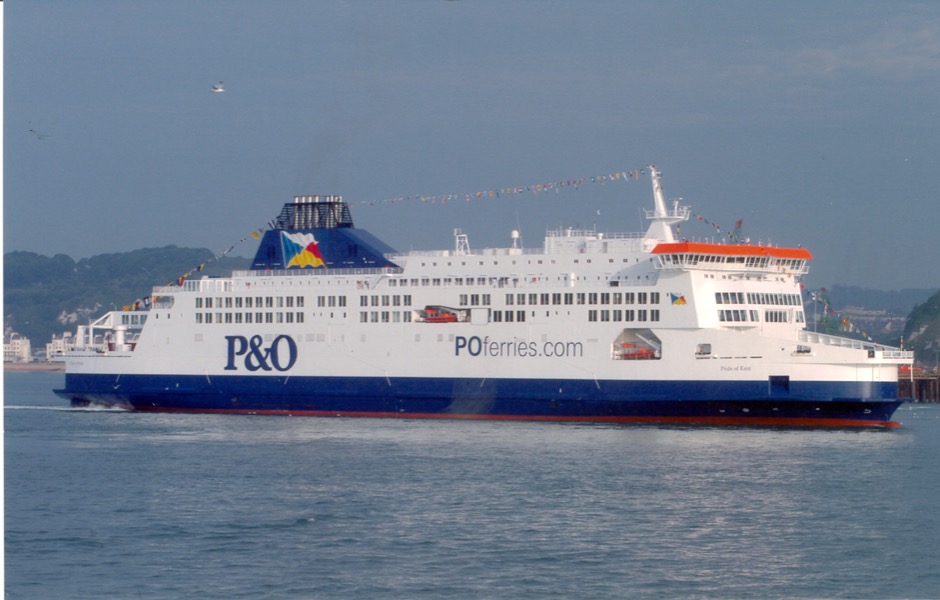
P&O Ferries has come under scrutiny for allegedly paying some crew members less than half of the UK minimum wage, exploiting a legal loophole that the British government vowed to close two years ago.
According to an analysis conducted by the Guardian and ITV News, agency workers at P&O Ferries, owned by Dubai-based DP World, have been receiving wages as low as £4.87 per hour.
These low-cost crew members, primarily from countries such as India, the Philippines, and Malaysia, are reportedly working gruelling 12-hour shifts without a day off for months at a time on the Dover to Calais route.
Describing the experience as akin to being in “jail,” one worker lamented the mental stress of the relentless cycle of work and sleep.

Transport Secretary Grant Shapps, who denounced P&O’s actions in 2022 as akin to “pirates of the high sea,” had pledged to legislate to improve pay for cross-Channel ferry workers. However, despite promises, the UK government has yet to deliver legally binding pay rates equivalent to the national minimum wage.
Maritime agency workers have less legal salary entitlements
While the UK minimum wage currently stands at £10.42 per hour, slated to rise to £11.44 per hour from April onwards, these rates do not apply to maritime workers employed by overseas agencies working on foreign-registered ships in international waters.
The French government is poised to respond to P&O’s actions by introducing legislation requiring cross-Channel operators to pay their workers at least the French minimum wage, which is set at €11.65 (£9.95) per hour.
Opposition figures, including Shadow Transport Secretary Louise Haigh, have criticised the government’s inaction, asserting that exploitative employment practices at sea cannot be allowed to continue.
Despite assurances from P&O Ferries that they adhere to minimum wage requirements, payslips obtained by the Guardian and ITV News suggest otherwise. Crew members are allegedly being paid below the company’s claimed lowest rate of £5.15 per hour, with an average hourly rate of £4.87 on recent payslips.
Also, it has been revealed that all payslips were issued by a Maltese recruitment business to workers from distant countries.
Ferry workers are vulnerable to exploitation
The promised legislative measures to ensure ferry operators pay rates equivalent to the UK minimum wage have yet to materialise, leaving cross-Channel ferry workers vulnerable to exploitation.
In response to inquiries, P&O Ferries reiterated their commitment to complying with national and international laws regarding minimum wage payments. They emphasised their efforts to ensure the welfare and well-being of their crew members.
The Department for Transport assured that measures were being swiftly enacted, with the Seafarers’ Wages Act expected to come into force in the summer, coinciding with similar legislation in France, establishing an international minimum wage corridor across the Dover Strait.

Amelia Brand is the Editor for HRreview, and host of the HR in Review podcast series. With a Master’s degree in Legal and Political Theory, her particular interests within HR include employment law, DE&I, and wellbeing within the workplace. Prior to working with HRreview, Amelia was Sub-Editor of a magazine, and Editor of the Environmental Justice Project at University College London, writing and overseeing articles into UCL’s weekly newsletter. Her previous academic work has focused on philosophy, politics and law, with a special focus on how artificial intelligence will feature in the future.
- Amelia Brand

- Amelia Brand
- Amelia Brand
- Amelia Brand









