

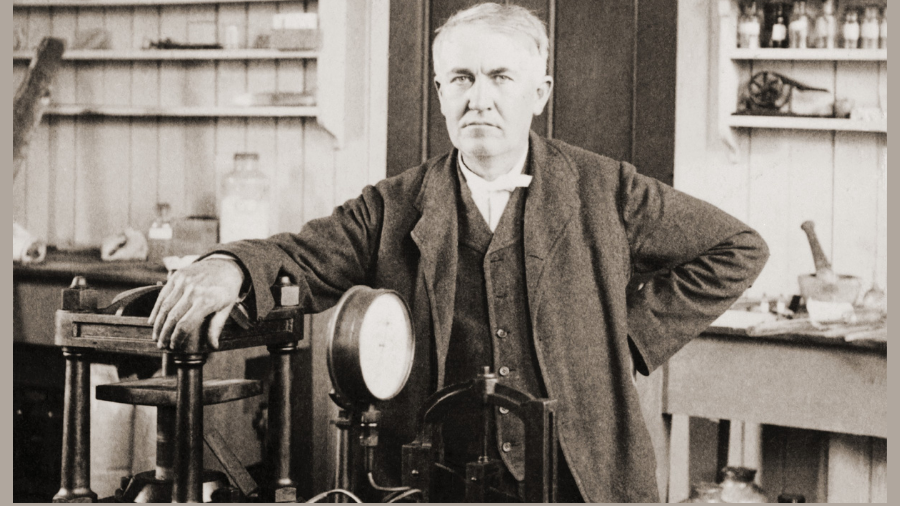
It has been exactly a hundred years since the job interview was started by the inventor of the alkaline storage battery, movie camera and the lightbulb – Thomas Edison.
In 1921, being a genius and frustrated with the university graduates who would ask him for a job, he developed a general knowledge test.
The questions were a mix of literature, history, geography, with some related directly to the job available.
Smithsonian reports only 7 percent of applicants could pass the 146 question quiz.

Newspapers of the time reported Edison’s new method of eliminating candidates, which led to more companies using questionnaires. Eventually, the process evolved into the system most firms use today.
To commemorate HRreview did a Q & A with General Manager EMEA & APAC at HireVue, Darren Jaffrey to see how much has changed.
He suggests using technology to make communications easier with candidates as well as streamlining recruitment processes.
How did job interviews start?
Thomas Edison introduced a screening process to help him select the most qualified and capable employees. Candidates had to complete a monstrous pre-employment quiz and it asked them a bizarre series of questions with no bearing on their ability to perform the jobs at hand. The questions included, ‘who invented logarithms?’, ‘how far is it from New York to Liverpool?’ and ‘where do we get domestic sardines?’.
The test was so notorious that the New York times panned it as “a test of a man’s memory and store of miscellaneous information, rather than of his knowledge, reasoning power or intelligence.”
Even Albert Einstein couldn’t pass the test, when it was put to him by New York Times reporters.
What is the best way to find a candidate that suits you?
When starting the interview process, organisations must ensure that job descriptions are clear and explanatory about the required skills.
Traditionally, hiring teams attempted to uncover candidate competencies through a combination of CVs and interviews. But CVs offer a very limited amount of information by which to judge a candidate’s abilities. University grades, other qualifications, and past work experiences may reveal little to nothing about their potential.
Instead, it’s more critical to look at the competencies that predict success in a new world of work. Three key qualities to look for in potential employees are the ability to learn quickly, soft skills such as collaboration and emotional intelligence, and the ability to work independently, particularly as remote working becomes the norm.
According to future of work expert Jeanne Meister, collaboration, cultural IQ, and emotional intelligence will be the skills most needed for future roles; and the industry or job a candidate has worked in previously may have no bearing on whether or not they have these skills. The right set of soft skills – or what Meister calls “power skills” – allow teams to innovate, solve problems, and execute ideas, while technical skills can be trained.
Is the personality of a candidate still important or is it their work – considering so many people work remotely now?
Being able to meet the challenges of a new role and produce good work will always be a core capability. But personality is still important when hiring candidates, whether they will be working remotely or not.
There are a number of personality traits that hiring teams should look for in employees who will be working from home either some or all of the time. These include:
-
Self motivation: A key trait for any successful work from home employee. Beyond hard skills, you need to find talent who are self-motivated and able to perform and learn on their own.
-
Conscientiousness: Your most valuable employees are the ones with the most self awareness. That’s partly because conscientious employees and candidates are the ones who can make the remote work situation work for themselves. These individuals can blend their personal and professional lives under one roof.
-
Work ethic: In the new normal this is all about dependability and having the ability to bring results-driven work to an organisation.
-
Independence: The biggest change in the COVID-era workplace isn’t whether or not a candidate can perform their job. It’s whether or not they can take on the personal challenge of merging their lives and careers – and do it independently while supporting the overall goals of your organisation.
-
Adaptability/openness: The ideal work from home candidates are the ones who can balance personal and professional lives under one roof, while learning the processes and procedures of a new company.
What can HR teams do to ensure candidates are wowed by their companies and want to work there after the interviews?
Candidate experience of an employer is a direct indicator of how much a company values its employees. This is made up of many touchpoints, starting with the application process, and continuing through to the hiring decision and beyond. With this in mind, organisations need to create a positive interview experience, from start to finish, to attract the best and most talented candidates and then implement meaningful benefits and a strong company culture to retain them.
Research has found that 86 percent of active job seekers in the US use their smartphones to begin a job search, so hiring managers need to make the application optimised for both desktop and mobile. Having your social media channels on display gives candidates a feel of the company culture and values.
Once a recruiter has selected the candidates they would like to interview, they should schedule interviews efficiently to avoid weeks of back and forth emails.
Recruiters also need to ensure they follow-up with candidates post-interview. 75 percent of applicants say they never hear anything back after applying for a job which can often make them feel disheartened and it’s no wonder 75 percent of people say the job search process is one of the most stressful parts of life.
According to a recent study, the ideal job in the UK has a 26-hour week, £44k salary and birthdays off. But it’ll take much more than advertising your benefits to attract the best talent.
Would you agree that one of the biggest issues with HR teams is the long drawn-out decision- making process?
Right now the greatest challenge facing recruiters is finding quality candidates and getting them through the interview process to hire. In order to do this it’s vital to understand that the “worker shortage” is more complicated than it appears. In fact, there is not a shortage of candidates, there is a rejuvenated job seeker community that is demanding more.
Candidates are resuming the job searches they put on hold at the start of covid, they’re applying for roles outside of where they live, they’re expecting higher wages and a better work/life balance. The convergence of all of this has fallen squarely onto hiring teams and stretched them to the limit in the race to find talent.
How can HR teams be more efficient during hiring?
In order to attract and secure top talent, speed and ease are crucial and hiring teams can achieve this by leveraging on-demand technology, text based communication and automated scheduling. With on-demand interviews that applicants can do from the comfort of their home and at a time that suits them, companies are able to recruit round the clock without the added organisation, cost and time of a job fair or in-person interview.
Hiring teams have to manage lots of spinning plates but by embracing the technology which helps make the process seamless and consistent, some of the burden can be eased, giving them time to focus on building a diverse, skilled and happy workforce.
—
Can you pass Thomas Edison’s test? Click here.

Feyaza Khan has been a journalist for more than 20 years in print and broadcast. Her special interests include neurodiversity in the workplace, tech, diversity, trauma and wellbeing.
- Feyaza Khan

- Feyaza Khan
- Feyaza Khan
- Feyaza Khan








