

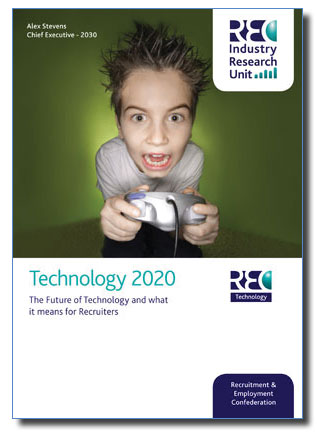
 Advances in technology will radically change workforce management patterns over the next ten years according to a major new report published today by the Recruitment and Employment Confederation’s (REC) Technology group.
The REC’s Technology 2020 report looks at the future shape of recruitment and workforce management over the next ten years in response to changing technologies. Jeff Brooks, chair of the REC Technology group explains:
“Technology already plays a major part in our working lives but in the next ten years we expect tools like instant messenger and video-conferencing to go mainstream, resulting in ‘hyper-connectivity’ amongst workers. This will radically change existing working patterns and free a large proportion of the workforce from working in fixed locations. The HR function will be at the heart of these changes and will be tasked with making the transition to this new way of working as smooth as possible.”
The report identified a number of key ways in which the workforce will be affected by changing technology:

- Self-management – As increasing numbers of workers choose to work remotely, they will need to adapt to a level of self-management which has not existed before. With reduced face-to-face time, HR professionals will need to broaden how they view employee engagement, staff motivation and management in light of how employees use social media and collaboration tools. They will also increasingly need to draw on the expertise of recruiters for checking candidates as they enter the workplace.
- Hyper-connectivity – Communications between staff and employers will become ‘hyper-connected’ through mass take-up of mobile devices, IM and social networking tools via the internet. While already commonplace today, these technologies will become a workplace necessity, requiring HR to closely monitor their use and regularly update acceptable usage policies to ensure that these communication channels are not being abused.
- Employee engagement – With increasing numbers of staff working remotely, building and sustaining employee engagement will become a much more diverse and complex activity. Remote workers may feel isolated as much as they feel liberated and performance management could be harder for the HR team due to reduced face-to-face time colleagues will have with their team.
- Essential IT – All functions will make use of specialist technology – a trend already evident in HR where applications for workforce planning, recruitment and performance management are commonplace. Moving forward, HR departments will need to ensure there is appropriate training in place to educate all employees on the software and applications that best supports their function.
- Technology and training – Education and training in the workplace will make the most of new technologies to combine visual and verbal acuity, technology appreciation and business understanding. This is an uncommon mix in today’s approach to training. The HR function will need to rethink how they approach training programmes and maximise new technologies to ensure that employees are fully engaged with education and training initiatives.
Brooks concluded:
“We have a steep learning curve ahead of us and employers will need to work closely with recruiters to understand how new technologies will affect working patterns and candidate expectations as they enter the workforce. Recruiters are well placed to gather the experiences that various employers have had when implementing new technologies and by sharing best practice we can make the most of the opportunities that these new technologies present to both employers and the wider workforce.”


Paul Gray is an entrepreneur and digital publisher who creates online publications focused on solving problems, delivering news, and providing platforms for informed comment and debate. He is associated with HRZone and has built businesses in the HR and professional publishing sector. His work emphasizes creating industry-specific content platforms.
- Paul Gray

- Paul Gray

- Paul Gray

- Paul Gray






