
Almost half of UK workers are considering leaving their jobs, but many say they feel unable to make a move due to financial fears, outdated beliefs and a lack of employer support.
New research reveals that 47 percent of workers have thought about changing roles in the past 12 months. But 43 percent feel too scared to act, with many citing age, job security and the cost of retraining as the main reasons for staying put.
The findings come from a survey of 2,000 workers and SME employers commissioned by Nottingham Trent University. The data points to a growing disconnect between the desire for career change and the options workers feel are available, particularly among mid-career professionals.
Many feel too old to retrain
Despite being seen as job-hoppers, younger workers are also affected. Four in 10 millennials said they felt “too old” to start again. One in three workers across all age groups believed they had already “missed their chance” to retrain or progress in a new direction.

Men were significantly more likely than women to feel trapped in their roles. Seven in 10 male respondents said they expected to remain in their current job until retirement.
Career satisfaction also varies by sector. While employees in research, pharma and engineering reported relatively high levels of engagement, others were far less positive. Workers in media, publishing and the police were among the most disillusioned, with one in three considering quitting their job this month alone.
Lack of development support from employers
A major theme emerging from the research is the lack of career advice and development support in the workplace. Three in 10 workers said they had never received career advice from their employer. One in five said they felt completely unsupported when it came to progression or retraining.
Yet 69 percent of workers said they would be happy to stay in their current job if their employer invested in their development. This gap between willingness to stay and support offered suggests a missed opportunity for employers to retain talent through clearer career pathways and access to structured training.
“These figures show a clear mismatch between what the public believes and what apprenticeships actually offer,” said David Drury, degree apprenticeships manager at Nottingham Trent University. “Employers are crying out for skilled staff, and apprenticeships are a proven way to train talent quickly, flexibly and affordably.”
Apprenticeship myths remain widespread
While 45 percent of workers said they would consider doing an apprenticeship to retrain or progress, many remain held back by persistent myths. A quarter of respondents wrongly believed they would earn significantly less than their peers if they took this route. One in three thought apprenticeships were only for manual jobs.
Misunderstandings around age were also widespread. Fifteen percent believed apprenticeships were only for 16 to 25-year-olds. Another 14 percent assumed the age limit was 30, while 20 percent admitted they were unsure.
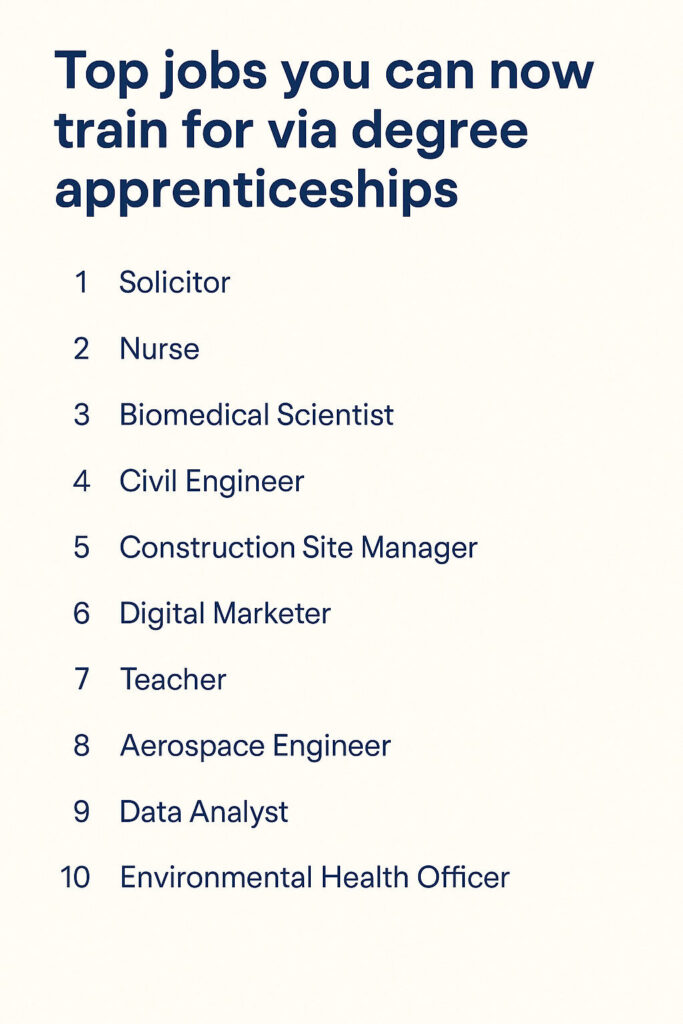
In reality, national data shows the average age of an apprentice in England is now between 36 and 41. Degree-level apprenticeships exist across a wide range of professions including law, healthcare, civil engineering and data analytics. Participants earn while they learn and do not need to return to full-time education.
“Adults in their 30s, 40s or 50s are ideal candidates; they bring maturity, life experience and motivation. It’s not too late to change your career, and the system is built to support you,” Drury added.
Personal stories show potential of mid-career change
Ben Taylor, 49, is halfway through a social work degree apprenticeship supported by NTU. After years as a support worker, the apprenticeship enabled him to progress without leaving his existing employer.
“After many years of being a support worker, an opportunity within my current job opened up for me to apply for an apprenticeship,” he said.
“I also have friends who are social workers and worked alongside social workers for many years. I felt it was a great opportunity for progression. Doing the course has really improved my confidence and focused my ambition on a career in social work.”
Employers missing out due to confusion and inaction
Employers themselves are not immune to misunderstanding how modern apprenticeships work. Four in 10 SME owners still believe apprenticeships are primarily for manual trades such as plumbing and carpentry. A fifth worry that apprentices lack real-world employability skills.
Twelve percent said they had trouble convincing senior leadership to support apprenticeship schemes. One-third of those who had never hired an apprentice said they were deterred by perceived start-up costs, and another third said the funding system was too confusing to navigate.
These misconceptions persist despite strong evidence of the benefits. Seventy-three percent of businesses that had taken on apprentices reported a significant boost in productivity. Over half said apprenticeships helped attract and retain talent. Four in 10 said they had closed longstanding skills gaps, and more than half said apprentices were a better cultural fit than traditional hires.
“You can now qualify as a solicitor, nurse, biomedical scientist or civil engineer via a degree apprenticeship and, what’s more, you can earn while you are learning. It’s not just for school leavers anymore,” Drury said.
“It’s time for a rethink. We need to bust the myths. If you’re feeling stuck or unmotivated in your career, there is a way forward, and it doesn’t mean starting from scratch. As a society we should be empowering people to follow the careers they truly want.”

William Furney is a Managing Editor at Black and White Trading Ltd based in Kingston upon Hull, UK. He is a prolific author and contributor at Workplace Wellbeing Professional, with over 127 published posts covering HR, employee engagement, and workplace wellbeing topics. His writing focuses on contemporary employment issues including pension schemes, employee health, financial struggles affecting workers, and broader workplace trends.
- William Furney

- William Furney
- William Furney
- William Furney