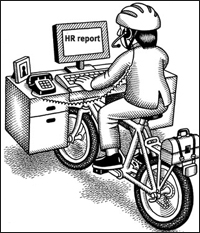
The Government has cleared up tax rules surrounding the Cycle to Work scheme, leading to more employers being able to offer the benefit to their workforce.
The Cycle to Work scheme allows employers to effectively loan cycles and cyclists’ safety equipment to employees as a tax-free benefit under salary-sacrifice arrangements.
Currently, bikes are sold to employees at the end of the hire period, usually 12 months, for their “fair market value” or secondhand price. This figure was widely taken as 5% of original value. New guidance from Her Majesty’s Revenue and Customs (HMRC) states that the 5% figure vastly undervalues most year-old bicycles and has tightened up its rules. The changes apply retrospectively as well as to bikes purchased via Cycle to Work in the future.

At the end of the hire period, participants can use a simplified valuation table issued by HMRC to calculate the value of the bike. For example, a cycle that costs £500 or less new will be worth 18% of that price one year on, 16% after 18 months, 13% after two years and almost nothing after five years.
Cyclists’ organisation CTC said the clarification would sweep away an area of uncertainty that was putting off employers from getting into the scheme in the first place.
Critics argue that this will make the Cycle to Work scheme less attractive to participants, a point HMRC denies. In a statement it said: “The Cycle to Work scheme is a very generous tax break and remains so.
After consultation with employer representatives we have provided a guide to what constitutes an acceptable price for a bike being sold to an employee to provide a simplified method for establishing the market value of the bike.
“There has been no change to the rules, if an employer passes a bike to a employee after its use under the cycle-to-work scheme at its full market value there is no tax charge.”
It will still be possible to argue that bikes are worth much less – for example if they are scratched or damaged – but employers would have to explain why the value was lower in their accounts.