<

!Google ads have two elements of code. This is the 'header' code. There will be another short tag of code that is placed whereever you want the ads to appear. These tags are generated in the Google DFP ad manager. Go to Ad Units = Tags. If you update the code, you need to replace both elements.> <! Prime Home Page Banner (usually shows to right of logo) It's managed in the Extra Theme Options section*> <! 728x90_1_home_hrreview - This can be turned off if needed - it shows at the top of the content, but under the header menu. It's managed in the Extra Theme Options section * > <! 728x90_2_home_hrreview - shows in the main homepage content section. Might be 1st or 2nd ad depending if the one above is turned off. Managed from the home page layout* > <! 728x90_3_home_hrreview - shows in the main homepage content section. Might be 2nd or 3rd ad depending if the one above is turned off. Managed from the home page layout* > <! Footer - 970x250_large_footerboard_hrreview. It's managed in the Extra Theme Options section* > <! MPU1 - It's managed in the Widgets-sidebar section* > <! MPU2 - It's managed in the Widgets-sidebar section* > <! MPU - It's managed in the Widgets-sidebar section3* > <! MPU4 - It's managed in the Widgets-sidebar section* > <! Sidebar_large_1 - It's managed in the Widgets-sidebar section* > <! Sidebar_large_2 - It's managed in the Widgets-sidebar section* > <! Sidebar_large_3 - It's managed in the Widgets-sidebar section* > <! Sidebar_large_4 - It's managed in the Widgets-sidebar section* > <! Sidebar_large_5 are not currently being used - It's managed in the Widgets-sidebar section* > <! Bombora simple version of script - not inlcuding Google Analytics code* >

Cycle to Work rule changes clear up problems

-

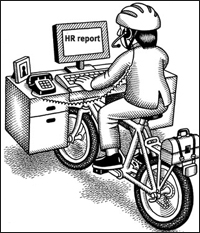
The Government has cleared up tax rules surrounding the Cycle to Work scheme, leading to more employers being able to offer the benefit to their workforce.

The Cycle to Work scheme allows employers to effectively loan cycles and cyclists’ safety equipment to employees as a tax-free benefit under salary-sacrifice arrangements.

Currently, bikes are sold to employees at the end of the hire period, usually 12 months, for their “fair market value” or secondhand price. This figure was widely taken as 5% of original value. New guidance from Her Majesty’s Revenue and Customs (HMRC) states that the 5% figure vastly undervalues most year-old bicycles and has tightened up its rules. The changes apply retrospectively as well as to bikes purchased via Cycle to Work in the future.

At the end of the hire period, participants can use a simplified valuation table issued by HMRC to calculate the value of the bike. For example, a cycle that costs £500 or less new will be worth 18% of that price one year on, 16% after 18 months, 13% after two years and almost nothing after five years.

Cyclists’ organisation CTC said the clarification would sweep away an area of uncertainty that was putting off employers from getting into the scheme in the first place.

Critics argue that this will make the Cycle to Work scheme less attractive to participants, a point HMRC denies. In a statement it said: “The Cycle to Work scheme is a very generous tax break and remains so.

After consultation with employer representatives we have provided a guide to what constitutes an acceptable price for a bike being sold to an employee to provide a simplified method for establishing the market value of the bike.

“There has been no change to the rules, if an employer passes a bike to a employee after its use under the cycle-to-work scheme at its full market value there is no tax charge.”

It will still be possible to argue that bikes are worth much less – for example if they are scratched or damaged – but employers would have to explain why the value was lower in their accounts.


Latest news

James Rowell: The human side of expenses – what employee behaviour reveals about modern work

If you want to understand how your people really work, look at their expenses. Not just the total sums, but the patterns.

Skills overhaul needed as 40% of job capabilities set to change by 2030

Forecasts suggest 40 percent of workplace skills could change by 2030, prompting calls for UK employers to prioritise adaptability.

Noisy and stuffy offices linked to lost productivity and retention concerns

UK employers are losing more than 330 million working hours each year due to office noise, poor air quality and inadequate workplace conditions.

Turning Workforce Data into Real Insight: A practical session for HR leaders

HR teams are being asked to deliver greater impact with fewer resources. This practical session is designed to help you move beyond instinct and start using workforce data to make faster, smarter decisions that drive real business results.
- Advertisement -

Bethany Cann of Specsavers

A working day balancing early talent strategy, university partnerships and family life at the international opticians retailer.

Workplace silence leaving staff afraid to raise mistakes

Almost half of UK workers feel unable to raise concerns or mistakes at work, with new research warning that workplace silence is damaging productivity.

Must read

Chinwe Odimba-Chapman and Raphael Mokades: Fighting Class Discrimination – Unintended Consequences

"For all its good intentions, we believe that using the Equality Act to tackle class discrimination could be problematic, and even counter-productive."

Are gender stereotypes being reinforced in AI?

Virtual assistants such as Siri, Alexa, and Cortana are making our lives easier.  However, the rise of AI with distinct personalities, voices, and physical forms is not as benign as it might seem.
- Advertisement -

You might also likeRELATED
Recommended to you

Exit mobile version
