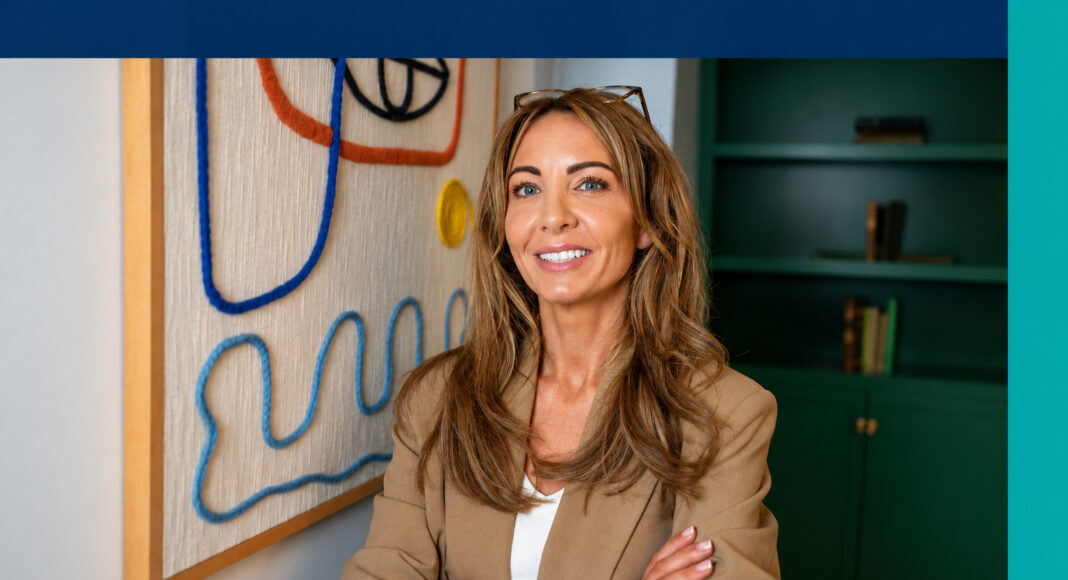
Kayleigh Wright has spent more than a decade helping to shape the culture of HSS ProService Marketplace, a procurement and marketplace platform that connects businesses with equipment, services and suppliers across the UK. Having joined the business in an internal recruitment role before moving into HR, she has progressed through the ranks to become HR director, overseeing people strategy during a period of significant organisational change.
Based in Cheshire and working remotely as well as from Trafford Park in Manchester, the 34-year-old lives with her fiancé, Stewart, whom she is due to marry this summer, and their two-year-old daughter. Her career journey, from retail and hospitality management into senior HR leadership, has given her a practical perspective on the challenges employees and managers face during periods of growth and transformation.
She discusses the role culture plays in business performance, the lessons learned from leading change at pace and why honest communication remains one of the most important tools available to HR leaders.
You’ve worked across people strategy, talent, engagement and organisational change. Which workplace challenge do you believe HR leaders are most underestimated in solving today?
The importance of shaping and nurturing culture and the impact this has on commercial performance.

There is still a tendency to view culture as the “softer” side of HR. It’s often seen as nice to have, but secondary to the numbers. HR budgets are unfortunately among the first on the list to receive cuts and it can be difficult for HR leaders to articulate the importance of investing in culture when trading conditions become difficult.
It’s vital that HR leaders facilitate two-way communication throughout the business, so leadership teams can drive business outcomes based on what colleagues are actually telling them. Building an authentic communication strategy that translates business strategy and humanises leadership is key to this.
It’s not just about a set of values on a wall that don’t resonate with colleagues. It’s about understanding what is truly at the heart of your culture — what makes you brilliant — and weaving that through the entire colleague journey.
HSS ProService Marketplace has gone through a major transformation in recent years. What has been the biggest people challenge during that period of change?
Communication.
We have not only transformed our business, but we have simultaneously transformed the colleague landscape. We have delivered change at a relentless pace and we recognise that during some of the more challenging moments, we could have done more to keep everyone connected and supported. These lessons are helping us build stronger, more open ways of working together.
Our recent engagement survey was an opportunity for us to pause and reflect on how we wanted to engage our colleagues in future changes. We aren’t slowing down any time soon. We’re committed to continuously improving and ensuring our colleagues feel informed, supported and involved every step of the way. The senior leadership team plays a big part in this. We are learning to communicate with more honesty and authenticity and to not be afraid of admitting when we’ve got things wrong.
The business has evolved from a traditional tool hire company into a digital marketplace. How do you bring employees with you when an organisation’s identity changes so significantly?
No business remains static for long and the evolution of our business is something we are immensely proud of. But this hasn’t happened by accident. At the heart of it, we have listened to not only our customers and suppliers but our colleagues too.
When change is led and initiated by those impacted by it, they are truly bought in to what you are trying to achieve. Our colleagues understand the scale of what we are delivering and how revolutionary this is for our industry, and that strong sense of pride is felt across the business.
This wasn’t a sharp left turn which happened overnight. It is the product of great insight, industry experience and the courage to carve out a truly different path.
This shift in our identity was necessary for us to deliver this successfully. Yes, there have been some difficult decisions made along the way, but ours is a culture that recognises the need to evolve and embraces it.
“Offering flexibility without the right support around it isn’t truly flexible at all.”
What does a strong employer brand look like in 2026, particularly for businesses competing with technology firms for talent?
One that’s honest and truthful about the lived experience of working there.
Employer brands shouldn’t be superficial beauty parades. They should be a genuine reflection of what it’s actually like to work in a business, articulated and shaped by the colleagues who know it best. Of course, showcase your best bits, but have fun with it, show personality and build a connection with candidates via your greatest asset: your people.
Don’t oversell it either, especially when it comes to flexibility and benefits. Colleagues joining your business are making a huge decision and it needs to be a decision made around their personal life and other commitments. Shifting the goalposts the moment they walk through the door is not only damaging to trust; it’s damaging to retention.
You’ve spoken previously about the importance of communication during complex business transitions. What have you learned about maintaining trust when employees are facing uncertainty?
That there’s power in admitting when things don’t go to plan. Colleagues don’t expect perfection, but they deserve honesty. We have navigated some truly challenging transformations, and standing in front of teams and avoiding the obvious elephant in the room doesn’t do anybody any favours. Own it, talk about it, learn from it and move on.
Remote and flexible working are now expected by many employees. Has that changed the way you recruit, develop and retain people?
We are immensely proud of the flexibility we offer. It gives us access to bigger talent pools and we aren’t afraid to think creatively about how we resource roles. But with that comes a relationship that needs to be built on trust. Set clear expectations, communicate regularly and be willing to review arrangements if they aren’t working.
Remote working is a hugely powerful tool, but it comes with real disadvantages that can’t be ignored. Colleagues may struggle to build internal networks or miss out on development opportunities that happen more naturally in person. HR leaders need to be actively working to mitigate this because offering flexibility without the right support around it isn’t truly flexible at all.
“Saying you support women in your workplace while only offering statutory maternity pay isn’t going to cut it.”
Diversity and inclusion remains a major focus across UK workplaces. Where do you think employers are making genuine progress, and where are they still falling short?
There is genuinely more awareness and education in workplaces about the power of diversity, and that matters. But awareness without investment is just lip service, and that’s where too many employers are still falling short.
Actions speak louder than policies. Saying you support women in your workplace while only offering statutory maternity pay isn’t going to cut it. Acknowledging only traditional Christian cultural events when your workforce is predominantly multicultural won’t make people feel seen, heard or valued.
The employers making genuine progress are the ones asking the right questions of their own people, listening honestly to answers and then backing that up with real investment.
The gender pay gap remains a challenge across many sectors. What practical things do you think make the biggest difference in improving representation and progression for women?
Relentlessly championing the development of female talent, offering genuine flexibility and calling out any behaviour policy or process that disadvantages women.
This isn’t easy and businesses like ours have a long way to go. But holding up a mirror and truly understanding where you are falling short is the best place to start. It can be uncomfortable, but it’s critical if we want to make progress.
The gender pay gap report isn’t just data to be hidden away on corporate websites. It should be an opportunity to pause, measure progress and set deliverables for the year ahead. Talk about it with colleagues. Ask your customers and suppliers what has helped them make progress. And most importantly, champion your female talent, visibly and consistently.
Careers are becoming less linear than they once were, so how can organisations better support employees who want to move across functions, industries or skill areas?
Embrace fluidity. Rigid job descriptions and overly siloed working limit the ability for colleagues to cross-train and seek out new opportunities. Leadership teams need to create environments where colleagues can collaborate, problem-solve and learn together.
It’s also important to give colleagues the space to be honest especially if they have a desire to re-train or move in a different direction. Many workplaces expect colleagues to be “lifers” in their current field and people can feel genuinely vulnerable admitting that their passion lies elsewhere. Let them know that’s okay. It doesn’t make them a bad employee. Help them grow with you rather than lose them altogether.
“AI should handle the transactional and the administrative, freeing up people teams to focus on the deeply human work that tech can’t replicate.”
Many HR teams are under pressure to deliver both cultural and commercial outcomes. How do you balance employee experience with business performance?
I don’t think any HR leader has truly nailed this balance consistently well without taking a few missteps along the way.
Both cultural and commercial outcomes should be genuinely aligned to the strategic goals of your organisation. Without the golden thread running through everything, you’ll constantly find yourself explaining the “why” behind decisions, both the easy ones and the difficult ones. When the alignment is right, the rationale becomes self-evident.
One doesn’t have to be delivered at the expense of the other. A strong colleague experience drives performance, reduces attrition and builds the kind of culture that attracts the right people. The role of HR leaders is to make that case clearly and consistently, not just to the board, but at every level of the business.
Looking ahead, what skills do you think HR leaders themselves will need to develop as organisations become more digital and data-driven?
HR leaders need to embrace the shift that is happening across workplaces rather than shy away from it. Digital transformation and the increased use of AI will naturally create uncertainty, but it also has the potential to truly transform how organisations operate and how people experience work.
We should be asking ourselves: what opportunities does this create? What talent and skills do we need to be nurturing and attracting? How do we emerge as a business at the forefront of this change rather than playing catch-up?
The answer lies in your people. HR leaders who can help colleagues unlock capacity, build new skills and find meaning in a changing landscape will be the ones who make the biggest difference. Tech is only as powerful as the people behind it.
And finally, how do you see HR evolving over the next five years?
HR is at a genuinely exciting inflection point and I think the next five years will define what the function looks like for a generation.
AI will play a significant role in that. HR teams that embrace it as a collaborator rather than a threat will be the ones that thrive. Used well, it should handle the transactional and the administrative, freeing up people teams to focus on the deeply human work that tech can’t replicate.
But the shift which is key is about moving away from performative culture to something more honest. People see through it and the next generation of colleagues will have even less tolerance for it. HR should be championing environments built on genuine trust, real flexibility and authentic communication. HR teams need to be commercially credible, digitally confident and relentlessly human.

William Furney is a Managing Editor at Black and White Trading Ltd based in Kingston upon Hull, UK. He is a prolific author and contributor at Workplace Wellbeing Professional, with over 127 published posts covering HR, employee engagement, and workplace wellbeing topics. His writing focuses on contemporary employment issues including pension schemes, employee health, financial struggles affecting workers, and broader workplace trends.
- William Furney

- William Furney
- William Furney
- William Furney