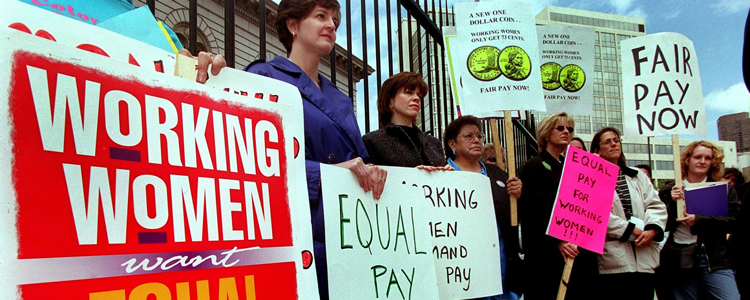
Firms to be forced to reveal gender pay gap details

-

Women's battle for equal pay has been a long one, but it is finally bearing fruit
Women’s battle for equal pay has been a long one, but it is finally bearing fruit

Companies that fail to address pay differences between male and female employees are to be highlighted in new league tables. However female employees will have to wait another two years to find out this information.

The new rule will apply to middle to large sized companies with over 250 employees and will affect around 8,000 employers across the UK.

Calculations

The firms will need to start calculating the pay gap from April 2017 – 12 months ahead of the first tables being published.

HRreview Logo

Get our essential weekday HR news and updates.

This field is for validation purposes and should be left unchanged.
Keep up with the latest in HR...
This field is hidden when viewing the form
Optin_date
This field is hidden when viewing the form


Many are often surprised to learn that in the age of equality, in the UK, women still earn 20 percent less than men.

Voluntary organisations 

Under the plans announced by Women and Equalities Minister Nicky Morgan, private companies and voluntary organisations will be required to reveal the number of men and women in each pay range to show where pay gaps are at their widest.

Crucially bonuses will be included in the figures to make sure a light is shone on pay disparity in City firms, where there is suspected to be a particular problem with pay inequality.

Robert joined the HRreview editorial team in October 2015. After graduating from the University of Salford in 2009 with a BA in Politics, Robert has spent several years working in print and online journalism in Manchester and London. In the past he has been part of editorial teams at Flux Magazine, Mondo*Arc Magazine and The Marine Professional.

Latest news

England’s overnight World Cup clash and 5am pub opening prompt CIPD advice

The CIPD is urging organisations to agree any flexibility before England's 1am World Cup last-16 tie to help minimise disruption at the start of the working week.

Russell Cowley: Gen Z – rebuilding workplace culture, break by break

Gen Z workers are taking proper breaks and in doing so, they may be fixing something the rest of us broke.

Fit for Work: Weekend warrior? You can still reap the health benefits

Weekend exercise can still improve long-term health, even for people who struggle to fit physical activity into the working week.

Superdry co-founder’s victim warns workplace power can silence abuse victims

A survivor's account raises questions about speaking-up cultures and accountability in organisations.
- Advertisement -

UK’s always-on work culture ‘driving employee burnout’

Nearly half of UK workers say they end most working days mentally exhausted as rising workplace pressure leaves employees and managers struggling to switch off.

Andrew Murray on why no two days look alike

A people development leader shares how travel, training and a passion for helping others shape a working day with little room for routine.

Must read

Matt Fryer: Five common mistakes made in IR35 mock audits

"Businesses should be taking time to review their flexible workforce engagements and ensuring that ongoing staff training is in place, with a focus on what their responsibilities are under the legislation".

Barry Ross: Positive action versus positive discrimination & what this means for HR

"There is an argument about whether the Rooney Rule should be adopted on a widespread basis in the UK and how that balances the nuance between positive discrimination and positive action."
- Advertisement -

You might also likeRELATED
Recommended to you