

 Claire Genkai, co founder of Relume Ltd, will be speaking at the Health @ Work Summit in London on the 20th June 2013. She will be discussing how to manage work life balance and burnout.
About the author
Claire Genkai Breeze is a Zen Buddhist and an experienced corporate coach of 24 years, specialising in working with people who have broader and deeper questions about what they are trying to cause in organisations; those who need to recover their confidence or their inner compass to lead and those regarded as talented but lacking in relational or EQ skills.

For the past six months Claire Genkai has been writing a resource book about Resilience in the workplace. The group of people helping with the task are senior executives in a range of UK and global businesses who all have one thing in common: they are either interested in increasing their own resilience, or they are looking for ways to help others in their companies to achieve the same.
The group receive a short summary on a particular aspect of resilience together with a case study, some provoking questions and inquiries to help them explore and some suggested practices for experimenting at work. People then share what they’re learning, pass the materials to others and get into discussions with each other about the emerging insights. Patterns of behaviour and the choices people are making in the moment at work are coming under self-scrutiny.
“Twenty years ago work was a very different place. The types of solutions and methods we offered people to reduce their stress and recover a sense of wellbeing were very different. We all need to wake up to the fact that there is a widening gap between the pace of our work and what our physiology can actually deal with successfully over time.”
Mind the Gap!
Technology at work has evolved at a much greater pace than our own biochemistry. The human body is well designed to cope with periods of intense stress followed by periods of discharge or release. These days work is more of a continuous stream of interruptions, meetings and demands throughout the day that can extend it to compensate for time zones in global businesses.
“Learning to work in this way needs some adjustments and the first place to start is with the realisation that the body has absolutely no idea what you earn or how important you are. Just because you are very senior does not mean that your body can magically endure more. It just means that the press may have less sympathy for you!”
The Four Pillars of Resilience
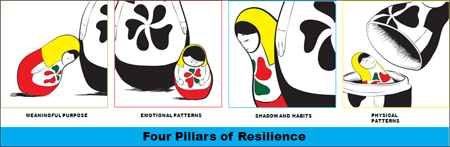 What is emerging is a realisation that there are four core areas of resilience that need attention to maintain a sense of wellbeing at work. Each of these areas, whilst distinct, is linked. So in working for example on the body, it actually delivers positive results in the emotional/intellectual domain too.
The key to an individual’s resilience may be nested inside any one of these pillars. Even people who are physically very fit can still suffer from burnout, or our preferred term ‘vital depletion’. The shadow pillar focuses on those aspects of identity or behaviour, which actually work against our wellbeing. For example in the case of HR professionals a common part of their shadow is the tendency to please and rescue others at the expense of their own wellbeing! Sometimes this lack of integration can contaminate the important aspect of meaningful purpose, leaving individuals feeling disconnected from the meaning in their work or how this fits into their lives. Over time this sense of disconnection can be a major source of vital depletion. the effect of which can be multiplied when people are in visible leadership positions.
“Helping people to understand much more about the physiology of their stress response, actually helps to put them back in control of themselves. We all share the same physiology, regardless of our roles or seniority in business. Sometimes there is a conspiracy of silence that pervades organisations. We see this even in places that are doing fantastic work on wellbeing programmes.
It doesn’t make sense does it?
You have great wellbeing programmes, but some people will continue to behave as if those are for someone else in the organisation and not for them. Secretly they simply hope to get through the rough patch and that they and their reactions will return to normal. It’s a sort of conditional future promise: ‘If I just get through this patch I will take better care of myself’; except by the time that future has arrived there is something else equally demanding to replace it. Waiting for a future moment to restore your wellbeing is a fool’s game.”
The Task of Integration
The challenge we’re facing in organisations today is two fold. We have begun by raising awareness about the need for people in business to take their wellbeing seriously. There is still progress to be made in this domain, but there is a much wider understanding of the relationship between our wellbeing and commercial performance over time.
The task ahead is to move to a place where wellbeing is integrated into the culture of organisations so deeply that the patterns of work and leadership are actually generators of resilience, not sources of difficulty that cause us to create excellent wellbeing programmes to counterbalance their effect. When the cohort involved in this research start noticing that in their organisations, we will know we have really turned a corner.
Contact details for Relume
RELUME LTD | +44(0) 1993 846459 | www.relume.co.uk

Pamela Flores is an events professional with experience at Symposium Events, a UK-based conference and events organization. She has worked in editorial and event coordination roles within the HR and expatriate management sector, contributing to the organization of major conferences including the Expatriate Management and Global Mobility conference. Her background spans online editorial work and events management within the professional conference industry.
- Pamela Flores

- Pamela Flores
- Pamela Flores
- Pamela Flores









