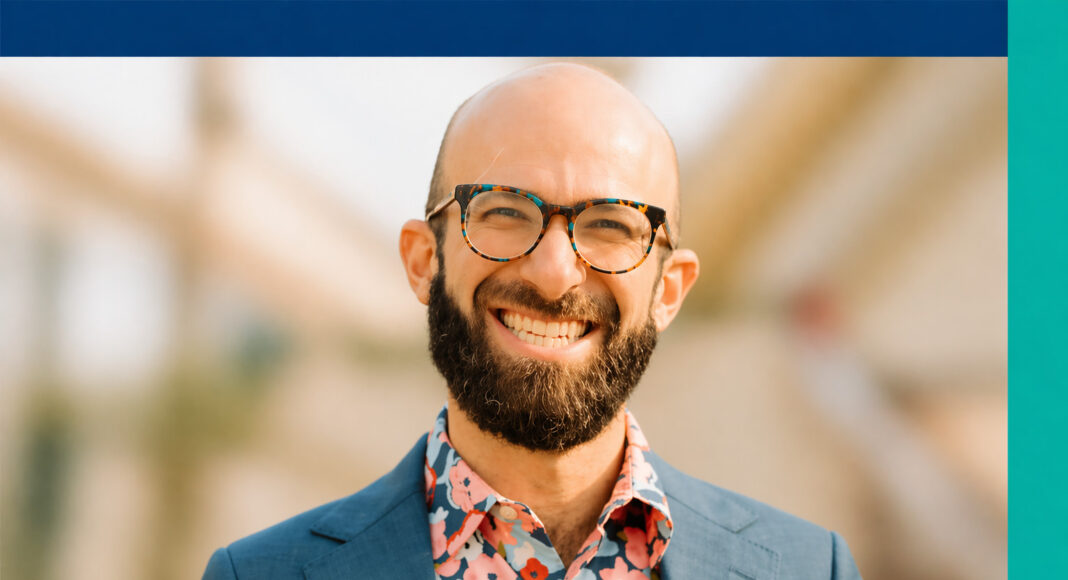
Mike Kohn has built his career around one idea, that strong organisations are created by putting people at the centre of every decision. As chief people officer at Kevel, an advertising technology company that enables brands to build and run their own ad platforms, he is shaping a global people strategy designed to scale with the business while remaining grounded in inclusion, transparency and trust.
Based in Philadelphia, the 39-year-old leads the People function across a distributed workforce that spans multiple regions, including the UK. He lives with his partner, Tim, and their Australian Cattle Dog, Stevie, and draws on his experience as a member of the LGBTQ+ community to shape inclusive cultures where people feel able to be themselves at work. His background in consulting at Deloitte and experience across high-growth organisations have shaped a pragmatic approach to culture, balancing structure with flexibility and data with human insight.
He shares his perspective on building consistent global cultures, supporting inclusion in a changing political landscape and maintaining connection and belonging in a remote-first world.
You lead the global People function at Kevel from the US. How do you build a consistent people strategy that works across different regions, including the UK, while respecting local workplace expectations?
Our approach is to build equitable and consistent principles first, then operationalise them in ways that work on the ground locally. We prioritise a “one Kevel” mentality while staying compliant with statutory and legal requirements and honouring local culture. The goal is to create a consistent global experience while respecting the nuances of each region.

You’ve worked across scaling tech firms, professional services and higher education. What lessons have you taken from those environments into building culture in a fast-growing ad tech business?
I’m a big believer in human-centricity when it comes to building philosophies and policies. Across all the organisations I’ve worked with, people are central to success. Knowledge work and delivery depend on individuals being supported and empowered. That’s informed my philosophy that the People function exists to help teams be greater than the sum of their parts. Building culture starts with listening, recognising, and supporting people to ensure we can deliver outcomes without sacrificing the human element. In other words, we can do well by doing good.
Kevel has been recognised as one of the most loved workplaces globally. What does a genuinely people-first culture look like in practice, beyond values and statements?
Much of a people-first culture is about truly centering people as humans in the approach. This means thinking through things that affect people first and workers second. For example, in change management, we think carefully about how changes will be perceived, giving people space to process and answering the “what’s in it for me?” questions upfront.
When it comes to crafting policies, this mirrors your first question where I talked about applying a consistent “one Kevel” mentality and considering the different elements that will impact people before finalising a decision. Then, when rolling out these policies, we try to first think through how the audience will receive the information.
To do this, we must communicate transparently and empathetically, explaining the reasoning behind decisions and acknowledging the difficult choices. Thoughtfulness in both design and communication is what brings a people-first culture to life.
“In the US, organisations are having to navigate legal and political constraints more actively, often focusing on creating inclusive cultures without explicit policy language that could be challenged.”
You place strong emphasis on authenticity, vulnerability and transparency at work. How do you embed those behaviours in leadership teams, particularly in high-growth environments?
It starts with role modeling. I embrace these behaviours myself in leadership forums and company-wide settings. We also call them out explicitly as core values, reinforcing when leaders demonstrate them. And when a peer isn’t embodying these behaviours, I provide constructive, one-on-one feedback to guide them toward authentic, transparent leadership.
DEI has become increasingly politicised in the US, with recent rollbacks and legal challenges. How are organisations responding, and what differences are you seeing compared to the UK approach?
In the US, organisations are having to navigate legal and political constraints more actively, often focusing on creating inclusive cultures without explicit policy language that could be challenged. In the UK, the approach is generally more structural and policy-driven, with clearer guidelines on equality, pay and inclusion. Across both regions, the focus is on creating psychologically safe spaces and ensuring that people can bring their whole selves to work.
As an LGBTQ+ leader, how have your own experiences shaped the way you approach inclusion and psychological safety at work?
Being the only LGBTQ+ member on leadership teams for much of my career has shown me the importance of representation and active advocacy. I role model my identities so others feel safe being themselves, whether LGBTQ+, gender-diverse, racial or otherwise. At the same time, I recognise my privilege as a cis white man and use that access to create opportunities, champion inclusion and protect psychological safety.
Supporting people to be themselves freely at work is critical, especially in today’s polarised society. The distractions from having to separate oneself at work, or suppress or ignore one’s natural self, can be extremely damaging, not just for mental health but also for performance.
So it’s in everyone’s best interest to create a culture that supports each and every team member as an individual. Even at Kevel, where we have multiple LGBTQ+ leaders for the first time in my career, I still embrace this approach because it makes the space for others to do the same.
“In the rush to achieve product-market fit and revenue growth, founders often overlook how culture is formed.”
Inclusion is often discussed at a strategic level, but how do you ensure employees genuinely experience it in their day-to-day work?
Inclusion is built into how we operate every day, not just policy. That means creating channels where employees can speak up, be heard, and see their contributions recognised. We train managers to embed inclusive behaviours in team interactions and decisions, and we measure engagement to ensure everyone feels valued and supported in real time.
Remote and distributed working are now embedded in many tech companies. How do you maintain connection, culture and belonging when teams are not physically together?
We use a mix of structured and informal touchpoints: monthly all-hands, regular team meetings and “Donut” pairing for peer connections. Quarterly events like Kevelfest help build relationships and reinforce culture. Slack channels, collaborative tools and shared rituals keep everyone engaged, while balancing flexibility and inclusivity for distributed teams.
You advise early-stage and scaling businesses as well as leading internally. What are the most common mistakes you see founders make when it comes to people and culture?
The biggest mistake is not prioritising people early. In the rush to achieve product-market fit and revenue growth, founders often overlook how culture is formed. Hiring decisions need to reflect not just skills, but also values alignment and the type of culture they want to build. Early intentionality avoids problems down the line and helps teams scale effectively.
“People value the flexibility that remote work offers, but they also want the connection and community that comes from spending time together in person.”
As organisations grow, there’s often tension between structure and agility. How do you design organisations that can scale without losing their identity?
We build in structure deliberately, but keep it flexible. Roles, processes and reporting lines are designed to support clarity without stifling innovation. We embed shared values and principles as the “north star” so that, even as the organisation grows, the culture and decision-making framework remain consistent. Regular feedback loops help us course-correct quickly when processes or policies start to feel too rigid.
Data is playing a bigger role in HR decision-making. How do you use people data to inform strategy while still keeping the human experience at the centre?
People data helps us identify patterns and inform decisions. For example, engagement trends, attrition signals and skills gaps. But we never lose sight of the individual. Every insight is validated through conversations with employees and leaders, ensuring that decisions are grounded in empathy, not just numbers. Data informs, but human context drives strategy.
And finally, how do you see HR evolving over the next five years?
Of course, one of the biggest shifts is the growing use of AI and tech innovation, both for the internal processes of HR as well as in managing our workforces. HR teams are starting to use tools like LLMs to streamline parts of the job, improve internal processes and automate routine tasks.
At the same time, the talent landscape itself looks very different in an AI world. This opens up significant changes to how we approach hiring, learning and development and coaching.
Another area that’s still evolving is hybrid and remote work. We swung dramatically toward remote during the pandemic, but then many companies introduced very intentional “return to work” policies when it was safe to do so. Now, it’s about striking the right balance. People value the flexibility that remote work offers, but they also want the connection and community that comes from spending time together in person. I don’t think there’s a single answer yet, so HR teams will have to keep experimenting with models that support both.
The development of truly international workforces is an interesting trend to watch. As more companies operate across borders and employees look for opportunities to work globally, the legal and regulatory landscape keeps evolving. Governments are updating legislation to protect workers and provide guidance for employers. This can make global hiring easier in some ways and harder in others. HR teams will need to keep up with those changes while still making sure people feel supported, connected and part of the same company experience, no matter where they’re based.

William Furney is a Managing Editor at Black and White Trading Ltd based in Kingston upon Hull, UK. He is a prolific author and contributor at Workplace Wellbeing Professional, with over 127 published posts covering HR, employee engagement, and workplace wellbeing topics. His writing focuses on contemporary employment issues including pension schemes, employee health, financial struggles affecting workers, and broader workplace trends.
- William Furney

- William Furney
- William Furney
- William Furney