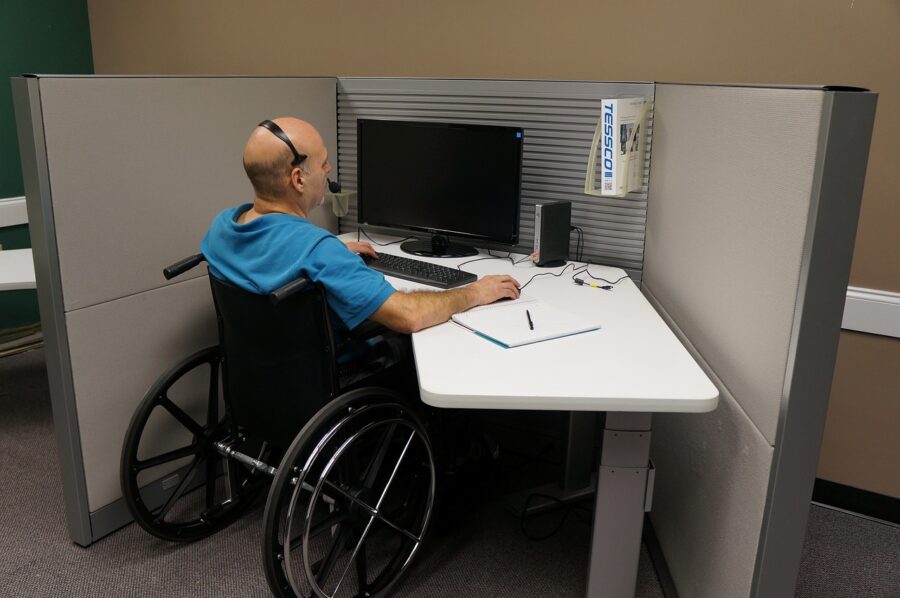
The Equality Act requires employers to make reasonable adjustments for workers with disabilities or physical and mental health conditions – but do UK employers go far enough?
UK mobility retailer CareCo aims to raise awareness of the “mobility gap,” where employers may unintentionally overlook barriers that deter candidates with mobility impairments. According to Scope for Business, nearly half (49 percent) of working-age adults with disabilities report feeling excluded from society due to their condition or impairment.
Addressing mobility-related obstacles to ensure workplaces are accessible to all is not only mandated by law, but can be instrumental in retaining talent. These adjustments can range from installing ramps for wheelchair access to providing audio-visual fire alarms for deaf employees. Despite this, many workplaces remain inaccessible, contributing to exclusion and reduced employment opportunities for individuals with mobility challenges.
Common Barriers
- Inaccessible workplaces: Many buildings lack ramps, lifts, or other essential modifications for wheelchair users.
- Insufficient parking: A shortage of accessible parking spaces often leaves individuals struggling to find suitable accommodations near their workplaces.
- Lack of awareness: Stigmatisation and misconceptions about the capabilities of those with mobility issues can create a hostile or unaccommodating work environment.
- Inflexible working hours: While flexible working has become more popular post-COVID, individuals with mobility challenges may require additional adjustments outside standard policies, such as tailored schedules or remote work options.
With over 16 million people in the UK living with disabilities and 48 percent of them experiencing mobility issues, these barriers are a challenge for employees with mobility issues.

Benefits of Addressing Mobility Barriers
CareCo stresses the advantages of creating inclusive workplaces that accommodate employees with mobility needs. These benefits extend beyond compliance, impacting organisational growth and employee satisfaction:
- A diverse workforce fosters growth: Organisations benefit from varied perspectives, with employees who bring unique life experiences often offering innovative solutions. A McKinsey study found that diverse teams are more likely to achieve higher profitability than their less diverse counterparts.
- Lower staff turnover: Valued employees tend to remain loyal. By offering supportive environments and making necessary adjustments, employers can reduce the financial burden of high turnover rates, which average £25,000 per replacement.
- Mitigation of legal risks: Discrimination claims related to disabilities pose significant financial risks. In 2022/2023, the average award for disability discrimination claims reached £45,435, with a maximum of £1,767,869. Employers are legally obligated to avoid both direct and indirect discrimination, ensuring policies do not inadvertently disadvantage individuals with disabilities.
- Access to a broader talent pool: With 41 percent of working-age adults with disabilities having mobility issues, addressing these barriers allows employers to tap into a vast, underutilised talent pool.
Creating Accessible Workplaces
Will Harrison, founder of CareCo, said, “The benefits to businesses are huge and can’t be ignored. It’s been shown time and time again that being able to recruit from a wider selection of candidates and create loyal colleagues impacts the bottom line for any company in a very real way. I’d encourage all companies to look at any potential barriers that they could have in place that could put anyone with a mobility issue at an inadvertent disadvantage because businesses could be significantly losing out on talented employees that support the growth of their business. As a Disability Confident Employer, this is something that we take very seriously.
“Barriers to entry for people with mobility issues to enter the workplace need to be addressed, and the benefits to both businesses and jobseekers are huge.”

Alessandra Pacelli is a journalist and author contributing to HRreview, where she covers topics including labour market trends, employment costs, and workplace issues.
- Alessandra Pacelli

- Alessandra Pacelli
- Alessandra Pacelli
- Alessandra Pacelli