
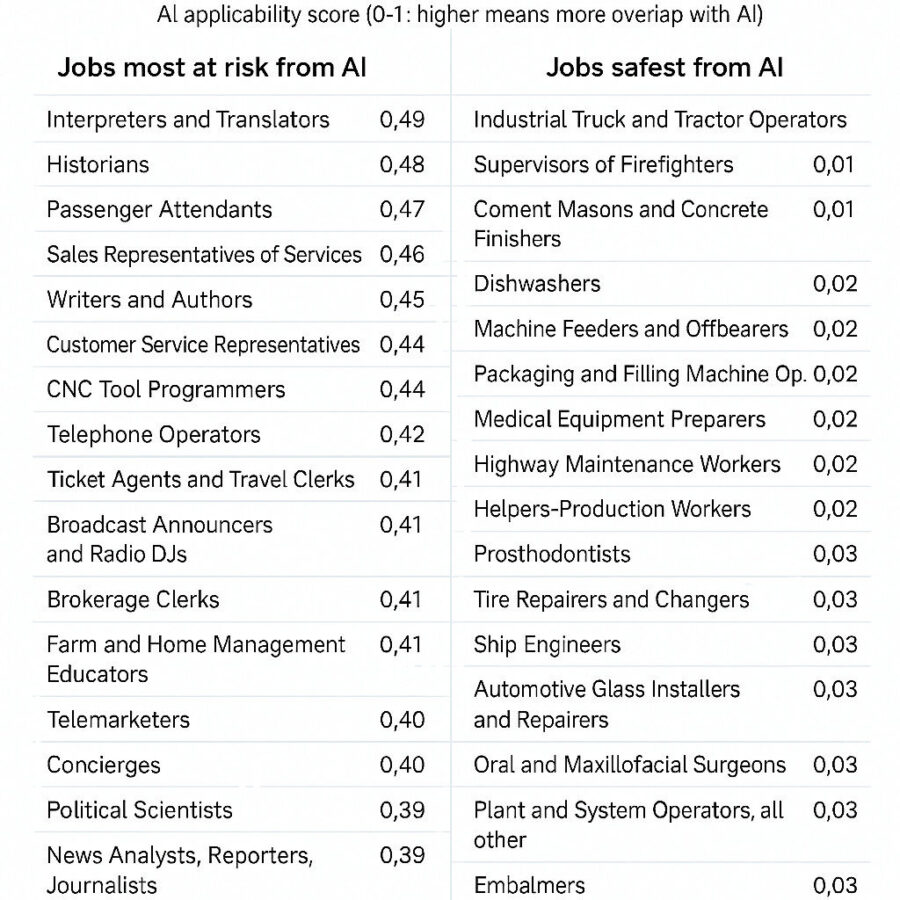
Artificial intelligence is hitting the knowledge economy, with an analysis revealing that translators, management analysts, sales representatives and customer service roles rank among the most exposed occupations.
Research by tech giant Microsoft warns that as AI tools mature, tasks centred around writing, information retrieval and communication are increasingly vulnerable to automation.
Microsoft’s study, Working with AI: Measuring the Applicability of Generative AI to Occupations, draws on over 200,000 anonymised user interactions with its Copilot tool and has gained little attention until now.
Researchers mapped how AI is used today — for tasks like drafting content, gathering data or advising — and compared that with task profiles across occupations. The result is an “AI applicability score” that estimates how much overlap exists between AI-assisted tasks and human work.

The analysis shows that while no role is entirely safe, jobs that centre on writing, research, translation or client communication are among those with highest exposure. By contrast, roles involving manual labour, hands-on skills or unpredictable environments tend to rank lowest in AI applicability.
High exposure: white-collar roles with strong overlap
According to the research, occupations identified as among the most exposed include:
- Interpreters and translators
- Management analysts
- Sales representatives (services)
- Customer service representatives
- Office and administrative support roles
These roles often involve frequent requests for information, summarisation, drafting and advisory tasks — exactly the areas where AI chat tools are already active.
Additional notes from Microsoft emphasise that the study does not equate high applicability with guaranteed job loss. The authors explicitly caution against interpreting their exposure scores as predictions of displacement. They stress that many supporting, contextual and judgement tasks lie outside the remit of AI chat tools.
Lower exposure: roles built on unpredictability and skill
On the safer end of the spectrum, Microsoft flags certain occupations as having lower AI applicability. They include:
- Nurses
- Ship engineers
- Plasterers
- Water treatment operators
These roles depend heavily on physical operations, manual skill, unpredictable environments, human interaction and judgement — areas where the study found AI performance less relevant.
Microsoft said the results reflected applicability, not necessarily replacement. The authors warn that their method does not account for full job complexity, domain expertise, interpersonal nuance or regulatory constraints, which are all factors that may protect many roles from full automation.
What it means for HR and workforce strategy
The findings serve as an early warning for HR executives, as roles with high exposure need proactive redesign. Skills such as oversight, critical thinking, prompt engineering, cross-disciplinary coordination and judgment may become essential anchors for workers in vulnerable jobs.
Workers in roles with high applicability might need to shift toward hybrid models of work: combining human oversight with AI tools or focusing on tasks AI cannot replicate. Entry-level roles, especially those heavy in routine communication or data work, may face particular pressure.
Organisations should map the AI applicability of their job families and ask which tasks can safely shift to AI, and which must remain in human hands? Experts say employers who ignore this reconfiguration risk being overtaken by AI-driven competitors.

William Furney is a Managing Editor at Black and White Trading Ltd based in Kingston upon Hull, UK. He is a prolific author and contributor at Workplace Wellbeing Professional, with over 127 published posts covering HR, employee engagement, and workplace wellbeing topics. His writing focuses on contemporary employment issues including pension schemes, employee health, financial struggles affecting workers, and broader workplace trends.
- William Furney

- William Furney
- William Furney
- William Furney