

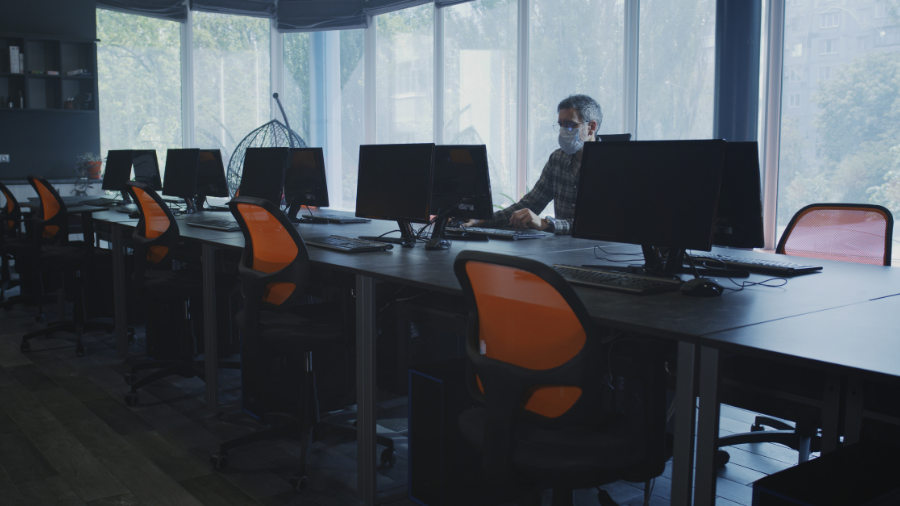
Employers need to offer workers private spaces to work.
This is to escape from noisy office spaces to allow them to concentrate on their work, according to new research by global real estate consultancy JLL.
The ‘Hybrid Work Decoded’ report reveals that people are now spending more than half of the week (2.8 days) in the office but find most of their work – focussed work – is easier to do from home.
France was found to be leading the return to the office in Europe with 3.5 working from home days compared to just 2.6 in the UK and 2.3 in Germany.

It was also found that Tuesday is the most popular day to WFO with Friday the least. Also, working hours in the office are only slightly higher than WFH.
Why are people wanting to return to the office?
The key drivers on returning to the office were found to be for social interaction, collaboration, and technology support while work-life balance and wellbeing are working from home strengths.
Also, half of all virtual collaboration during the week is happening in the office, and half of the office virtual collaboration is done at the desk.
It was found that more than a third of people use the office establish a proper life/work separation.
There is a richer purpose to the office of the future than the one we initially anticipated. Besides supporting collaboration and socialization, the office plays a key role in work-life separation and in establishing necessary healthy working routines.
What issues need to be addressed?
The post-pandemic office must address the need for focused individual work. Today, people still spend 50 percent of their time on focused work in the office. To make the journey to the office worthwhile, both collaborative and focused work need to be enabled.
Also, hybrid workers are not properly supported in their new workstyle today.
They are the least satisfied worker group by their Human Experience
on-site. Their difficulty in re-establishing a healthy working routine makes the experience of the office more stressful than before. This is an opportunity for the office to reinvent its promise.
Sue Asprey Price, EMEA CEO of Workplace Dynamics at JLL, said: “This is a fascinating insight into how office workers are making decisions about how best to work in the new hybrid environment. It is clear most people value the office for the social and collaborative elements of the job and are choosing to spend more than half of the week there.
“But we also know 55 percent of our week is on ‘focussed work’ and we need to make sure people can do this effectively in the office. This means private working space away from the office chatter that allows people to concentrate.
“Perceptions of noise have changed after the pandemic when people got used to working from a quieter environment. Just 28 percent now believe the office is the best place for focussed work.
“This presents a challenge for the industry to make sure new and redesigned offices offer a choice of spaces to support different activities. Both collaboration and focused work need to be accommodated. This means providing enough comfortable workstations with suitable acoustics which accommodate the need for privacy and reviewing inefficient desk and meeting room booking systems.
“Employers also need to consider the growing importance of wellbeing to all workers. Availability of healthy food, comfortable temperatures, air quality, pleasing views and access outdoor space are all measures which can improve the office experience.”

Amelia Brand is the Editor for HRreview, and host of the HR in Review podcast series. With a Master’s degree in Legal and Political Theory, her particular interests within HR include employment law, DE&I, and wellbeing within the workplace. Prior to working with HRreview, Amelia was Sub-Editor of a magazine, and Editor of the Environmental Justice Project at University College London, writing and overseeing articles into UCL’s weekly newsletter. Her previous academic work has focused on philosophy, politics and law, with a special focus on how artificial intelligence will feature in the future.
- Amelia Brand

- Amelia Brand
- Amelia Brand
- Amelia Brand








