HR as a function has been late to the party in adopting data driven decision making but is now aiming to make up for lost time. Leading organisations are addressing the need to invest in data management tools and approaches whilst reskilling or borrowing business analytics skills in order to leverage metrics and deploy a data focused approach to talent management.
In reward you may be wondering what all the fuss is about. After all we have always prided ourselves on our number crunching abilities and happily wearing our ‘Excel Ninja’ badges. But we need to work with our colleagues in HR to grasp the business opportunity of leveraging a broader range of employee data to improve operational performance and optimise the business impact of the compensation spend.
Reward systems evolve
Reward management has been enabled by technology, increasingly so in the last decade, as organisations have moved from spreadsheets which corralled data and performed calculations to deploying innovative Software as a service (Saas) solutions. To date this technology adoption has primarily been more about achieving operational efficiency and data security, freeing you from basic administrative activities to focus more on reward outcomes rather than just processes. At Curo we have called this approach ‘Faster, Safer and Smarter. The next stage in the evolution of reward technology is the wide scale adoption of integrated analytics so you can take ‘Smarter’ to the next level.

Impact on the role of reward management
The adoption of effective business intelligence across HR will change the way we operate as reward practitioners, ultimately allowing us to emerge from number crunchers to evidence based business enablers proving insight to business leaders that focuses on real business outcomes. It will help us to make the leap to really linking compensation spend to employee productivity.
Improve the way we manage compensation data
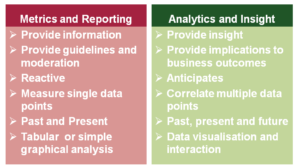
These new analytical approaches will change the way we manage compensation data from the somewhat one dimensional approach of metrics and reporting to more advanced analytics and business insight. The table below summarises the key differences in the approaches.
Data visualisation and actionable insight
A key development in advancing the effectiveness of business intelligence is going to be the use of data visualisation that will allow us to transform the way we manage and present compensation data. As the saying goes, “a picture is worth a thousand words” and it is scientifically proven that we can process information easier graphically.
Statistical information is abstract. If you think about how much statistical data we use in compensation with compa-ratios, benchmarking data, historical data, exchange rates and total remuneration breakdowns this will be hugely beneficial. Also, advanced analytical tools will allow you to interact with data visualisations so you can monitor key trends as well as connecting with the underlying data in order to take appropriate action.
This will allow us to move towards providing actionable insight, providing information to business leaders that gives enough insight into the future or makes it clear what actions should be taken. This is very powerful when you start to think about the importance of influencing decision-makers behaviour when they are actually making reward decisions during a compensation review. All too often we are left dealing with the outcomes of manager’s recommendations during a pay review after the event, once all recommendations have been collated. Imagine the power of being able to influence decisions such as fair and equitable pay whilst decision making is actually happening!
Support new approaches to reward
Adopting advanced analytics in reward will also help to support new approaches to reward management and the broadening of reward philosophy from traditional pay for performance to pay for talent approaches. Pay for performance tends to be backward looking, focusing only on an employee’s performance in the prior year. Pay for talent aims to calibrate multiple factors, both past and present in order to capture employee value using adding additional information such as retention risk, critical skills and future talent to support compensation decision making.
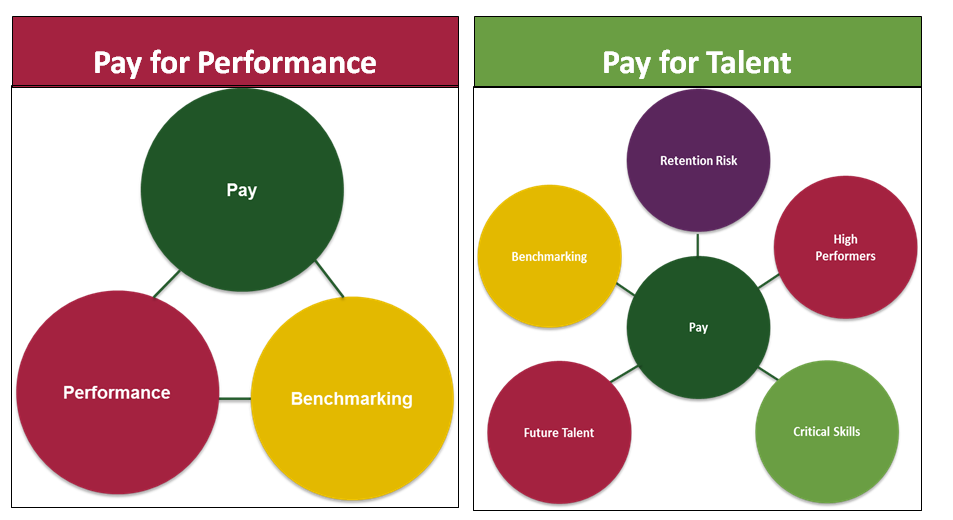
This ensures organisations reward those employees who provide the most value in terms of performance and contribution but also potential, critical skills and key talent in the future. By integrating talent data in this way imagine the sorts of insights you can provide and the types of questions you can begin to answer, such as:
- Am I recognising my employees most at risk of leaving?
- Who has the key skills I need for next year’s deliverables?
- Am I differentiating reward for my hyper performers?
- Am I rewarding for a build versus buy approach to talent?
However, this does involve calibrating multiple data points which is complex with simple reporting approaches so new analytical tools significantly improve capability.
Ensure equity, transparency and risk alignment
The other great thing about data driven decision making, particularly in reward, is that it reduces subjectivity and enables equitable decisions, a key goal of any reward philosophy. Whilst this is not a new approach, the power of calibrating multiple data points to get more powerful insights into the impact of compensation spend used in combination with forward looking analytics (known as predictive analytics) to anticipate the impact of reward decisions on talent retention will be transformational.
So, are you ready for the ‘datafication’ of reward?
There is a need for a bit of a reality check before we can get too excited about advanced analytics and the possibilities they might bring. For many data integrity and data calibration are still major challenges and there are some basic steps to focus on first:
- Tackle data integrity – start the data cleanse
- Work out what data you need to take your analytics to the next level
- Plan to centralise the data you need for strategic reward management in one place
- Future proof your requirements for new reward approaches
- Build the business case for technology and tools to support you
But the goals are clear; we need to unlock the potential of employee and compensation data to drive business outcomes in order to fulfil a role of evidence based business enablers.

Ruth Thomas is a founder and Senior Consultant with Curo. With over 25 years of global HR and reward management experience in the financial services sector she also has international expertise in the management of compensation processes and the design of pay and benefit structures, salary progression systems and management incentive plans. Her corporate experience includes Lloyds TSB Group, Price Waterhouse Coopers, Dow Jones Group and Credit Suisse.
- Ruth Thomas