


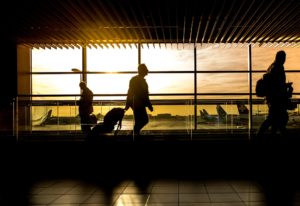
Business trips have a negative impact on UK employees with many feeling isolated, tired and stressed out as a result of these journeys, all leading to a feeling of occupational burnout.
Research conducted by Exclusiveprivatevillas.com, a company that rents out luxury villas, reveals that poorly organised business trips can leave UK employees feeling overwhelmed by the pressure.
A fifth (20 per cent) of UK workers want their employer to be more aware of the toll business travel can have on their employees’ health.

This is a particular problem as, previously reported by HRreview, the World Health Organisation (WHO) has officially recognised burnout as a classified disease which can seriously impede an employee’s ability to be productive at work.
This research indicates that this feeling of burnout is not contained to an office environment but instead can follow UK employees abroad.
Just under one in five (18 per cent) state that business travel makes them feel stressed out and exhausted. Furthermore, 15 per cent state that they suffer from poor sleep whilst away on business trips whilst another 15 per cent report missing their friends and family.
One in ten UK workers (10 per cent) state that business trips abroad leave them so exhausted that they are unable to function properly. Additionally, 10 per cent of UK employees cannot relax whilst away as they suffer from being in ‘business mode’ constantly.
Keith Potts, chairman of Exclusiveprivatevillas.com, said:
These results provide a real insight into the effects of business travel on the health of employees.
The days when business travel was viewed as a perk of the job by employees are gone. In fact, many will be struggling to sleep, missing their nearest and dearest or feeling overworked.
Now that the WHO has labelled burnout an occupational phenomenon, the onus is on employers to find a solution.
More focus must go on ensuring staff are happy, comfortable and able to relax during business travel. The result will be happier, more engaged workers.
These results were obtained by a survey, commissioned by Exclusiveprivatevillas.com which asked 1000 frequent business travelers.

Monica Sharma is an English Literature graduate from the University of Warwick. As Editor for HRreview, her particular interests in HR include issues concerning diversity, employment law and wellbeing in the workplace. Alongside this, she has written for student publications in both England and Canada. Monica has also presented her academic work concerning the relationship between legal systems, sexual harassment and racism at a university conference at the University of Western Ontario, Canada.
- Monica Sharma

- Monica Sharma
- Monica Sharma
- Monica Sharma








