

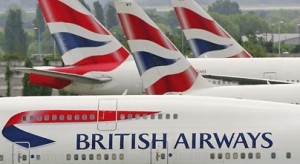
 Last year BA reported a sharp rise of operating profit to £883 million, which in view of the rising fuel price and their falling market share, seemed to be bucking the downward global trend.
This year they reported a loss of £401 million.
Somewhere between the two reality probably lies, but when has reality ever paid out a performance bonus? And when have the published numbers ever reflected what is actually happening to a business?
Mr Willie Walsh, speaking for BA said last month: “The combination of unprecedented oil prices, economic slowdown and weaker consumer confidence has led to substantially lower first quarter profits.” “But,” He said ”British Airways is well prepared and has adapted its plans in the event of further economic uncertainty.”

These reported performance figures for BA and their smooth denial of concern reminded me of the last time BA management hit the news.
It was several years ago and Rod Eddington, the then chairman of British Airways, was responding on TV to concerns about the profitability of British Airways.
He was having a moan about how the budget airlines were cutting into his market share,
but he was still being quite bullish about it.
He told the interviewer how, in the last three years, he had cut the operating costs of British Airways by 5% and that although the competition was tough they fully expected to maintain their market share.
What he didn’t say was that in the past three years, to make that 5% saving, he had made redundant 16,000 members of his workforce.
He must have had some idea of the consequences of those redundancies for the remaining workforce. How did he think they felt about it?
Did he think they still felt good about working for British Airways?
Did he think they still felt their jobs were secure?
Did he think they felt proud of what had happened.
At the time Rod Eddington seemed supremely unconcerned by any of the consequence of his actions other than the ability to boast about the financial savings he thought he had made.
The men and women who worked for BA had. in the main. been in their dream jobs.
Pilots, who as schoolboys had pictured themselves wearing Raybans while they lounged around in the cockpits of big jets.
Cabin crew who used to dream of all the exotic destinations they would go to.
Baggage handlers and support staff who at the time could use BA to nip over to Paris for the weekend for the price of a cup of strong coffee.
And then, by making 16,000 redundancies, Rod Eddington completely changed the way that the remaining BA employees felt about what they did.
He had changed their attitudes and behaviours from those of a proud group of motivated people, dedicated to the service of their customers, to a bunch of disillusioned job hunters.
By making these redundancies British Airways changed the behaviour of their whole workforce from a powerful group of people who were proud of what they did, to an apathetic, untrusting workforce who were only interested in where they could send their next CV.
In the latest twist in the saga of the failure of BA we read of the appeal from the current management for the workforce of BA to give the company one months work without pay to try to save the company.
Since the days of Rod Eddington, management at BA have completely lost the loyalty of their staff by the way that they have behaved towards them, creating a morally bankrupt organisation,
Make no mistake, this moral bankruptcy was caused by BA management.
Now we see the current management attempting to cash a cheque against the BA account that they themselves have already emptied.
Is this BA management completely misreading the way that the workforce feel about the company they work for? Or is this a cynical manoeuvre by management to deflect the blame for the failure of the company.
It is possible that the company will fail without these individual contributions from the workforce, The workforce must be aware that it is just as likely that the company will fail even after they have put themselves into personal debt to try to keep it afloat, the only difference being that when the company fails, even after the workforce have given their time for free, the workforce will be in an even worse position to support their families.
Either way, management have already broken the trust of the workforce and since none of the management team seem to have offered to work for nothing it seems even less likely that any of the workforce will be persuaded to stick their necks out.
Do BA management truly believe that the workforce, working for nothing, will save them or are they working a spin, which when the company goes to the wall will enable them to say
“It was not our fault, We were let down by the workforce who would not support us.”
In this ongoing crisis we have to be very careful about what we do to survive and how that changes the way that our remaining workforce feel about they are asked to do.
Ride roughshod over the workforce during the recession because you can, and like BA you will have a very hard time continuing to trade even when the rest of the world has resumed doing business, Or, take care of your people when they most need it and they will take care of you when you need it.
We can’t have it both ways.
What goes around comes around.
Peter A Hunter
www.breakingthemould.co.uk




