


The COVID-19 pandemic has disproportionately affected women in G20 countries, says an OECD report on gender discrimination at work.
It found that between 2019 and 2020, fewer women were able to work in most G20 countries except Germany and the UK, and this was exacerbated by Covid-19.
This was part of a wider study on women and girls in general, not just within the workforce.
Fewer women managers

Gaps between women’s and men’s levels of representation in management also remain important, says the study. It found that the average share of women in managerial positions stood at 31 percent compared to 69 percent for men in 2019.
The report highlights that there is still a long way to go for G20 countries to achieve their commitment to reduce the gender gap in labour force participation of 25 percent by 2025.
In 2019, women still earned a shocking 18 percent less per hour than their male counterparts – across all G20 countries.
In 2020, only 59 percent of women were participating in the labour market when compared with 79 percent of men.
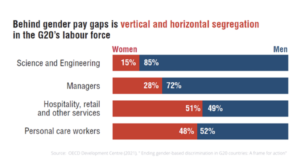 Ending gender-based discrimination in G20 countries: a frame for action calls for policy measures to fast-track women’s labour inclusion, promote women’s entrepreneurship and access to finance. It also wants governments to better address violence against women and girls in the context of COVID-19.
Within workplaces, the report says HR teams must ensure a strong legal framework and policy environment that includes a women-focused approach to business creation and development.
Workplace training
It also wants workplaces and banks to facilitate women’s access to finance. It says creating access to capital for women entrepreneurs through grants and lower interest rates and by making use of digital technologies such as e-banking and mobile money, including in rural areas will even the playing field.
Another recommendation is for governments to establish training programmes and coaching to close the digital gender gap. The study says that if women’s financial and digital literacy was improved with awareness-raising campaigns, it would challenge stereotypes about women’s potential as entrepreneurs.
The study recommends that to even the statistics, recovery measures should focus on safeguarding labour equity, fostering entrepreneurship and finance, and fighting violence against women and girls.
Violence against women hampers growth
Violence against women and girls, is hampering their ability to succeed at work – 26 percent of women have experienced intimate partner physical and/or sexual violence at least once in their lifetime.
The report says this has been amplified by lockdowns and other COVID-19 containment measures, The severity of violence against women, especially domestic violence, has also hindered their ability to seek safety, justice and support.
To curb this, the report suggests supporting a culture of awareness of and zero-tolerance towards violence against women and girls through information-sharing. This, it says, can be done by engaging with men and boys in unpacking masculine norms.




