
How can we support a multi-generational workforce?

-

Designing a benefits strategy that has something for everyone, and appeals to the whole of a workforce can be a challenge for any business, as employees at different ages or life stages can have very varied needs.

A new report from leading Financial Wellbeing Provider, Neyber, shows how we can help to support a multi-generational workforce.

All companies must now offer a pension, but some employers will also choose to make other benefits such as medical insurance or life cover, available to all employees. Others will offer voluntary extras only or take a flexible benefits approach.

HRreview Logo

Get our essential weekday HR news and updates.

This field is for validation purposes and should be left unchanged.
Keep up with the latest in HR...
This field is hidden when viewing the form
Optin_date
This field is hidden when viewing the form


However, regardless of an employer’s benefits strategy, our research found some consistent patterns amongst the employees we surveyed.

35 to 64 year olds appreciate their pension more than any other benefit

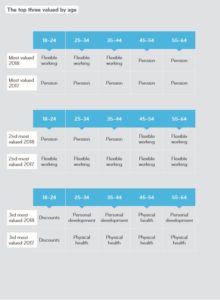
Flexible working and pensions highly valued across all age groups. Younger workers value flexible working over pensions, but those aged between 35 and 64 appreciate their pension more than any other benefit.

This is an interesting shift from 2017, where pensions were the most valuable benefit across all age groups. Could this mean that flexible working is becoming more widely available, or has auto-enrolment made pensions ‘business as usual’ for younger workers?

Neyber’s full report – the DNA of financial wellbeing – can be found here.

www.neyber.co.uk

Rebecca joined the HRreview editorial team in January 2016. After graduating from the University of Sheffield Hallam in 2013 with a BA in English Literature, Rebecca has spent five years working in print and online journalism in Manchester and London. In the past she has been part of the editorial teams at Sleeper and Dezeen and has founded her own arts collective.

Latest news

Helen Wada: Why engagement initiatives fail without human-centric leadership

Workforce engagement has become a hot topic across the boardroom and beyond, particularly as hybrid working practices have become the norm.

Recruiters warned to move beyond ‘post and pray’ as passive talent overlooked

Employers risk missing most candidates by relying on job boards as hiring methods struggle to deliver quality applicants.

Employment tribunal roundup: Appeal fairness, dismissal reasoning, discrimination tests and religious belief clarified

Decisions examine appeal failures, dismissal reasoning, discrimination claims and religious belief, offering practical guidance on fairness, causation and proportionality.

Fears of AI cheating in hiring ‘overblown’ as employers urged to rethink assessments

Employers may be overstating concerns about AI misuse in recruitment as evidence of candidate manipulation remains limited.
- Advertisement -

More employees use workplace health benefits, but barriers still limit access

Many workers struggle to access employer healthcare support due to confusion, costs and unclear processes.

Gender pay gap in tech widens to nine-year high as AI roles drive salaries

Women in IT earn less as salaries rise faster in male-dominated AI and cybersecurity roles, widening pay differences.

Must read

Nathan Stearns: How can businesses help employees working remotely to thrive?

The pandemic has brought about a significant shift in the way we work, with remote and hybrid models gaining immense popularity, says Nathan Stearns.

David Price: Body image disorders are on the rise —are your employees affected?

Dysmorphia is serious, and is far more than simply feeling insecure about your body. And it’s possible that someone you know suffers from it. Do any of your employees show the signs?
- Advertisement -

You might also likeRELATED
Recommended to you







