

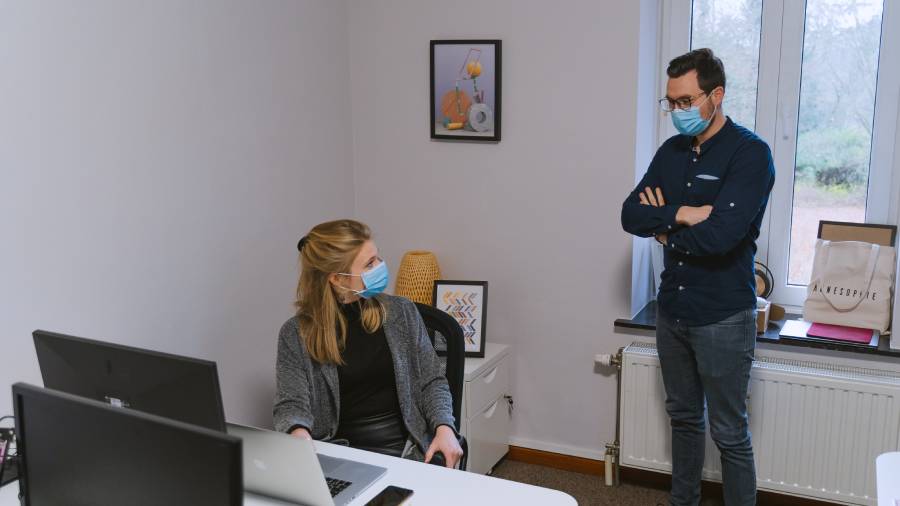
A Government review is currently underway which has seen businesses being asked about social distancing measures, working from home and the potential relaxation of rules.
Businesses have been contacted in light of a Government review which is currently occurring, mapping out the safety rules which will be instated in offices once restrictions are completely lifted.
The Government have stated that part of this Social Distancing Review is looking at how and when to safely lift or amend the 1m+ rule and related COVID-secure measures, as well as guidance on working from home. The review is also analysing what guidance can be provided to enable individuals to take informed personal choices.
As current guidance lays out, businesses are expected to maintain a 2m distance between employees as part of social distancing within the offices. Alternatively, companies can also enforce 1m+ with risk mitigation. However, this is subject to change as the pandemic continues.

A spokesperson for the Government stated:
As part of the social distancing review, discussions are taking place with businesses to see how social distancing requirements could be relaxed in different settings.
All workplaces should continue to follow Covid-secure guidance to minimise the risk of transmission. This does not include the wearing of face masks where social distancing can be adhered to.
The Financial Times reported that, as part of this consultation with businesses, the Government are looking to see whether it would be viable to introduce up to six months of social distancing annually. This is in addition to using masks and transparent plastic screens long-term.
However, Tamzen Isacsson, Chief Executive of the MCA, criticised this possibility as being “complicated and expensive” for small businesses as they lack the flexibility to increase or decrease office space every six months.
This sentiment was also echoed by Stephen Moore, Partner and Head of Employment at law firm Ashfords, who stated:
The [Government’s] guidance includes completing risk assessments, maintaining social distancing and ensuring the workplace remains clean and well ventilated, with good hygiene being encouraged.
This will be more challenging for smaller offices. Visitors should be limited and remote meetings encouraged. At present, office workers should still be working from home where possible until 21 June 2021, at which point the guidance will be reviewed and the government hopes to remove limits on social contact, which could lead to a gradual return to the office.
Despite this, Mr. Moore did acknowledge that many companies were finding ways to work around these limitations:
As part of the planning, we are already seeing a number of businesses commit to more flexible and remote working and it’s likely that this will continue, with some employees working a couple of days a week at home. Office spaces may have to develop to facilitate this. Employees may feel apprehensive towards returning to the office, so employers should engage with their staff and communicate the steps taken to ensure their safety at work.
*To find the Government’s full guidelines for health and safety in offices during the pandemic, please click here.

Monica Sharma is an English Literature graduate from the University of Warwick. As Editor for HRreview, her particular interests in HR include issues concerning diversity, employment law and wellbeing in the workplace. Alongside this, she has written for student publications in both England and Canada. Monica has also presented her academic work concerning the relationship between legal systems, sexual harassment and racism at a university conference at the University of Western Ontario, Canada.
- Monica Sharma

- Monica Sharma
- Monica Sharma
- Monica Sharma








