

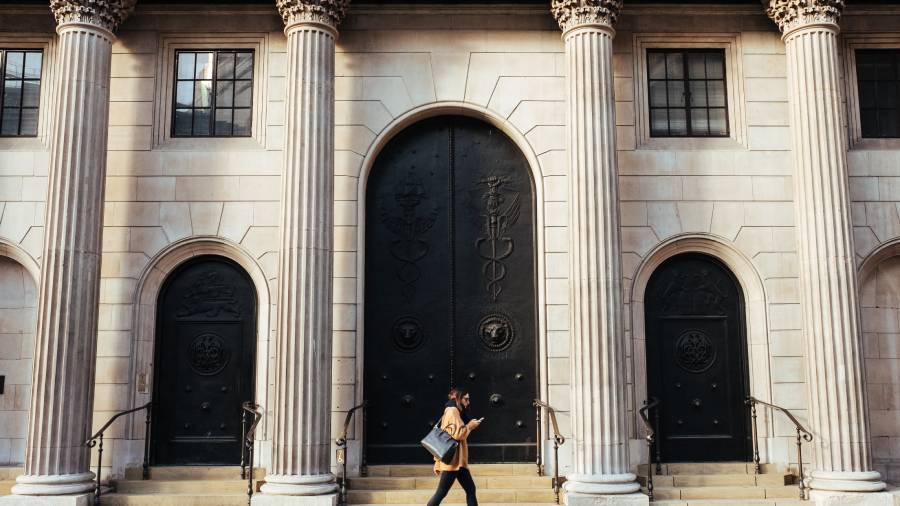
In August, the Bank of England predicted that job losses in the UK would hit a peak of 7.5 per cent. However, a policymaker for the Bank of England (BoE) says figures could rise higher than the initial predicted statistics.
HRreview previously reported on the ONS statistics revealing that unemployment was at its highest rate since 2017. However, a policymaker from the BoE has reported that unemployment in the UK could rise higher than initially predicted by the bank.
Gertjan Vlieghe, a member of BoE’s Monetary Policy Committee, stated that, at the height of the pandemic, over 30 per cent of the private sector workforce was on furlough.
Although Mr. Vlieghe said that two-thirds of these employees had returned to work, this still left two million employees who were not yet back to work.

Regarding this, Mr. Vlieghe said:
To be clear, we do not expect the 9 per cent of private sector workers who are currently on furlough to lose their jobs.
However, Mr. Vlieghe did state the fact that “redundancies are rising sharply” whilst “the number of vacancies is only at 60 per cent” in comparison to the amount of vacancies posted at the start of 2020. He further stated that this “makes it difficult to see a scenario where all of the remaining furloughed workers [would be] reintegrated seamlessly into the workforce”.
To put the numbers into perspective, the policymaker compared current numbers to previous recessions in the UK. The global financial crisis of 2008-2009 saw a net 3.3 per cent of the workforce lose their jobs whilst during the recession in the 1990s, this figure stood at 3.8 per cent. In the 1980s recession, the unemployment was 6.6 per cent.
Mr. Vlieghe further said:
There is huge uncertainty about the scale of job losses, in both directions, but in my view, the risks are skewed towards even larger losses, implying even more slack in the economy than in our central projection.
The hypothetical country that ignores public health but saves the economy does not and cannot exist.
This is because the majority of the damage to the economy arises from restrictions that people voluntarily impose on themselves in order to protect their health, not from restrictions that the government imposes.
In a country where the virus is more widespread, people will cut their spending more as they avoid crowded places, cutting back on travel, hospitality, leisure, culture, what we have started to call ‘social spending’.
On the other hand, a country that puts in place a range of measures to contain the spread of the virus will experience less of an economic hit, as people are relatively more willing to engage in social spending if it is associated with much lower health risks.
Ultimately, the BoE policymaker suggested that the outlook for monetary policy “was skewed towards adding further stimulus” given that COVID cases have been on the rise once again. BoE stated they were considering the idea of negative interest rates.

Monica Sharma is an English Literature graduate from the University of Warwick. As Editor for HRreview, her particular interests in HR include issues concerning diversity, employment law and wellbeing in the workplace. Alongside this, she has written for student publications in both England and Canada. Monica has also presented her academic work concerning the relationship between legal systems, sexual harassment and racism at a university conference at the University of Western Ontario, Canada.
- Monica Sharma

- Monica Sharma
- Monica Sharma
- Monica Sharma








