


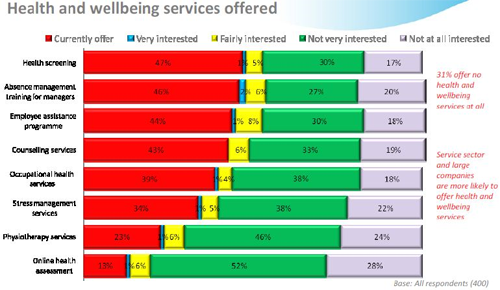
 Nearly half of businesses are currently offering absence management training for their line managers, research conducted on behalf of Legal & General has shown. Following recent CIPD research which estimated that line managers are responsible for managing absence in two thirds of organisations, the findings suggest a growing appreciation amongst businesses of the importance of training line managers in managing absence.

The important role of line managers was also recently highlighted by Esther McVey MP, who called line managers “the crucial frontline force” in tackling sickness absence at a roundtable organised by Legal & General last year.
Commenting on the findings, Diane Buckley, Managing Director of Group Protection at Legal & General, said:
“Every year hundreds of thousands of people’s journey to long term sickness benefits begins in the workplace. We want to work with Britain’s line managers to help provide them with the support they need to cut sickness and absence”.
She added:
“Our own internal wellbeing pilot has demonstrated that early intervention and wellbeing programmes alongside proactive line management can have a significant impact on absence rates in businesses.”
The research from which these stories were taken is Legal & General’s Group Protection Product Research 2012, conducted by Reed Business Insight. The research was conducted via a survey of 400 businesses, split into 5 groups of 80 by size. The 5 groups were businesses with between 10 and 99 employees, 100 and 249 employees, 250 and 499 employees, 500 and 999 employees, and with 1,000 employees or more. 240 of the 400 were in services, whilst 160 were in general industry.

Pamela Flores is an events professional with experience at Symposium Events, a UK-based conference and events organization. She has worked in editorial and event coordination roles within the HR and expatriate management sector, contributing to the organization of major conferences including the Expatriate Management and Global Mobility conference. Her background spans online editorial work and events management within the professional conference industry.
- Pamela Flores

- Pamela Flores
- Pamela Flores
- Pamela Flores








