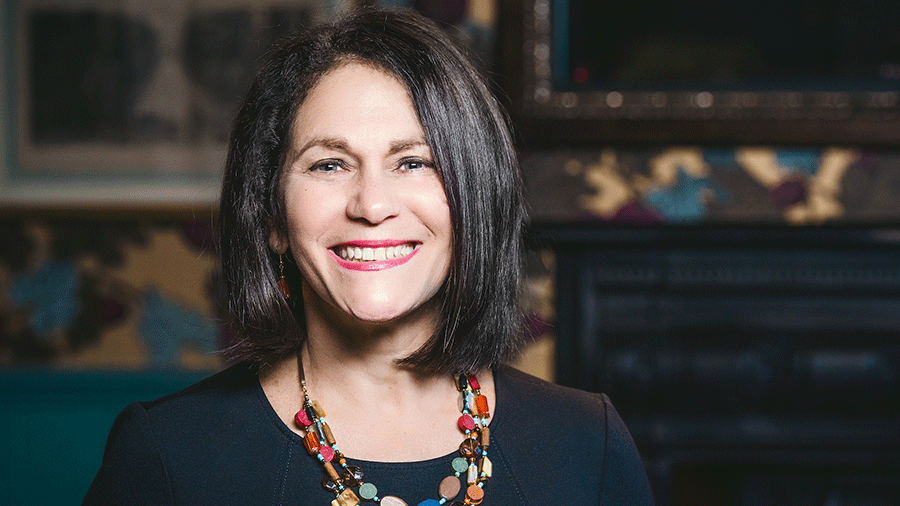
At Symposium Events Recruitment and Retention Conference 2019, HRreview spoke to Debra Corey, co-author of Build It: The Rebel Playbook for World-Class Employee Engagement and chief ‘pay it forward’ officer at DebCo HR.
HRreview: Why do you describe yourself as a ‘rebel’?
Ms Corey: I am on this mission to be a rebel, which means thinking and acting differently and challenging the status-quo and how I have done things over the years. I ask questions like why what is it doing and really pushing the boundaries to help companies engage their workforce in a better and more effective way.
HRreview: What sort of tools do you think a company needs to motivate its workforce?

Ms Corey: For me, I think engagement is multidimensional, everybody is engaged in different ways, so for one person they might be engaged by having a meaningful job, for some other people its more important to be recognised, other people want to get to the next level in their career. There are lots of different motivators but I do think there are some common things when it comes to engaging and motivating a workforce. They are having really strong communications, being open and honest, having clear purpose mission values so everyone knows where they are going and having leaders and managers who see themselves as engagement leaders and managers.
HRreview: Why do you think it is important to have an engaged workforce and how do you measure that?
It’s really important these days to engage our workforce, more and more organisations are seeing the return on investment (ROI) and leaders are starting to see the importance of it as well. Whats helped. is there are some really valuable data out there that shows how from a business perspective, its driving business, things like increased sales, increased productivity, lower turnover, better safety, the list goes on so what I would encourage you to do is find those key performance indicators (KPIs). Those numbers will make sense in your organisation and use them as levers to show them engagement is not pink and fluffy, that it can truly have a difference in your organisation.
HRreview: As technology advances, do you feel we rely too much on communication technology to motivate staff, or do you think a face to face alternative is more effective?
Ms Corey: As someone who has grown up and seen technology evolve over the years I think technology is wonderful, I think it really helps us engage and communicate with our workforce in a quicker way and more flexible way. But there is nothing like good old fashion face to face communication. I am all for balance and also trying to understand what’s going to work in different situations and for the right person. Again a big fan of technology but just as big fan of the face to face, really honest conversation.
HRreview: Do you think engagement is easier to obtain in smaller companies compared to larger companies?
Ms Corey: I am always asked these questions, is it easier to engage companies of different sizes, in different countries, even different industries and to me, I think you have to have an engagement mindset, that’s really where it starts. Once you get that engagement mindset in your organisation with your leaders, your HR team and your employees, to me that’s when the magic happens. So it’s not necessarily easier or harder, it is really starting with that mindset.

Darius is the editor of HRreview. He has previously worked as a finance reporter for the Daily Express. He studied his journalism masters at Press Association Training and graduated from the University of York with a degree in History.
- Darius McQuaid

- Darius McQuaid
- Darius McQuaid
- Darius McQuaid