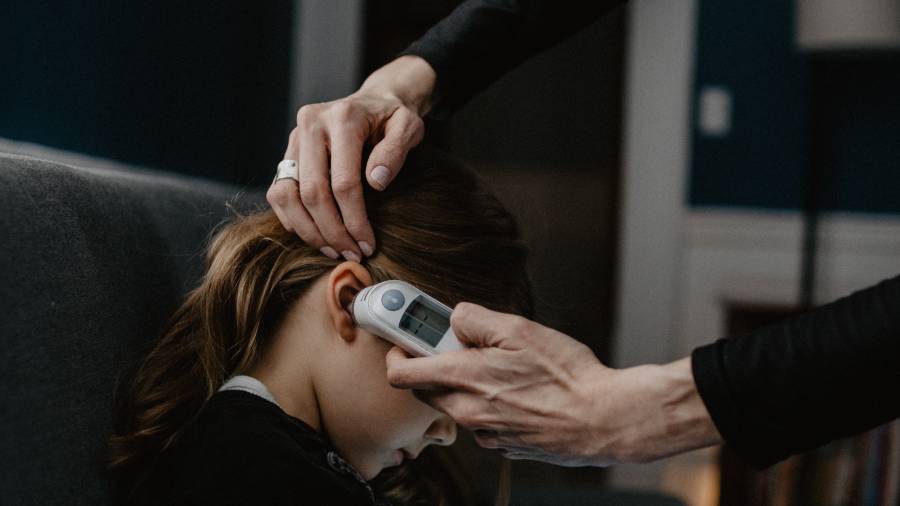
As the tier system comes into full force and some workers return to their workplace, HRreview asks whether an employee can attend work if their child is sent home from school due to COVID-19.
With the ending of the national lockdown in England and the introduction of a tiered system, many employers will be wondering how to navigate deciding whether employees – who may be placed under different tiers – can come into work if their child has been sent home due to the coronavirus pandemic.
According to the Government’s new guidelines on the tiers, all three tiers have been strongly asked to work from home if possible.
However, the Government has also accounted for the fact that some employees may not be able to work from home, whether this is because of mental health issues or because employees work in industries that must be on-site to perform their job.

Therefore, if an employee has a child who is sent home from school due to the coronavirus (whether that be due to a classmate having it or developing symptoms themselves), what should HR advise?
James Tamm, Director of Legal Services at employment law and HR services, Ellis Whittam, said:
Schools have been working under extreme circumstances since September. Most have done a fantastic job of piecing together relevant parts of government guidance in order to guide parents through what needs to happen if a case is detected at school. The problem is the prevalence of the virus which often leads to large numbers of children sent home to self-isolate, often without symptoms.
Reviewing the latest guidance, the likelihood is yes, parents can attend work if their child has been sent home due to COVID-19 provided they are asymptomatic. However, employers have choice, and employees need to clearly understand what must happen if anyone in their household goes on to shows symptoms.
James adds that the official NHS Test and Trace states that individuals who have had recent contact with someone who has tested positive for the virus must self-isolate. However, this does not extend to the rest of the household. The guidance states ““if you live with other people, they do not need to self-isolate” but that “they should avoid contact with you as far as possible and follow advice on hygiene”.
However, parents are not likely to be able to avoid contact with younger children sent home who live within the same household.
What happens if an employee’s child shows symptoms of COVID-19 at school?
Emergency guidelines published by the Department for Education state that if anyone in a school becomes symptomatic, they must be sent home immediately, self-isolate for at least 10 days, and seek a COVID-19 test.
The Test and Trace guidelines explain that in this scenario, all members of the same household must self-isolate for 14 days – also confirmed in the government’s self-isolation guidance. However, unless the child or the parent have symptoms, the parent does not appear to be required to self-isolate if the child is sent home.
However, what happens when an employee cannot work from home but their child has been sent home due to someone else in their school having COVID-19?
James states that the challenge here is “greater”.
The parents may be unable to attend their workplace due to self-isolation and/or a need to look after their child. Sharing a household with a child who doesn’t have symptoms, but who has come into contact with a COVID-positive individual at school and thus required to self-isolate is not covered in the scenarios which entitle an employee to statutory sick pay (SSP).
What should employers do in this situation?
The latest guidance following the extended furlough scheme confirms that if someone cannot attend work as they are required to care for a dependent – which would include a child – then it is permissible to place them on furlough. Whilst this remains the best option, whether or not to place an employee on furlough is completely at the employer’s discretion. Given the requirement to contribute employer NICs and pension – with the threat that greater employer contributions may be required from January, the situation may fall to be dealt with by the policies and procedures you have in place.
The employee can either take unpaid leave or annual leave for the period of time required to look after a child, or – as per the government’s published guidelines around “time off for family and dependants” – an employer “may pay you for time off to look after dependants, but they don’t have to”. If a parent wishes to attend their workplace and is ready and willing to work but their employer forbids this as a precaution, this could be categorised as a suspension from work on health and safety grounds. Generally, this would be on full pay, unless there are contractual provisions otherwise. Depending on eligibility, the extended furlough scheme might also be considered.
What happens if a member of the employee’s household does begin to show symptoms?
Importantly, if anyone in the employee’s household develops symptoms of COVID-19, the scenario completely changes. Under updated regulations, the employee is entitled to SSP for every day of absence, or contractual sick pay depending on the company rules of that scheme.
However, James states that the rules around self-isolation are “changing constantly” so employers should stay up to date with the latest guidance.
In addition, the position in Scotland, Wales and Northern Ireland may differ to England so seeking out guidance from the relevant government site is vital.

Monica Sharma is an English Literature graduate from the University of Warwick. As Editor for HRreview, her particular interests in HR include issues concerning diversity, employment law and wellbeing in the workplace. Alongside this, she has written for student publications in both England and Canada. Monica has also presented her academic work concerning the relationship between legal systems, sexual harassment and racism at a university conference at the University of Western Ontario, Canada.
- Monica Sharma

- Monica Sharma
- Monica Sharma
- Monica Sharma